GR00T N1 + Unitree G1: decoupled WBC+VLA architecture from 6Hz to 500Hz
This is post 1 of the GR00T N1 + Unitree G1 series. The series walks through every step from data collection to deploying a working whole-body VLA policy on G1, using G1 as the concrete example but structured to adapt to any humanoid with a URDF.
This post explains why the architecture must be decoupled, and what the different frequencies mean in practice.
The core problem: 150ms inference vs 5ms control
Every architectural decision in this stack traces back to one unchangeable reality:
GR00T N1 inference:  ~150ms  →  ~6 Hz
GEAR upper body ctrl:  20ms  →  50 Hz
SONIC loco ctrl:        5ms  → 200 Hz
Robot joint servo:      2ms  → 500 Hz
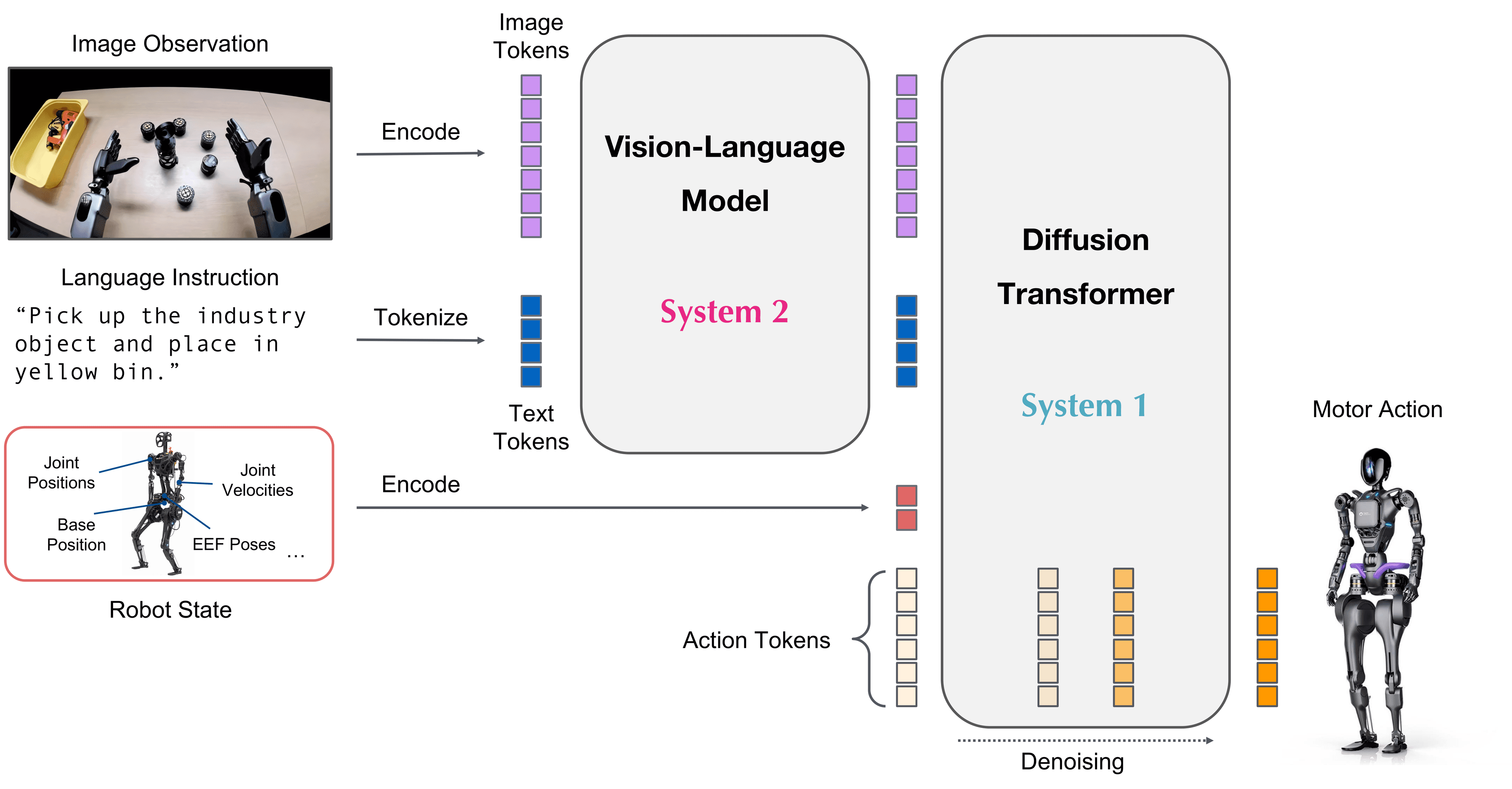
If you try to run end-to-end — VLA output directly into joint servos — the robot will jerk heavily every 150ms and lose balance. The solution is decoupled layers: each layer runs at its own frequency and interpolates.
Three layers in the GR00T-WBC stack
┌─────────────────────────────────────────┐
│  GR00T N1 (VLA)          6Hz / 150ms   │
│  Input: camera × 3 + language           │
│  Output: target wrist pose L/R          │
│          + gripper width L/R            │
└──────────────┬──────────────────────────┘
               │ high-level command
┌──────────────▼──────────────────────────┐
│  GEAR (upper body)       50Hz / 20ms   │
│  RL-trained arm controller              │
│  Input: wrist target + proprioception   │
│  Output: arm joint torques              │
└──────────────┬──────────────────────────┘
               │
┌──────────────▼──────────────────────────┐
│  SONIC / HOVER (loco)   200Hz / 5ms    │
│  MPC + RL whole-body balance            │
│  Input: CoM target + terrain            │
│  Output: ALL joint commands (30+ DoF)   │
└──────────────┬──────────────────────────┘
               │
┌──────────────▼──────────────────────────┐
│  Robot servo drivers     500Hz / 2ms   │
│  PD controller per joint                │
└─────────────────────────────────────────┘
Why split this way?
- VLA doesn't need to know how to balance — it only needs to know "hand goes here"
- Locomotion doesn't need to understand language — it only needs to know where the CoM should be placed
- Each layer has a clear domain, debugged independently, replaced independently
GR00T N1: model architecture
Repo: NVIDIA/Isaac-GR00T
Input:
  - Left wrist camera RGB (224×224)
  - Right wrist camera RGB (224×224)
  - Head camera RGB (224×224) [optional]
  - Language instruction (tokenized)

Backbone:
  - Eagle2 vision encoder (NVIDIA, 300M params)
  - Llama-3 language model (adapted)
  - Fusion: cross-attention layers

Action head:
  - Flow-matching diffusion
  - Predicts action chunk (T=16 steps ahead)
  - Output per step: Δ end-effector pose L/R + gripper binary

Parameters: ~2B total
Inference: ~150ms on RTX 4090
Action chunking: GR00T N1 doesn't predict a single action — it predicts a chunk of 16 steps ahead. The robot executes that chunk while N1 infers the next one. This is how 6Hz becomes smooth-feeling motion.
Unitree G1: joint map
G1 has 29 DoF in full config (with gripper):
Each leg (×2):
  hip_yaw, hip_roll, hip_pitch  → 3 DoF
  knee_pitch                    → 1 DoF
  ankle_pitch, ankle_roll       → 2 DoF
  = 6 DoF × 2 legs = 12 DoF

Each arm (×2):
  shoulder_pitch, shoulder_roll, shoulder_yaw → 3 DoF
  elbow_pitch                               → 1 DoF
  wrist_roll, wrist_pitch                   → 2 DoF
  = 6 DoF × 2 arms = 12 DoF

Torso (waist):
  waist_yaw                     → 1 DoF

Gripper (×2):
  gripper_left, gripper_right   → 2 DoF

Total: 12 + 12 + 1 + 2 = 27–29 DoF
GR00T-WBC controls all 27-29 DoF simultaneously — which is why WBC is much more complex than an arm-only policy.
Adapting for other robots
The stack is modular — you can swap G1 for any humanoid with a full URDF and joint SDK.
Swapping the robot: 3 steps
Step 1: Provide URDF
# Directory structure in GR00T-WBC
groot_wbc/robots/
  ├── g1/
  │   ├── g1.urdf
  │   ├── joint_config.yaml     ← this is what to modify
  │   └── pd_gains.yaml
  ├── gr1/
  └── YOUR_ROBOT/               ← create new directory
      ├── your_robot.urdf
      ├── joint_config.yaml
      └── pd_gains.yaml
Step 2: Edit joint_config.yaml
# joint_config.yaml for your robot
robot_name: "your_robot"
urdf_path: "robots/YOUR_ROBOT/your_robot.urdf"

# Map joint names in the order your URDF specifies
left_arm_joints:
  - "left_shoulder_pitch_joint"
  - "left_shoulder_roll_joint"
  - "left_shoulder_yaw_joint"
  - "left_elbow_pitch_joint"
  - "left_wrist_roll_joint"
  - "left_wrist_pitch_joint"

right_arm_joints:
  - "right_shoulder_pitch_joint"
  # ... same pattern

leg_joints:
  - "left_hip_yaw_joint"
  # ... 12 joints for 2 legs

# End-effector frames (must exist in URDF)
left_ee_frame: "left_gripper_link"
right_ee_frame: "right_gripper_link"
Step 3: Tune PD gains
# pd_gains.yaml — adjust to match your motor specs
joint_gains:
  left_shoulder_pitch_joint:
    kp: 150.0   # position gain
    kd: 10.0    # velocity gain (damping)
  left_elbow_pitch_joint:
    kp: 80.0
    kd: 5.0
  # ... each joint has its own gains
For G1: gains are already tuned by NVIDIA in
groot_wbc/robots/g1/pd_gains.yaml. For other robots, start with low gains (kp 50, kd 3) and increase after testing in sim.
Hardware requirements to run this series
| Component | Minimum | Recommended |
|---|---|---|
| GPU (training) | RTX 4090 (24GB) | A100 40GB |
| GPU (inference) | RTX 3090 (24GB) | RTX 4090 |
| RAM | 32GB | 64GB |
| Storage | 500GB SSD | 2TB NVMe |
| Robot | Optional for posts 2-4 with sim | Unitree G1 |
| Sim | Isaac Lab (Isaac Sim 4.x) | Isaac Lab |
No G1? Posts 2-4 can be done entirely in Isaac Sim with the G1 URDF. Post 5 (sim2real) requires real hardware.
Series roadmap
| Post | Topic |
|---|---|
| Post 1 (this) | Decoupled architecture, G1 joints, robot adaptation |
| Post 2 | Data collection: Isaac Lab teleop + xr_teleoperate, LeRobot format |
| Post 3 | Fine-tune GR00T N1: GPU config, training script |
| Post 4 | Deploy GR00T-WBC on G1: GEAR + SONIC |
| Post 5 | Sim2real + Evaluation: domain rand, humanoid-bench |
Key takeaway
The most important insight from this post: decoupled is not a compromise — it is correct engineering. Mixing VLA inference (ML) and joint servo (control) into a single loop gives you a system that can't be debugged and isn't safe. Each layer has a clear responsibility, tests independently, and fails clearly when something goes wrong.
Next: Data collection with Isaac Lab and xr_teleoperate → LeRobot format.
References
- GR00T N1 paper (arxiv:2503.14734)
- GR00T-WBC paper (arxiv:2506.08000)
- NVIDIA/Isaac-GR00T GitHub
- NVlabs/GR00T-WholeBodyControl GitHub
- Unitree G1 URDF