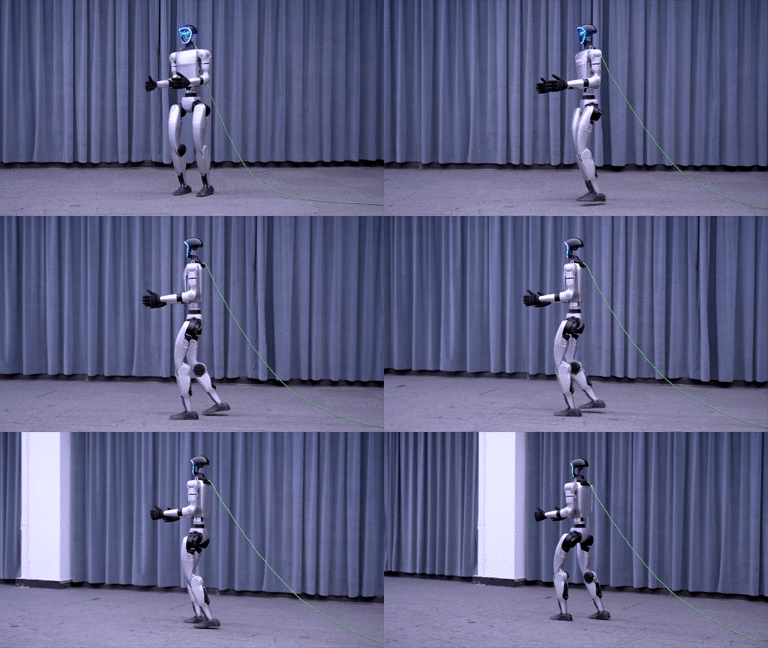
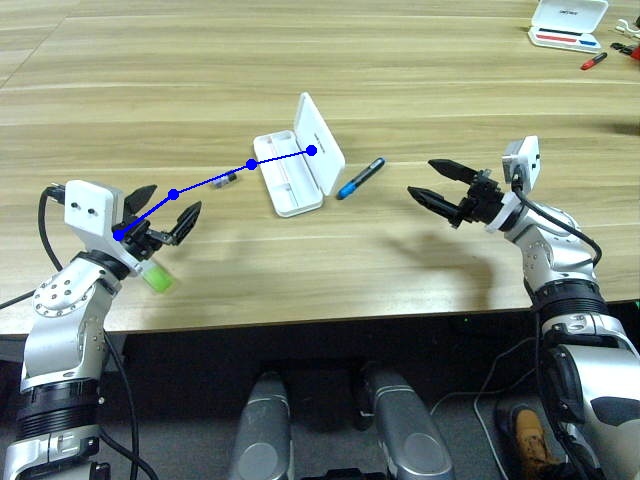
VLA + WBC repos landscape 2025-2026: all humanoid GitHub repos mapped
Over the past 18 months, the humanoid race has shifted from hardware to software stack — specifically two core problems: VLA (Vision-Language-Action) for manipulation and WBC (Whole-Body Control) for locomotion. Both are converging: robots need to walk and manipulate simultaneously, and understand language to know what to do.
This post maps all active GitHub repositories from companies and research labs — organized by geography and problem type. The next two posts dive deeper into each group.
VLA and WBC: why they need each other
VLA solves: "the robot knows what to do (and how) when it sees a scene and hears a command." Foundation model takes image + language → action vector.
WBC solves: "the robot maintains balance and moves while its arms are working." Unified controller for all 30+ degrees of freedom simultaneously.
Combined: loco-manipulation — humanoid walks to a location, picks up an object, places it somewhere else. This is the practical benchmark every company is racing toward.
2023: VLA + WBC research running in parallel
2024: Starting to combine in labs (HumanPlus, OmniH2O)
2025: Companies start releasing repos (NVIDIA GR00T, Unitree unifolm)
2026: Ecosystem forming, repos interconnecting
All repos by group
US / Western group
| Repo | Stars | Company/Lab | Type |
|---|---|---|---|
| physical-intelligence/openpi | ~12k | Physical Intelligence | VLA model (π0, π0.5) |
| NVIDIA/Isaac-GR00T | ~7k | NVIDIA | VLA foundation model |
| NVlabs/GR00T-WholeBodyControl | ~2.2k | NVIDIA | WBC platform |
| NVlabs/HOVER | ~742 | NVIDIA | Humanoid locomotion |
| MarkFzp/HumanPlus | ~847 | Berkeley | WBC from mocap |
| OpenTeleVision/TeleVision | ~1.3k | Stanford + MIT | VR teleoperation |
| OpenHelix-Team/OpenHelix | ~378 | UIUC + others | VLA bimanual |
| OpenDriveLab/EgoHumanoid | ~161 | OpenDriveLab | Loco-manip from ego demos |
| thu-ml/RoboticsDiffusionTransformer | ~1.7k | THU | RDT-1B bimanual |
Chinese group
| Repo | Stars | Company/Lab | Type |
|---|---|---|---|
| unitreerobotics/unifolm-vla | ~477 | Unitree | VLA for G1/H1 |
| unitreerobotics/unitree_rl_gym | ~3.3k | Unitree | RL sim2real |
| unitreerobotics/xr_teleoperate | ~1.5k | Unitree | XR teleoperation |
| roboterax/humanoid-gym | ~2k | RobotEra | Humanoid RL training |
| carlosferrazza/humanoid-bench | ~772 | MIT (original) | Benchmark tasks |
No public repo (closed-source / paper only)
Some companies have not released code:
- Figure AI — Helix system: proprietary
- Tesla Optimus — full software stack: proprietary
- Boston Dynamics Atlas — Atlas control: proprietary
- 1X Technologies — NEO: proprietary
- AgiBot — mostly proprietary
- LeVERB — April 2026 paper, no public repo yet
Reading star counts correctly
Star count is a proxy for community interest, not technical quality:
openpi(~12k): largest VLA community because Physical Intelligence pioneered π0Isaac-GR00T(~7k): NVIDIA brand + tutorial ready → many want to use it immediatelyunitree_rl_gym(~3.3k): many people have Unitree hardware → directly applicable repoTeleVision(~1.3k): requires Apple Vision Pro → hardware barrier keeps star count lowerEgoHumanoid(~161): just released (RSS 2026), stars will grow
Taxonomy: 4 types of repos
Not all repos are used the same way. Understanding the type prevents misuse:
1. Foundation VLA model (openpi, Isaac-GR00T): pretrained model, you fine-tune with your own data. Needs large GPU to fine-tune, can inference on workstation.
2. WBC platform (GR00T-WholeBodyControl, HOVER): controller set to deploy on real robot. Output is joint commands, input is desired end-effector trajectory.
3. Data collection / teleoperation (xr_teleoperate, TeleVision, HumanPlus): not a policy — it's a data collection pipeline. Output is a dataset for the training step.
4. Simulation / benchmark (unitree_rl_gym, humanoid-gym, humanoid-bench): environments for RL policy training and evaluation. Not directly deployed to real robot.
A real project typically needs all 4 types in pipeline:
[4] Train RL sim baseline → [3] Collect real data → [1] Fine-tune VLA → [2] WBC deploy
Choosing a starting point by hardware
Most practical question: what hardware do you have?
| You have | Start here |
|---|---|
| Unitree G1 / H1 | unifolm-vla + xr_teleoperate |
| Unitree Go2 / B2 (quadruped, no arms) | unitree_rl_gym for locomotion |
| Robot arm (Franka, UR5) | openpi or UMI series |
| Any ROS2 robot | OpenHelix (multi-robot) or EgoHumanoid |
| Simulation only | humanoid-gym + humanoid-bench |
| No hardware | Isaac-GR00T tutorial (has sim workflow) |
What this series covers
Three posts:
- This post — Overall landscape, taxonomy, how to choose a starting point
- Post 2: US repos — NVIDIA, Berkeley, Stanford, Physical Intelligence — deep dive per repo
- Post 3: Chinese repos — Unitree, THU, and the open community — complete Unitree stack
Overall observation
What's interesting when looking at the full ecosystem: the repos don't compete — they complement each other.
openpi provides a strong VLA backbone. GR00T-WholeBodyControl provides the WBC layer. xr_teleoperate provides data collection. humanoid-bench provides evaluation. The best practitioners will be those who can combine multiple repos into a unified pipeline — not those who pick one repo and wait for it to solve everything.
Next: Deep dive into US repos — from NVIDIA to Physical Intelligence.
References
- GR00T N1 (NVIDIA, 2025)
- π0 (Black et al., Physical Intelligence, 2024)
- EgoHumanoid (RSS 2026)
- HumanPlus (Fu et al., 2024)
- RDT-1B (THU, 2024)