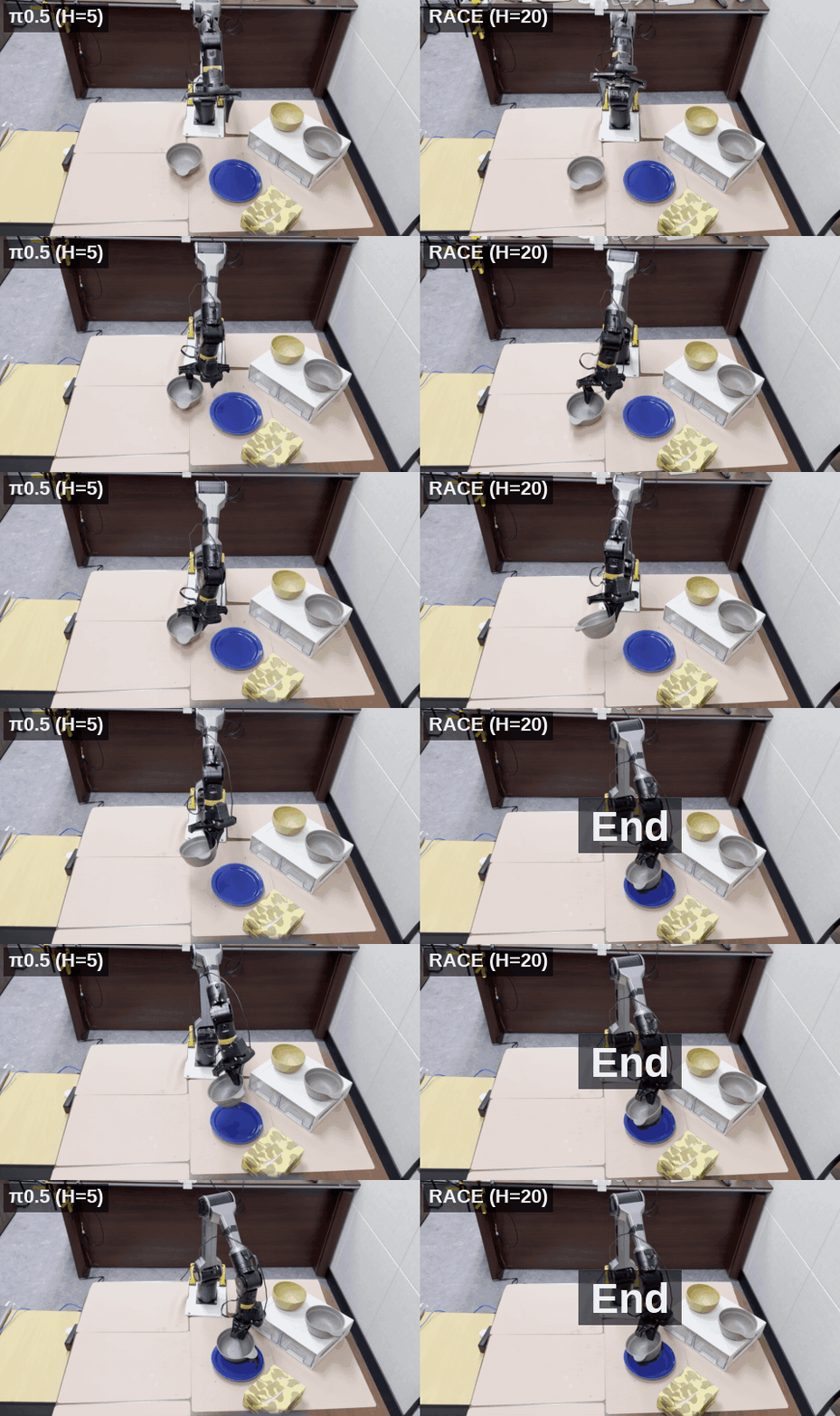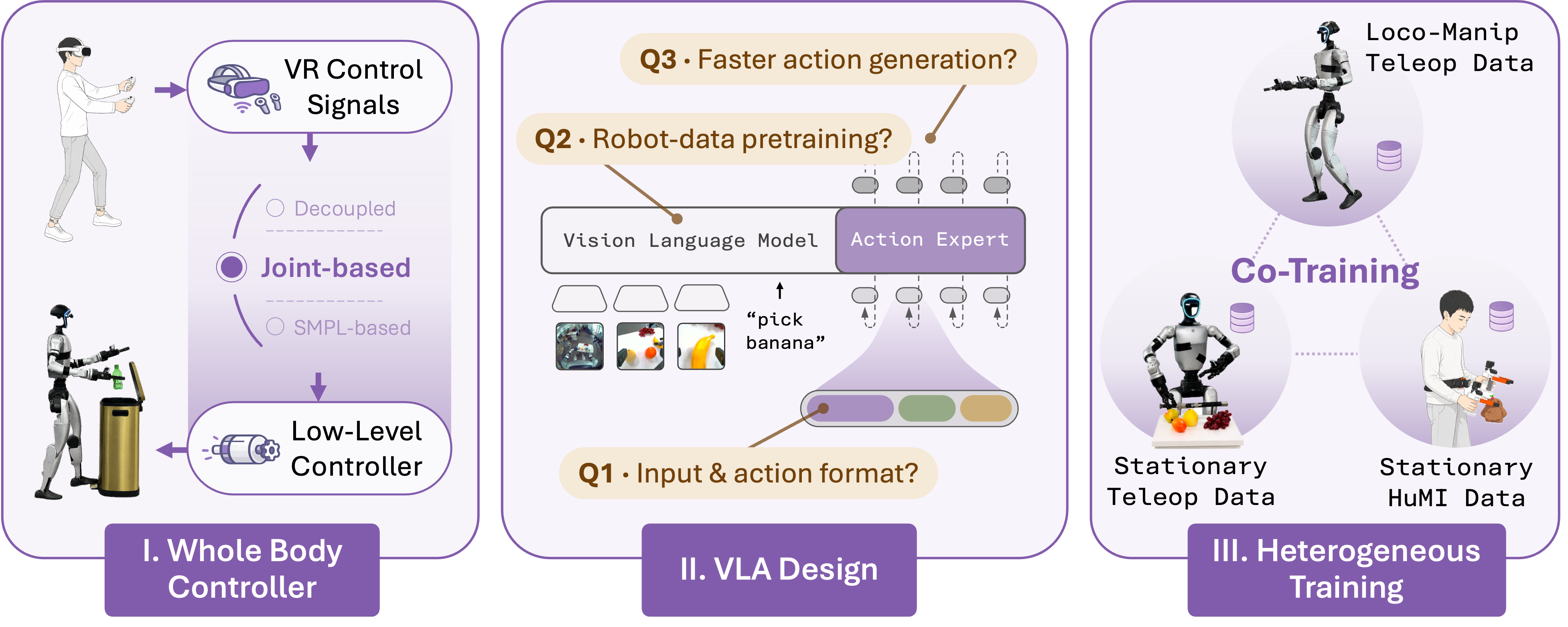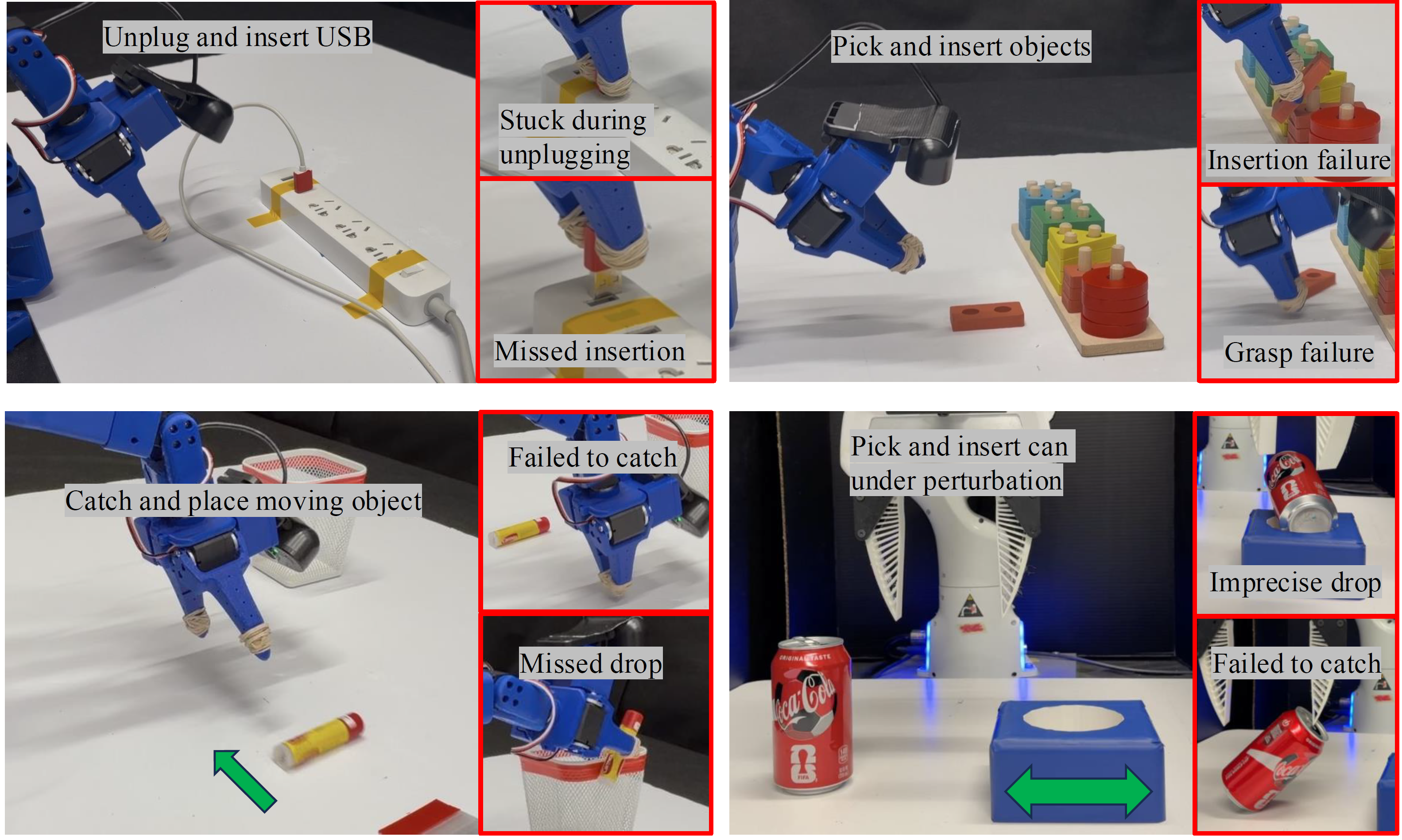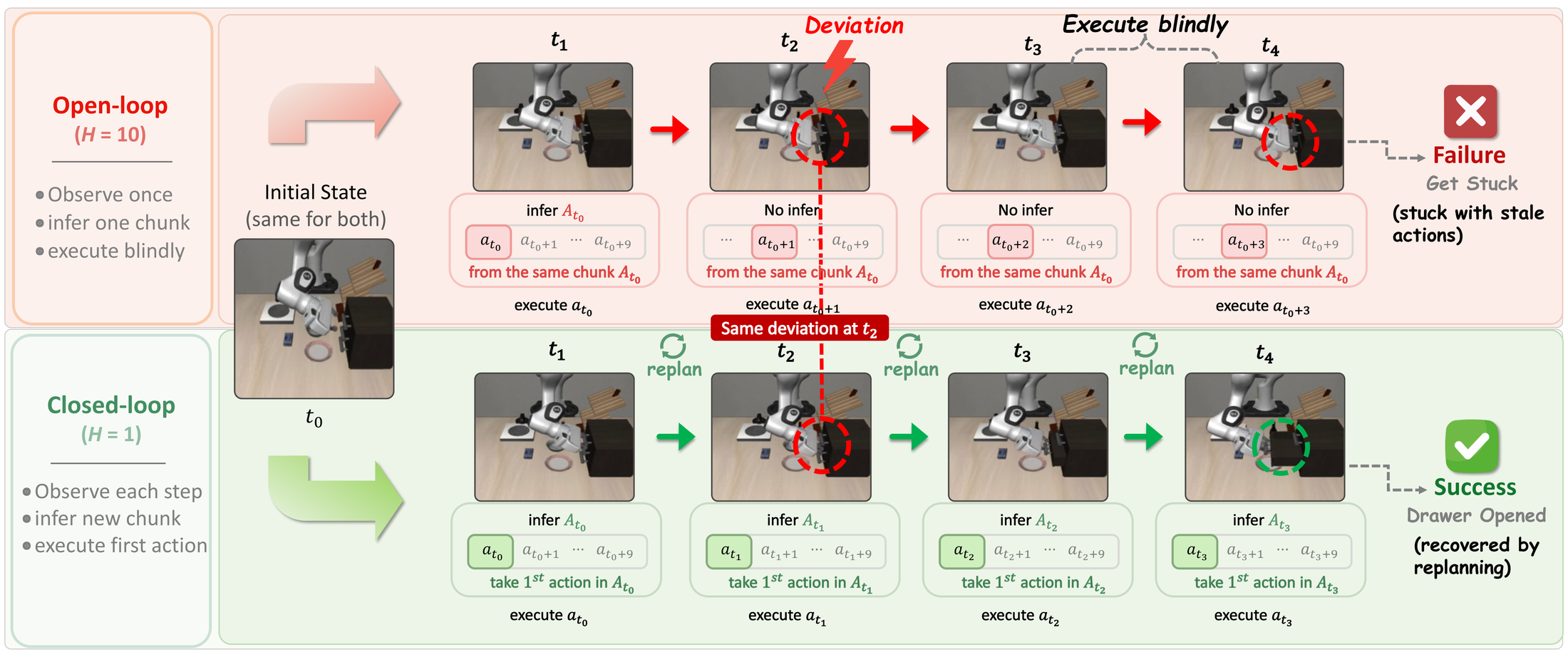
The Problem: Action Chunks Are Efficient, but They Create a Blind Spot
Modern VLA policies usually do not control a robot by calling the model at every control step. That would be too expensive, especially when the backbone is a large generative model such as PI0.5, SmolVLA, or X-VLA. Instead, the policy receives images, a language instruction, and the current robot state, then predicts an action chunk: a sequence of future actions. The controller executes the first part of that chunk before asking the policy for a new one. This executed window is the action horizon.
The engineering trade-off is clear. If one inference call produces 50 future actions, the robot needs fewer VLA calls, trajectories look smoother, and model latency is easier to amortize. But the paper VLA-Corrector: Lightweight Detect-and-Correct Inference for Adaptive Action Horizon, from Zhejiang University and Alibaba DAMO Academy, points out a practical failure mode: while the robot is executing the queued actions, the camera still receives new observations, but the policy does not use them until the next replan. The paper calls this the open-loop blind spot.
That blind spot is especially painful in manipulation. A drawer can shift by a few millimeters, a block can slip in the gripper, a target bowl can be moved by a human, or the end-effector can touch an edge earlier than expected. Once that happens, the remaining actions in the queue may become stale actions. If the controller keeps executing the stale queue, a small local error can compound into a failed grasp, collision, missed insertion, or an out-of-distribution state that the next replan cannot recover from.
VLA-Corrector does not try to remove action chunking. It keeps the efficiency of long chunks during stable phases, then adds an inference-time detect-and-correct layer that shortens the horizon only when the current chunk is no longer trustworthy.
This article is based on the arXiv 2607.01804 paper, the official project page, and the ZJU-OmniAI/vla-corrector GitHub repository. The repository states that the implementation is LeRobot-based and includes modified VLA evaluation entry points plus latent dynamics corrector training modules. It does not include datasets, raw demonstrations, pretrained weights, fine-tuned VLA checkpoints, trained corrector checkpoints, logs, or caches.
Core Idea: Do Not Pick One Fixed Horizon, Decide When to Stop Trusting the Chunk
The simplest way to recover closed-loop behavior is to set H = 1: call the VLA at every control step. For large VLA models, that is rarely practical. Inference latency becomes the control bottleneck, GPU cost increases, and constantly regenerated chunks may make motion less consistent. The opposite choice, a long horizon such as H = 50, gives better efficiency but poor reaction to drift.
The paper reframes the question. Instead of asking "which fixed horizon should we use?", it asks "is the current chunk still reliable?". If execution is still on track, keep the long chunk. If visual dynamics start to diverge from what the policy expected, stop early, discard the remaining actions, and replan in a corrective mode.
VLA-Corrector has four main parts:
| Component | Role |
|---|---|
| Frozen VLA backbone | Generates action chunks as usual, without retraining |
| External latent dynamics corrector | Predicts how visual latents should evolve under on-track execution |
| Latent-space Vision Monitor (LVM) | Compares predicted latent evolution with fresh camera observations |
| Online Gradient Guidance (OGG) | Guides the next replan after an interrupt toward recovery |
For beginners, the key point is that VLA-Corrector is not a second policy that replaces the VLA. The VLA remains the main action generator. The corrector learns a narrower runtime signal: whether local visual evolution still looks consistent with successful execution.
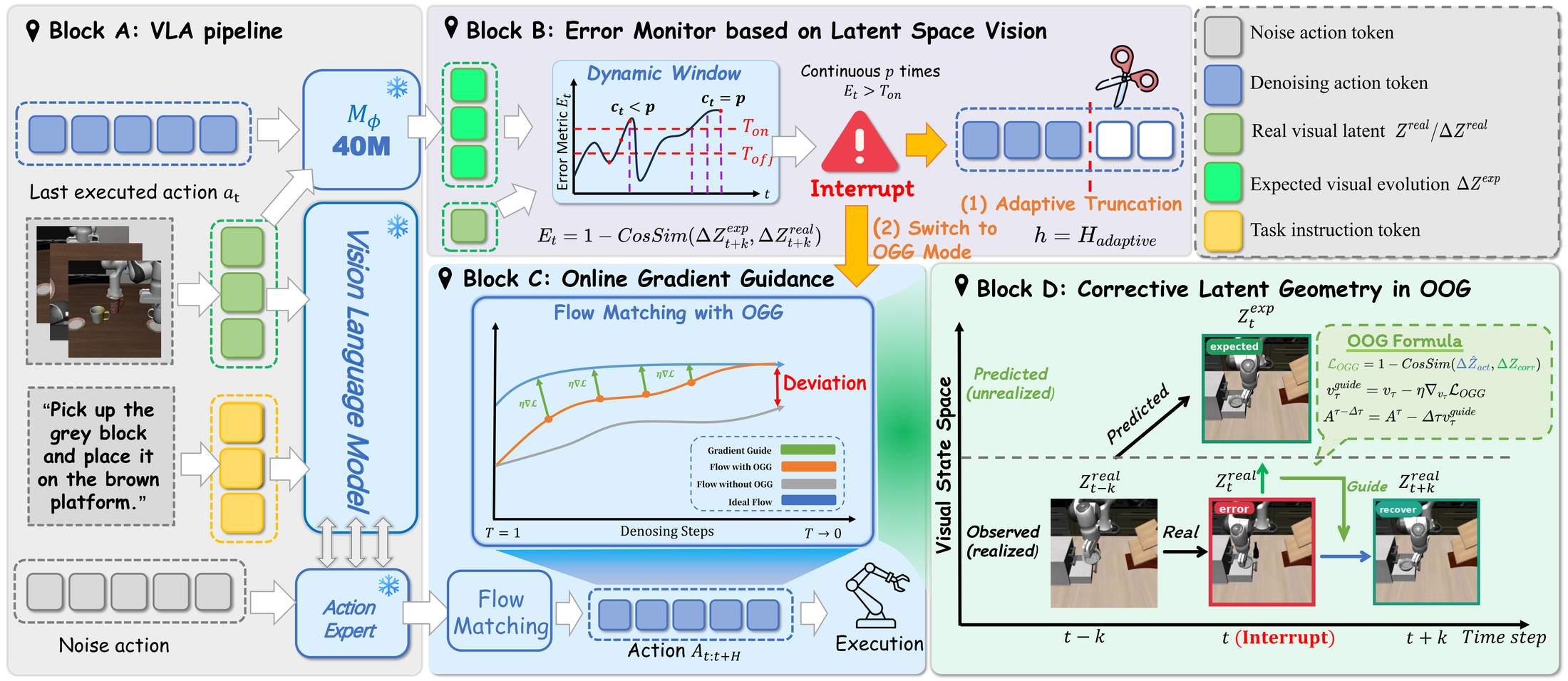
Architecture in Detail
A standard action-chunked VLA pipeline looks like this:
camera + state + language instruction
        |
        v
VLA policy predicts an action chunk [a_t, a_{t+1}, ..., a_{t+C-1}]
        |
        v
controller executes the first H actions
        |
        v
ask the VLA again when the queue is exhausted
The weak point is the controller phase. During those H steps, new observations are available, but the system does not check whether the remaining chunk is still valid. VLA-Corrector fixes this by separating action generation from execution monitoring:
VLA policy predicts an action chunk
        |
        +--> action queue for the controller
        |
        +--> LVM monitors latent visual dynamics during execution
                    |
                    +-- stable: continue the chunk
                    |
                    +-- persistent drift: interrupt, drop stale actions, OGG-guided replan
External Latent Dynamics Corrector
After the VLA policy has been obtained, the backbone is frozen. The VLA visual encoder is used to extract visual latents from demonstration trajectories. For each transition, the corrector learns to predict a short-horizon latent residual: given the current latent visual state and an executed action, how should the visual latent change if the robot remains on a successful trajectory?
This is not a full world model. A world model tries to predict rich future scene evolution. VLA-Corrector only needs a narrower signal: whether local latent dynamics remain consistent with on-track execution. Because the task is local and lower-dimensional, the repository uses an MLP-style corrector. The paper reports residual MLP correctors of roughly 38-42M parameters, commonly summarized as a lightweight 40M corrector. Compared with the VLA backbone, this is a small external module.
LVM: Latent-space Vision Monitor
LVM runs while the action queue is being executed. It receives the actual latent from fresh observations, compares it with the expected latent evolution predicted by the corrector, and produces an inconsistency score. A single noisy spike does not immediately stop the robot. The paper uses a sliding window, median absolute deviation, and hysteresis thresholds so the monitor does not flip states due to camera noise or small teleoperation jitter.
The runtime details are useful for implementation. The monitor keeps a recent-score window of size 15, requires sustained deviation before triggering an interrupt, needs 5 consecutive safe steps before reset, and uses a 10-step cooldown after intervention to prevent repeated immediate triggers. This makes LVM a persistent-drift detector, not a brittle pixel-level alarm.
Event-Triggered Truncation
When LVM confirms persistent drift, VLA-Corrector emits an interrupt event. The controller discards the unexecuted actions in the current queue. A nominally fixed horizon, such as H = 50, becomes a shorter realized horizon if the robot only executed 17 steps before the interrupt. This is why the paper describes the method as an event-triggered adaptive action horizon.
Truncation is powerful because it stops error accumulation early. If the gripper has already missed the block but the controller still executes 30 more queued actions, the next replan may come too late. If the stale queue is dropped as soon as visual dynamics drift, the policy has a better chance of returning to a recoverable state.
OGG: Online Gradient Guidance
After an interrupt, naive replanning may not be enough. The current observation may already be slightly off the demonstration distribution, and the frozen policy may not automatically generate the best recovery chunk. Online Gradient Guidance uses the discrepancy between expected and observed latent evolution to guide the next generation step. In the paper, OGG is applied only to the single policy query immediately after an interrupt. Subsequent calls return to standard inference unless another interrupt is detected.
Practically, truncation gives the model a chance to decide earlier, and OGG makes that next decision more recovery-oriented. The ablation results show that truncation alone gives a large gain, while truncation plus OGG performs best.
Installing the LeRobot-Based Repository
The official repository documents a Conda setup:
conda env create -f environment.yml
conda activate lerobot
python -m pip install -e . --no-build-isolation
For a PushT simulation smoke test:
python -m pip install -e '.[pusht]' --no-build-isolation
Or install the requirements directly:
python -m pip install -r requirements.txt
The exported environment name is lerobot. If you already have another LeRobot environment, edit the name: field in environment.yml before creating the environment. The repository is a LeRobot-based codebase, so do not run its scripts from an unrelated virtual environment where the modified policy wrappers cannot be imported.
You must prepare these paths yourself:
<DATASET_DIR>             # LeRobot, MetaWorld, or LIBERO dataset
<EXTRACTED_CACHE_DIR>     # latent cache after extraction
<POLICY_CHECKPOINT>       # PI0.5, SmolVLA, or X-VLA policy checkpoint
<CORRECTOR_CHECKPOINT>    # trained latent dynamics corrector checkpoint
<OUTPUT_DIR>              # local output directory, usually outside tracked source
This matters for beginners: cloning the repository is not enough to reproduce the benchmark. You still need the dataset, the VLA checkpoint, and a trained corrector checkpoint.
Training: From Demonstrations to a Latent Dynamics Corrector
Training has two layers. First, you need a VLA policy, such as PI0.5 or SmolVLA, already fine-tuned for the benchmark or robot task. Second, you train the external corrector. VLA-Corrector does not retrain the full VLA backbone during corrector training.
The first step is latent extraction:
python -m siglip_dynamics.extract \
  --dataset-path <DATASET_DIR> \
  --dataset-repo-id <DATASET_REPO_ID> \
  --dataset-loader parquet \
  --dataset-format <metaworld_or_libero> \
  --output-path <EXTRACTED_CACHE_DIR> \
  --encoder-backend <pi05_or_smolvla_or_xvla> \
  --use-normalized-delta-action \
  --encoder-policy-path <POLICY_CHECKPOINT> \
  --encoder-local-files-only
Important parameters:
| Parameter | Meaning |
|---|---|
--dataset-format |
Selects the benchmark format, documented as metaworld or libero |
--encoder-backend |
Selects the visual backend: pi05, smolvla, or xvla |
--use-normalized-delta-action |
Uses normalized action deltas to make latent dynamics easier to learn |
--encoder-policy-path |
Points to the VLA checkpoint |
--encoder-local-files-only |
Useful when pretrained weights are already downloaded |
A typical extracted cache contains:
metadata.json
z_q.npy
z_scale.npy
actions.npy
episode_index.npy
Do not commit these files. They can be large and experiment-specific.
After latent extraction, train the MLP corrector:
torchrun --nproc_per_node=1 -m siglip_dynamics.train \
  --model-type mlp \
  --h-window 1 \
  --k-step-list 10 \
  --dataset-path <EXTRACTED_CACHE_DIR> \
  --batch-size 512 \
  --epochs 30 \
  --train-loss-type cosine \
  --checkpoint-dir <CORRECTOR_CHECKPOINT>
h-window 1 means the MLP uses a short local context. k-step-list 10 means it learns a short future residual, which matches the goal of monitoring drift rather than long-horizon planning. train-loss-type cosine emphasizes directional alignment of the latent residual. In practice, the direction of visual change is often more important than perfect absolute scale for detecting whether execution is still on track.
The repository also includes siglip_dynamics.train_split_sweep for data-efficiency experiments. It performs episode-level splits, keeps validation and test sets fixed, trains from scratch for different train_ratio values, then reports metrics such as cosine similarity and MSE. If you have limited demonstrations, run this sweep before collecting much more data. If performance saturates early, your corrector may already have enough local on-track examples for that setting.
Inference and Evaluation
The main modified evaluation entry point is:
python -m lerobot.scripts.lerobot_eval_modified_detection --help
A PI0.5-style MetaWorld command looks like this:
export MUJOCO_GL=egl
export PYOPENGL_PLATFORM=egl
export EGL_PLATFORM=surfaceless

python -m lerobot.scripts.lerobot_eval_modified_detection \
  --policy.path=<POLICY_CHECKPOINT> \
  --policy.device=cuda \
  --policy.n_action_steps=10 \
  --policy.chunk_size=50 \
  --policy.compile_model=false \
  --env.type=metaworld \
  --env.task=<TASK_SPLIT> \
  --env.episode_length=300 \
  --eval.batch_size=1 \
  --eval.n_episodes=20 \
  --eval.use_async_envs=false \
  --env.max_parallel_tasks=1 \
  --seed=1000 \
  --safety_model_path=<CORRECTOR_CHECKPOINT> \
  --safety_k=10 \
  --guidance_eta=1 \
  --guidance_apply_every=1 \
  --guidance_loss_objective=attract_delta_z_correction \
  --guidance_compare_baseline=true \
  --meltdown_cooldown_steps=10 \
  --output_dir=<OUTPUT_DIR> \
  --save_analysis=false \
  --save_raw_video=false \
  --save_summary_csv=true \
  --save_summary_json=true
Here, --policy.chunk_size=50 is the number of actions generated by the policy. --policy.n_action_steps=10 is the number of actions normally executed per policy window. --safety_model_path points to the corrector checkpoint. --safety_k=10 matches the short latent residual prediction interval. --guidance_eta=1 is the default guidance strength reported in the paper. Larger eta is not automatically better; the paper reports that overly strong guidance can hurt harder tasks.
For SmolVLA and X-VLA, the entry point is the same but policy-specific arguments change. A full evaluation still needs simulator dependencies, GPU resources, datasets, policy checkpoints, and trained corrector checkpoints.
Reported Results
The project page and README summarize the main results as follows:
| Setting | Baseline | + VLA-Corrector | Change |
|---|---|---|---|
| MetaWorld, PI0.5 avg. success | 48.70 | 64.35 | +15.65 |
| MetaWorld, SmolVLA avg. success | 61.90 | 66.65 | +4.75 |
| MetaWorld, X-VLA avg. success | 55.55 | 59.60 | +4.05 |
| LIBERO, PI0.5 few-shot avg. success | 94.00 | 97.80 | +3.80 |
| AgileX PiPER real-world avg. success | 55.6 | 73.3 | +17.7 |
The PI0.5 MetaWorld result is the easiest to interpret: the average success rate rises from 48.70 to 64.35. That suggests the failure is not only a weak policy problem. A major part of the issue is that the execution queue keeps running after the visual state has drifted.
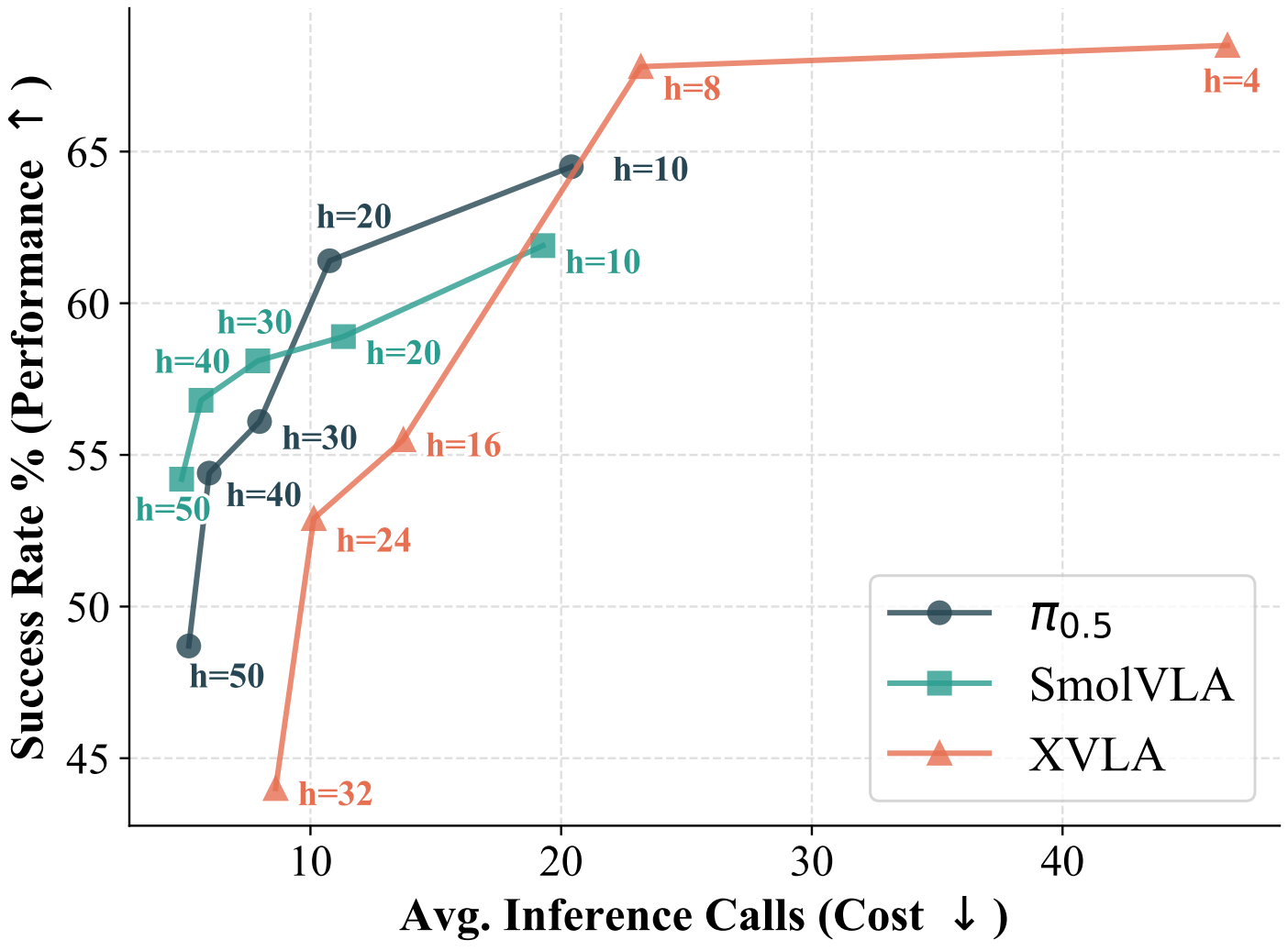
The paper also analyzes success-per-call efficiency. For PI0.5 at horizon 50, success increases from 48.7% to 58.7% while average policy calls drop slightly from 5.15 to 4.98, giving a reported success-per-call gain of about 24.6%. For SmolVLA at horizon 10, success improves from 61.90% to 73.00% while policy calls decrease from 19.27 to 15.64. This is important: VLA-Corrector is not simply buying success by calling the model more often. It tries to make each policy call count by avoiding wasted execution of stale chunks.
On LIBERO, a few-shot fine-tuned PI0.5 model plus VLA-Corrector reaches 97.8% average success, above the fully fine-tuned baseline reported at 96.9%. The right interpretation is not that correctors replace good data. Rather, the inference-time monitor reduces the need for the backbone to have seen every rare recovery state during supervised fine-tuning.
On the real AgileX PiPER 6-DoF arm, the paper groups tasks into pick-and-place, alignment, and disturbance recovery. Average success improves from 55.6% to 73.3%. The gain is smaller on standard pick-and-place because the original chunk often remains valid when the object and target are static. The gain is larger on alignment and disturbance recovery, where the remaining action chunk frequently becomes outdated.
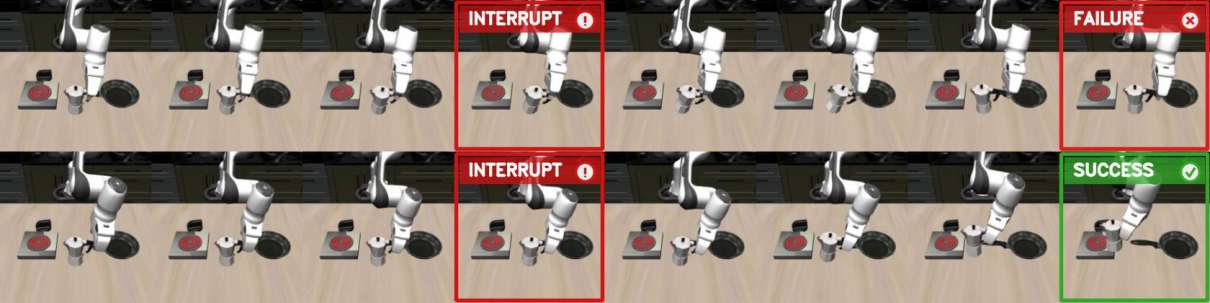
Ablation: Truncation Does the Emergency Stop, OGG Improves Recovery
The ablation is useful because it separates two questions:
- Is early chunk truncation enough?
- After truncation, does OGG add value?
On MetaWorld, the README reports that truncation alone improves average success from 48.70% to 60.35%. Adding OGG reaches 64.35%. This says that event-triggered truncation is the main emergency mechanism: stop executing stale actions. OGG is the recovery shaping mechanism: make the next replan more aligned with returning to a good trajectory.
The paper also reports that 83.7% of truncations occur in manually labeled critical phases, such as precise grasping and alignment. That is a good sign. The monitor is not firing randomly across the episode; it concentrates intervention around the phases where small errors matter most.
When Should You Use VLA-Corrector?
VLA-Corrector is most relevant when three conditions are true:
| Condition | Why it matters |
|---|---|
| The policy uses action chunks | If the policy already replans every step, adaptive horizon adds less |
| The task has contact-rich or precision-sensitive phases | This is where stale chunks create compounding errors |
| You have successful demonstration trajectories | The corrector learns local on-track latent dynamics from demonstrations |
Good candidate tasks include drawer opening, placing objects into bowls, insertion, object alignment, target-shift disturbance recovery, and bimanual manipulation with contact. Very simple tasks with static objects and short horizons may not need this machinery.
The method also has limits. The paper notes failures when the object or fixture is moved outside the reachable region, when the disturbance happens too late after the gripper has entered a bad pose, or when visual ambiguity is severe due to occlusion and poor contrast. OGG still depends on the frozen VLA action prior. It can bias generation toward a better corrective direction, but it cannot invent a recovery skill that the backbone cannot represent at all.
A Practical Lab Checklist
If you want to test this direction in a small lab, follow this order:
- Run the fixed-horizon VLA baseline first. Log success, policy calls, failure phases, and video.
- Pick a task with obvious stale-chunk failures, such as object drift after grasp or a shifted placement target.
- Prepare successful demonstration trajectories in a LeRobot/MetaWorld/LIBERO-compatible format.
- Fine-tune or load the VLA backbone checkpoint.
- Run
siglip_dynamics.extractto build a latent cache from the frozen visual encoder. - Train the MLP corrector with
siglip_dynamics.train. - Evaluate with
lerobot_eval_modified_detection, saving CSV/JSON summaries for baseline and corrector runs. - Move to the real robot only after simulation looks stable; start with low speed, a clear workspace, and an emergency stop ready.
A useful debugging rule: do not tune guidance_eta before watching failure videos. If the baseline fails because perception cannot see the object, OGG is not solving the root cause. If the baseline fails because it keeps executing a stale chunk after a small drift, VLA-Corrector is much closer to the actual problem.
Conclusion
VLA-Corrector is a pragmatic 2026 robotics idea: keep the VLA backbone, keep action chunking, and add a runtime monitor that decides when the current chunk has gone stale. LVM detects latent visual drift. Event-triggered truncation stops error accumulation. OGG makes the next recovery query more purposeful.
The bigger lesson is architectural. A strong VLA policy still benefits from a runtime monitor. In real manipulation, the robot does not only need to know what to do at the start of a chunk. It also needs to know when to stop trusting the old plan.