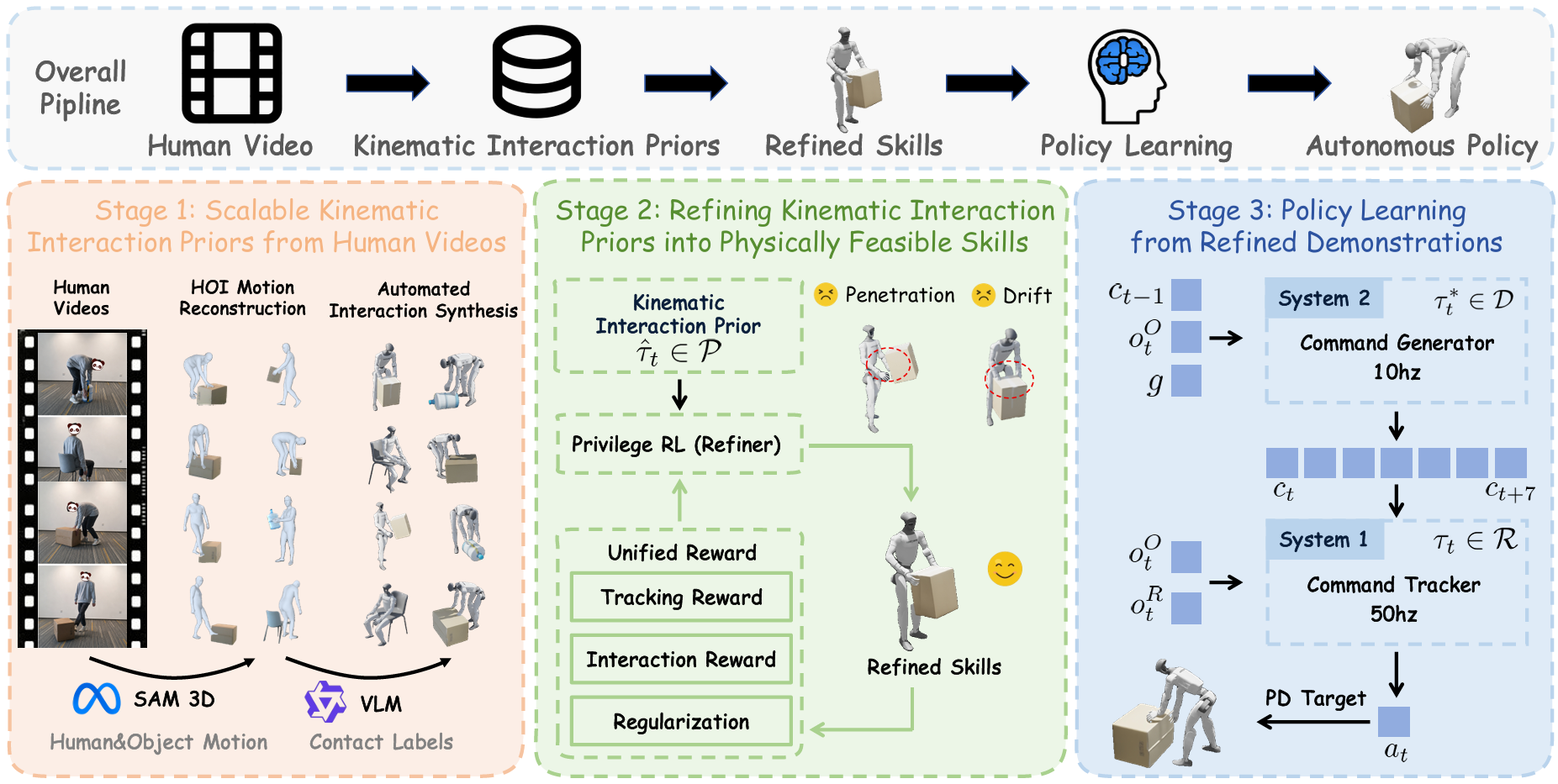
Loco-Manipulation là gì?
Hầu hết các research về humanoid tập trung vào locomotion (đi, chạy, leo) HOẶC manipulation (cầm, nâng, thao tác). Nhưng ứng dụng thực tế đòi hỏi cả hai cùng lúc: robot phải vừa đi vừa mang đồ, vừa di chuyển vừa mở cửa, vừa bước lên cầu thang vừa giữ thăng bằng vật trên tay.
Đây là loco-manipulation -- một trong những bài toán khó nhất của humanoid robotics hiện nay.
Tại sao khó?
- Coupling: Khi tay nâng vật nặng, trọng tâm (CoM) thay đổi -> ảnh hưởng balance
- Competing objectives: Locomotion cần chân ổn định, manipulation cần tay linh hoạt -- cả hai dùng chung cơ thể (skeleton)
- High-dimensional: Humanoid có 30-75 DOF, điều khiển toàn bộ cùng lúc rất phức tạp
- Contact-rich: Cả chân (tiếp xúc mặt đất) và tay (tiếp xúc vật) đều có contact dynamics

Phương pháp 1: Decoupled Upper/Lower Body
Ý tưởng đơn giản nhất: tách riêng điều khiển thân trên (manipulation) và thân dưới (locomotion). Mỗi phần có controller riêng, giao tiếp qua interface nhẹ.
Mobile-TeleVision (arXiv:2412.07773)
Paper "Mobile-TeleVision: Predictive Motion Priors for Humanoid Whole-Body Control" (arXiv:2412.07773) là ví dụ điển hình của decoupled approach.
Kiến trúc:
- Upper body: IK + motion retargeting từ người điều khiển (teleoperation)
- Lower body: RL policy cho locomotion, conditioned trên upper body motion
- PMP (Predictive Motion Priors): CVAE model dự đoán upper body motion tương lai, giúp locomotion policy "biết trước" tay sẽ làm gì
Tại sao cần PMP? Nếu locomotion policy chỉ nhìn trạng thái hiện tại của tay, nó sẽ reactive -- phản ứng chậm khi tay thay đổi đột ngột (ví dụ nâng vật nặng lên). PMP cho phép policy anticipate -- biết tay sắp nâng vật -> điều chỉnh tư thế trước.
# Simplified decoupled control architecture
class DecoupledController:
    def __init__(self):
        self.upper_body_ik = InverseKinematics(arm_joints)
        self.lower_body_rl = load_policy("locomotion_policy.pt")
        self.pmp = load_model("predictive_motion_prior.pt")

    def step(self, upper_body_target, velocity_command):
        # 1. Upper body: IK cho tay
        arm_targets = self.upper_body_ik.solve(upper_body_target)

        # 2. Predict upper body motion tương lai
        motion_prior = self.pmp.predict(
            current_arm_state=arm_targets,
            history=self.arm_history
        )

        # 3. Lower body: RL conditioned trên motion prior
        obs = concat([
            proprioception,       # Joint states
            velocity_command,     # Di chuyển command
            motion_prior,         # Dự đoán chuyển động tay
        ])
        leg_actions = self.lower_body_rl(obs)

        return concat([arm_targets, leg_actions])
Kết quả: Tested trên Fourier GR-1 và Unitree H1 trong simulation, và Unitree H1 trong thực tế. Robot có thể vừa đi vừa cầm vật, vừa đi vừa mở cửa.
Ưu điểm của Decoupled
- Dễ debug: Tách riêng từng phần
- Reusable: Locomotion policy có thể dùng lại cho nhiều manipulation tasks
- Teleoperation friendly: Người điều khiển chỉ cần control tay, chân tự động
Nhược điểm
- Limited coordination: Khó làm các task cần toàn thân (ví dụ ném bóng xa)
- Interface bottleneck: Thông tin giữa 2 phần bị giới hạn
- Sub-optimal: Không thể tối ưu đồng thời cả loco và manip
Phương pháp 2: Teleoperation + Imitation Learning
Thay vì thiết kế controller thủ công, học từ người:
- Teleoperate humanoid: Người điều khiển robot làm task (cầm vật, dọn dẹp, ...)
- Thu thập data: Ghi lại observations và actions
- Train policy: Dùng Imitation Learning (Behavior Cloning, ACT, Diffusion Policy) để học policy
Hệ thống Teleoperation cho Humanoid
TWIST (Teleoperated Whole-Body Imitation System) và Open-TeleVision là 2 hệ thống teleoperation nổi bật:
- VR headset: Oculus/Meta Quest cho head tracking + hand tracking
- Motion capture: Toàn thân người điều khiển được tracked
- Retargeting: Map chuyển động người -> chuyển động robot (khác nhau về kích thước, DOF)
- Force feedback: Người điều khiển cảm nhận lực từ robot
# Teleoperation data collection pipeline
class TeleoperationCollector:
    def __init__(self, robot, vr_interface):
        self.robot = robot
        self.vr = vr_interface
        self.dataset = []

    def collect_episode(self, task_name):
        """Thu thập 1 episode teleoperation."""
        episode_data = []

        while not task_complete:
            # Đọc VR input
            head_pose = self.vr.get_head_pose()
            hand_poses = self.vr.get_hand_poses()  # Left + Right
            body_pose = self.vr.get_body_pose()

            # Retarget sang robot
            robot_targets = retarget(
                human_pose={
                    'head': head_pose,
                    'hands': hand_poses,
                    'body': body_pose
                },
                robot_model=self.robot.model
            )

            # Thực hiện trên robot
            observation = self.robot.get_observation()
            self.robot.set_targets(robot_targets)
            action = self.robot.get_applied_action()

            # Lưu data
            episode_data.append({
                'observation': observation,
                'action': action,
                'image': self.robot.get_camera_images()
            })

        self.dataset.append(episode_data)
Imitation Learning cho Loco-Manipulation
Sau khi có data, train policy bằng:
Behavior Cloning (BC) -- đơn giản nhất:
# policy(observation) -> action
loss = MSE(policy(obs), expert_action)
ACT (Action Chunking with Transformers) -- hiệu quả hơn:
- Predict chunk of actions (ví dụ 100 actions tương lai) thay vì 1 action
- Dùng CVAE để model multi-modal behavior
- State-of-the-art cho manipulation tasks
Diffusion Policy -- mạnh nhất cho multi-modal:
- Model action distribution bằng diffusion process
- Xử lý được multi-modal behaviors (nhiều cách làm 1 việc)
Chi tiết về ACT và Diffusion Policy: xem Imitation Learning cho Robotics và ACT: Action Chunking with Transformers.

Phương pháp 3: End-to-End RL
Thay vì tách riêng, train 1 policy duy nhất cho toàn bộ loco-manipulation.
ALMI -- Adversarial Locomotion and Motion Imitation
ALMI sử dụng adversarial training giữa upper và lower body:
- Lower body cung cấp locomotion robust
- Upper body track các motions khác nhau
- Adversarial loss đảm bảo 2 phần "hợp tác" tốt
ResMimic -- Residual Learning
ResMimic dùng 2 stages:
- Stage 1: Train general motion tracking policy (biết đi, đứng, vẫy tay, ...)
- Stage 2: Train residual policy trên stage 1 cho specific task (cầm vật, mở cửa)
Residual policy chỉ cần học sự khác biệt giữa general motion và task-specific motion -- nhanh hơn và ổn định hơn train từ đầu.
class ResidualPolicy:
    def __init__(self):
        self.base_policy = load_pretrained("motion_tracking.pt")  # Frozen
        self.residual = nn.Sequential(                             # Trainable
            nn.Linear(obs_dim, 256),
            nn.ReLU(),
            nn.Linear(256, 256),
            nn.ReLU(),
            nn.Linear(256, action_dim)
        )

    def forward(self, obs):
        with torch.no_grad():
            base_action = self.base_policy(obs)

        residual_action = self.residual(obs)

        # Final action = base + residual (với scale nhỏ)
        return base_action + 0.1 * residual_action
WholeBodyVLA -- Vision-Language-Action
WholeBodyVLA (ICLR 2026) là framework mới nhất, kết hợp Vision-Language-Action model với humanoid loco-manipulation:
- Học từ egocentric videos (video từ góc nhìn robot) -- rẻ và dễ thu thập
- Dùng VLA architecture để hiểu ngôn ngữ + hình ảnh -> action
- Tested trên AgiBot X2, vượt qua các baselines 21,3%
Đây là hướng đi hot nhất hiện nay -- kết hợp LLM/VLM với whole-body control.
So sánh các phương pháp
| Phương pháp | Ưu điểm | Nhược điểm | Papers |
|---|---|---|---|
| Decoupled | Dễ debug, reusable | Sub-optimal, limited | Mobile-TeleVision |
| Teleop + IL | Học từ demo, flexible | Cần data, operator | TWIST, Open-TeleVision |
| End-to-end RL | Optimal, no human | Khó train, reward design | ALMI |
| Residual | Nhanh, stable | Cần base policy | ResMimic |
| VLA | Language grounding | Cần compute, data | WholeBodyVLA |
Challenges còn lại
1. Dexterous manipulation trong khi đi
Hầu hết research chỉ demo power grasp (nắm chắc) trong khi đi. Dexterous manipulation (xoay vật, mở nắp, sử dụng công cụ) trong khi di chuyển vẫn rất khó.
2. Reactive balance
Khi robot đang cầm vật nặng và bị đẩy, nó cần đồng thời giữ vật và giữ thăng bằng. Priority nào cao hơn? Trade-off này chưa được giải quyết tốt.
3. Long-horizon tasks
Các task dài (ví dụ dọn phòng, nấu ăn) đòi hỏi kế hoạch dài hạn -- điều mà current policies chưa làm tốt. Cần kết hợp với task planning (LLM-based).
4. Multi-contact
Robot tương tác đồng thời với nhiều vật (ví dụ cầm 2 tay, dùng chân chèn khóa) -- số điểm tiếp xúc tăng, độ phức tạp tăng theo.
Hướng nghiên cứu 2026-2027
- VLA + Whole-body: Dùng language models để điều khiển toàn thân humanoid
- Teleoperation at scale: Thu thập data từ hàng trăm người, train general-purpose policy
- Sim-to-real cho manipulation: Hiện tại sim-to-real cho locomotion đã tốt, nhưng cho manipulation vẫn khó (contact-rich)
- Multi-robot loco-manipulation: 2 humanoid hợp tác nâng vật nặng
Tiếp theo trong series
- Part 4: RL cho Humanoid: Humanoid-Gym đến sim2real
- Part 6: Tương lai Humanoid: Cơ hội cho kỹ sư robotics
Bài viết liên quan
- Imitation Learning cho Robotics -- Behavior Cloning, DAgger, và hơn thế
- ACT: Action Chunking with Transformers -- State-of-the-art manipulation policy
- Diffusion Policy cho Robot -- Diffusion-based control
- Foundation Models cho Robot: RT-2, Octo, OpenVLA -- VLA models
- RL cho Bipedal Walking -- RL locomotion cơ bản