Humanoid Robotics 2026: The Three-Way Race
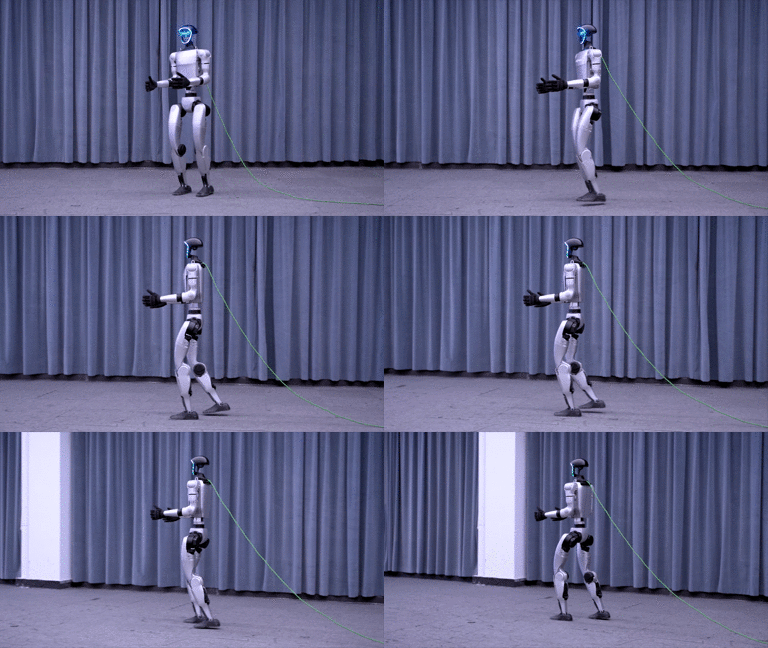
2026 marks the inflection point for humanoid robot market when three major platforms officially enter: Unitree G1, Unitree H1, and Tesla Optimus (Gen 3). From lab to factory, humanoid robots are no longer sci-fi — they have price tags, SDKs, and real-world deployments.
This article compares specs, software, pricing, and applications of the 3 most popular humanoid platforms, helping you decide which to invest in for research or commercial deployment.
Three Platform Overview
Unitree G1 — Affordable Humanoid for Education & Research
Unitree Robotics (China) shocked market with G1 at just $99,000 (~2.5B VND) — 5-10x cheaper than other humanoids. G1 is 1.27m tall, weighs 35 kg, compact and accessible for university labs and startups.
G1 doesn't aim to replace factory workers. It's a research platform — where you experiment with locomotion, manipulation, and AI algorithms without million-dollar budgets.
Unitree H1 — High-Performance Humanoid
H1 is G1's bigger brother: 1.80m tall, 47 kg, significantly more powerful. Designed for real-world applications — security patrol to logistics support. With 3.3 m/s running speed (fastest humanoid), H1 holds Guinness record for humanoid running speed.
Tesla Optimus (Gen 3) — Production-Scale Ambition
Tesla Optimus (Tesla Bot) is Elon Musk's ambitious project: mass-producing humanoids for factories, replacing workers on repetitive tasks. Gen 3 (2026) improved significantly from prototypes, with 22-DOF hands and better manipulation.
However, as of mid-2026, Optimus hasn't entered commercial sales — Tesla is deploying internally at Gigafactories before commercialization (target 2027-2028).

Detailed Specs Comparison
| Metric | Unitree G1 | Unitree H1 | Tesla Optimus Gen 3 |
|---|---|---|---|
| Height | 1.27 m | 1.80 m | 1.73 m |
| Weight | 35 kg | 47 kg | 57 kg (est.) |
| DOF (degrees of freedom) | 23-43 (config) | 26 | 28+ (22-DOF hands) |
| Walking speed | 2.0 m/s | 3.3 m/s (record) | 1.5 m/s (est.) |
| Arm payload | 3 kg | 5 kg | 4.5 kg (each) |
| Battery | ~58V LiPo | ~58V LiPo | 2.3 kWh (Tesla cell) |
| Runtime | ~2 hours | ~2 hours | ~5 hours (est.) |
| Camera/Sensors | Depth, IMU, LiDAR (opt) | Depth, LiDAR, IMU | 8 cameras (Tesla Vision), IMU |
| Compute | Unitree MCU + Jetson Orin (opt) | Unitree MCU + Jetson Orin | Tesla FSD chip |
| Price | From $99,000 | From $150,000 | Not sold (target $20K-30K) |
| Status | Shipping now | Shipping (limited) | Internal Tesla only |
| SDK | Unitree SDK + ROS 2 | Unitree SDK + ROS 2 | Not public |
Software & SDK Comparison
Software determines what you can actually do with the hardware, not just specs.
Unitree G1 & H1: Open and Developer-Friendly
Unitree's software strategy is most open of three platforms:
- Unitree SDK (C++/Python): Low-level control API per joint, supports position, velocity, torque control modes
- ROS 2 integration: URDF model, Gazebo simulation, Nav2 navigation — full ROS 2 ecosystem integration
- Isaac Sim support: Simulate in NVIDIA Isaac Sim for reinforcement learning
- MuJoCo model: Model ready for MuJoCo — popular physics simulation for RL research
- Community: Active GitHub, Discord with thousands of developers
- Sim-to-Real: Clear pipeline — train policy in simulation, deploy on real robot
Key advantage: You can run your own AI models on Jetson Orin mounted on robot, no lock-in to manufacturer's ecosystem.
Tesla Optimus: Closed and Vertically Integrated
Tesla takes opposite approach:
- No public SDK — Tesla develops software completely internally
- End-to-end neural network: Like Full Self-Driving (FSD) for cars, Optimus uses neural networks from camera input to motor commands
- Tesla FSD chip: Custom silicon optimized for on-device inference
- Dojo training: Uses Tesla's Dojo supercomputer for large-scale model training
- Teleoperation data: Collects data from human operators to train imitation learning
Advantage of closed system: Tighter integration, software optimized for specific hardware. Disadvantage: You can't customize or run your own algorithms.
| Software Criteria | Unitree G1/H1 | Tesla Optimus |
|---|---|---|
| Public SDK | Yes (C++/Python) | No |
| ROS 2 support | Official | No |
| Simulation | Gazebo, Isaac Sim, MuJoCo | Internal (proprietary) |
| Custom AI models | Can deploy on Jetson | Only Tesla AI |
| Community | GitHub + Discord active | None |
| Programming model | Low-level joint + high-level API | End-to-end neural network |
| Licensing | Open-source friendly | Proprietary |
Use Cases: What Are Humanoids Used For?
Academic Research
Clear use case now. University labs need humanoids to:
- Research bipedal locomotion — walking, running, stair climbing, rough terrain
- Experiment whole-body manipulation — coordinating arms and legs to manipulate objects
- Develop imitation learning — robot learning from human videos
- Benchmark reinforcement learning policies on real hardware
Recommendation: Unitree G1 — cheapest, open SDK, active research community. Many papers at ICRA and RSS 2026 use G1.
Warehouse & Logistics
Humanoid can replace humans on picking, packing, moving inside warehouses — especially in spaces designed for humans (stairs, doors, narrow aisles) where wheeled AMRs fail.
Recommendation: Unitree H1 — more powerful than G1, 5kg payload sufficient for most packages, 3.3 m/s speed for high throughput.
Manufacturing (Factory)
Ultimate goal — humanoid replaces assembly worker. Requires extremely precise manipulation, 8-12 hour continuous operation, 99.9%+ reliability.
Recommendation: Wait for Tesla Optimus — if Tesla executes timeline, Optimus at $20K-30K target price would be game-changer for manufacturing. But timeline remains uncertain (2027-2028 earliest).
Service & Retail
Tour guide, restaurant server, security patrol. Requires natural interaction, safe movement in crowds.
Recommendation: Not ready in 2026 — no humanoid platform truly suitable yet. Wheeled robots (Softbank Pepper) still better for these tasks.
Purchasing & Delivery Status
Unitree G1
- Available to buy now via Unitree website or distributors
- Lead time: 4-8 weeks (configuration-dependent)
- Base config (23 DOF, no Jetson): ~$99,000
- Full config (43 DOF, Jetson Orin, LiDAR): ~$150,000
- Ships internationally, including Vietnam
- 1 year hardware warranty
Unitree H1
- Available but limited stock
- Lead time: 8-12 weeks
- Price from $150,000, configuration-dependent
- Direct contact with Unitree sales team required
- Ships internationally
Tesla Optimus
- Not for sale to public
- Tesla deploying internally at Gigafactories
- Elon Musk announced 2027 target for commercial launch, $20K-30K price
- No official pre-order or wait-list
- Commercialization timeline still uncertain
Which Humanoid for Vietnam?
If you are a researcher / university lab
Unitree G1 base config is obvious choice:
- ~2.5B VND fits NAFOSTED project or university budget
- Open SDK, ROS 2 support — students and researchers start immediately
- Large community, reference code on GitHub
- Compact (1.27m, 35kg) — fits lab without large space
If you are robotics startup
Unitree H1 if you need to demo or develop commercial application:
- More impressive for customer demo than G1 (human-sized, fast)
- Sufficient payload for logistics applications
- Same SDK as G1, code port trivial
If you are large factory
Wait — no humanoid production-ready for manufacturing in 2026. Instead:
- Use cobot (UR, Doosan, FANUC) for assembly tasks
- Use AMR for transport
- Pilot program with Unitree to explore and prepare
Important Considerations
Battery Life
Biggest limitation. With 2-hour battery (Unitree), robot needs frequent charging — doesn't suit 8-hour continuous operation. Tesla Optimus with ~5 hours estimated might be better, but unverified.
Safety
Humanoid robot weighing 35-57 kg moving at 1.5-3.3 m/s is real hazard. Currently no dedicated safety standard for humanoids — ISO 10218 and ISO/TS 15066 written for robot arms, not bipedal robots. When deploying, do rigorous risk assessment.
Maintenance & Spare Parts
Bipedal robots have many joints, experience impact forces each step, complex mechanics. Actuators, gearboxes, bearings wear faster than wheeled/arm robots. Budget 15-20% of robot cost per year for maintenance.
Regulation in Vietnam
Currently no specific regulation for humanoid robots in Vietnam. If deploying in public space, check regulations on automated equipment and international robot safety standards.
Future Humanoids: 2027 and Beyond
Market is early adopter phase. Beyond these three:
- Figure 02 (Figure AI): Backed by Microsoft, NVIDIA, Jeff Bezos. Piloting at BMW.
- 1X NEO (1X Technologies): Light (30kg) for household tasks.
- Agility Digit: Already commercialized, focused on logistics/warehouse.
- Boston Dynamics Atlas (Electric): Switched to electric, demos impressive, not yet for sale.
- Apptronik Apollo: Partnership with Mercedes-Benz for manufacturing.
Competition intensifying, prices dropping fast. If you're researching or planning ahead, now is time to learn — not necessarily buy immediately, but understand technology before costs drop.
For deeper humanoid knowledge, read Comprehensive Guide to Humanoid Robotics.
Conclusion
Among three platforms, Unitree G1 is most practical choice for 2026 — buy now, open SDK, acceptable price. H1 for higher performance needs. Tesla Optimus most promising long-term but still "vaporware" until actually shipping.
Humanoid robots aren't for replacing humans tomorrow — they're platforms for research, development, and preparation for increasingly automated future. That future arrives faster than you think.