MOV.AI is not just another fleet dashboard — it is a full robotics operating system for AMRs, complete with FlowStudio (visual behavior programming) and multi-vendor fleet orchestration.
That depth is exactly why teams look for alternatives: MOV.AI is built for OEMs and system integrators who need to program robot behavior from scratch. If you are an end-user running an existing fleet, that complexity and pricing may be overkill.
Four situations drive people to look for MOV.AI alternatives:
- Too much complexity — FlowStudio is powerful but requires deep ROS knowledge to leverage
- Opaque pricing — enterprise-only, no public self-serve tier for smaller teams
- Not a monitoring tool — if you only need observability, MOV.AI is an expensive way to get it
- Mixed fleet needs — you need arms, drones, or custom hardware alongside AMRs
Here are 5 alternatives for 2026, including our platform VnRobo.

TL;DR
| Platform | Best for | Starting price | Complexity |
|---|---|---|---|
| VnRobo | Mixed fleet, monitoring + lifecycle | $29/mo | Low |
| Open-RMF | Multi-vendor, open-source | Free (time cost) | High |
| Freedom Robotics | Monitoring + remote ops | ~$50/robot | Low |
| InOrbit | AMR warehouse specialist | Enterprise | Medium |
| ROS 2 Nav2 + DIY | Research lab, full control | Free | Very high |
When MOV.AI is still the right choice
Reality check first: MOV.AI is the right tool when you are an OEM or system integrator building a robot product — not when you are an end-user running an existing fleet.
Stay with MOV.AI if:
- You are building a robot product and need FlowStudio for programming behavior
- Your team has deep ROS expertise and wants full customization
- Your customers need a white-label robotics OS
Look for alternatives if:
- You are an end-user operating a fleet, not building one
- You need transparent pricing and self-serve signup
- Your fleet is under 20 robots and you do not need visual behavior programming
- You want learning + simulation integrated into the same platform
The 5 alternatives
1. VnRobo — mixed fleet, full lifecycle
Website: app.vnrobo.com
Full disclosure: our platform. We did not build a FlowStudio replacement — we do not have visual behavior programming. But if you need to monitor and manage an existing fleet with learning and simulation integrated, VnRobo fits better.
Strengths vs MOV.AI:
- Self-serve signup — no sales calls, no enterprise POC required
- Transparent pricing: $29/mo for 25 robots, $79/mo for 100 robots
- Mixed fleet: AMR, robot arms, humanoids, drones — all on one dashboard
- Full lifecycle: Academy (learning), Sandbox (MuJoCo sim), Deploy (ROS 2 agent), Monitor
- 2-minute setup — install
vnrobo-agenton the robot and you are connected
Weaknesses vs MOV.AI:
- No visual behavior programming (FlowStudio) — MOV.AI owns that category
- Less specialized for OEM/manufacturer use cases
- Younger platform with fewer published case studies
Verdict: Pick VnRobo if you are an end-user operating a fleet, not an OEM building one. If you need to program robot behavior from scratch, MOV.AI or ROS 2 Nav2 is the right path.
2. Open-RMF — truly open-source, multi-vendor
Website: open-rmf.org
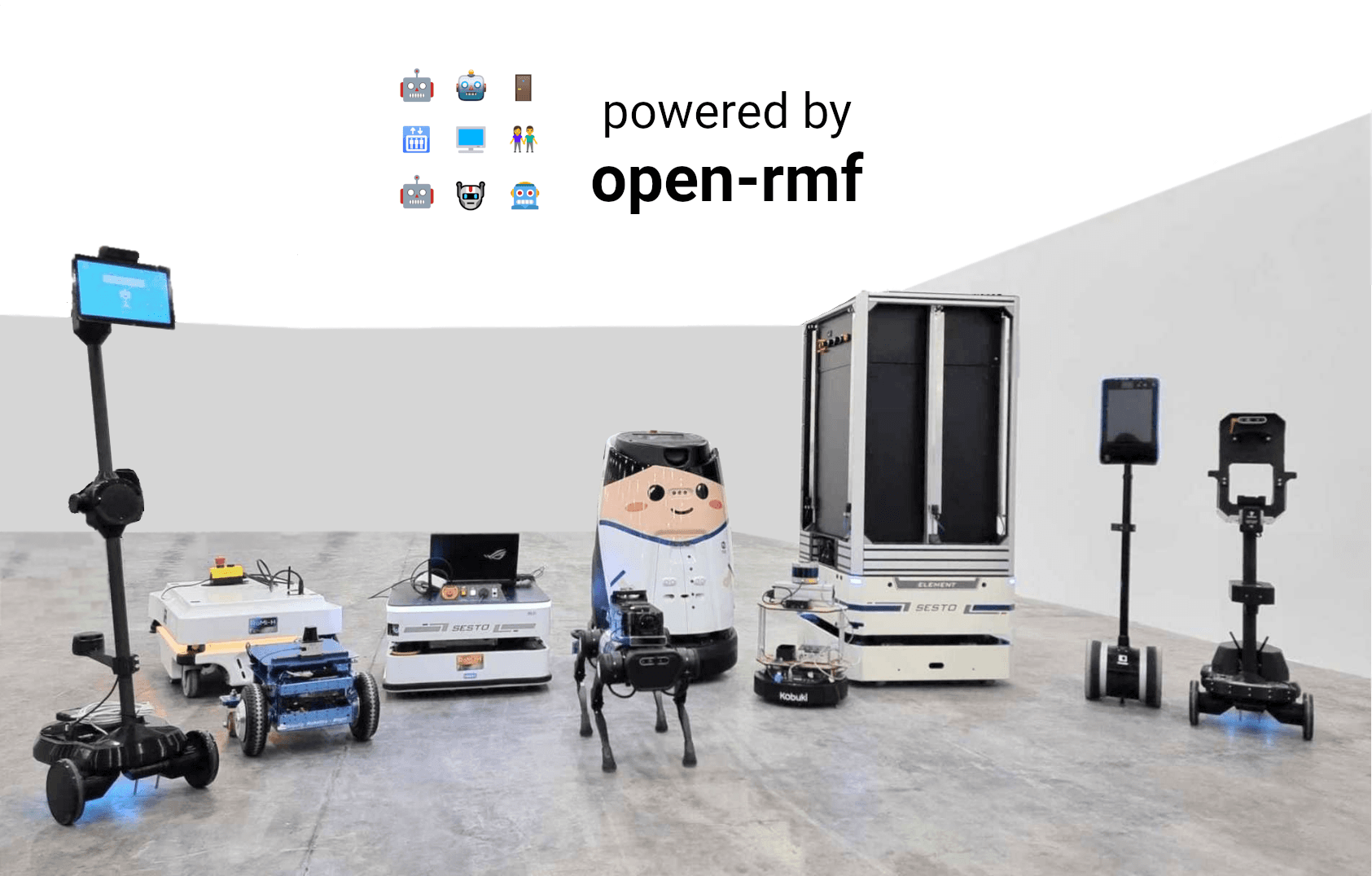
Open-RMF (Robot Middleware Framework) is the open-source project closest to MOV.AI technically — both are ROS-based, both support multi-vendor fleets. The difference: Open-RMF has no visual programming, but no license cost either.
Strengths vs MOV.AI:
- Fully open-source — zero license cost
- Genuinely multi-vendor via adapter drivers (MiR, OTTO, Fetch, etc.)
- Used in production: Singapore hospitals, Changi Airport
- ROS 2 native, clean integration with existing robotics stacks
Weaknesses vs MOV.AI:
- No visual behavior programming equivalent to FlowStudio
- Complex setup — weeks to months for production deployment
- You own all operations — no commercial support
- Limited dashboards out of the box — you build monitoring yourself
Verdict: Right for research institutions or teams with strong DevOps who need zero license cost. Not for small teams needing production-ready quickly.
3. Freedom Robotics — fast monitoring + remote ops
Website: freedomrobotics.ai
Freedom Robotics is not a MOV.AI replacement for behavior programming, but if you only need monitoring, alerting, and remote operations — it onboards in minutes instead of months.
Strengths vs MOV.AI:
- Onboarding in 5 minutes — no deep ROS background required
- Public pricing (~$50/robot/month)
- Good live video streaming
- Supports both ROS and non-ROS robots
Weaknesses vs MOV.AI:
- No behavior programming — monitoring layer only
- Pricing gets painful at scale ($50 × 30 robots = $1,500/month)
- No simulation or learning platform
Verdict: Good if you have an existing fleet running ROS and only need a clean monitoring layer. Keep robot behavior in your own stack; Freedom Robotics is your eyes.
4. InOrbit — AMR warehouse specialist
Website: inorbit.ai
InOrbit was built specifically for AMR warehouses — native VDA 5050, deep MiR/OTTO/Locus integrations, polished mission planning UI. If your fleet is all-AMR and you want a more end-user-friendly platform than MOV.AI, InOrbit is worth evaluating.
Strengths vs MOV.AI:
- Native VDA 5050 — the EU industry standard for AMR coordination
- Deeper MiR/OTTO/Locus integrations for end-users
- Mission planning UI easier than FlowStudio for non-ROS users
- Free tier for 3 robots to test
Weaknesses vs MOV.AI:
- No behavior programming — monitoring and mission dispatch only
- Enterprise pricing after free tier — no transparent public pricing
- AMR-only — no robot arms, drones, or custom hardware
Verdict: Pick InOrbit if your fleet is 100% warehouse AMRs and you want a turnkey platform without requiring ROS expertise.
5. ROS 2 Nav2 + Custom Stack — full DIY
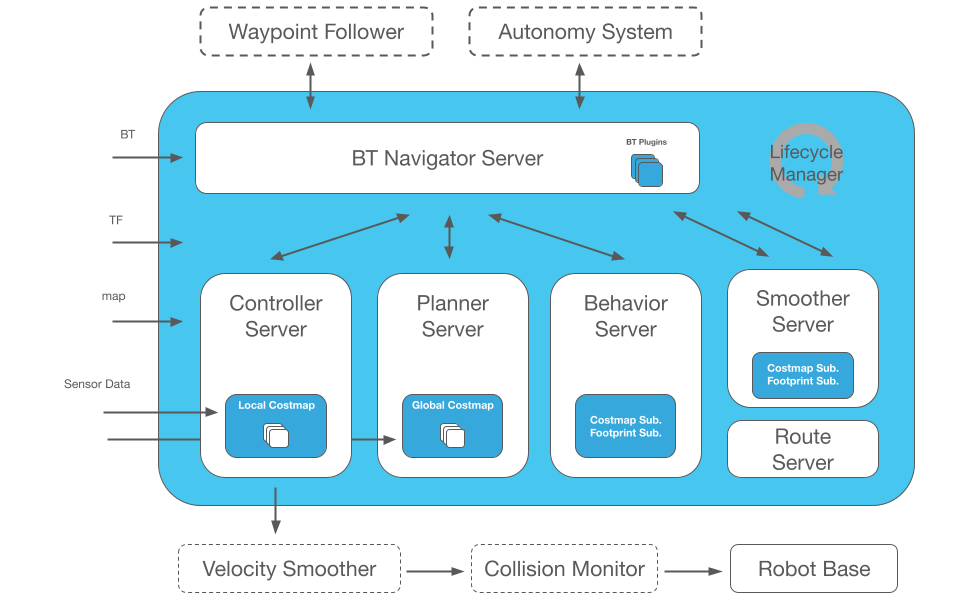
If you want to replace MOV.AI without depending on any vendor, build your own stack:
- ROS 2 Nav2 — navigation stack
- SROS 2 — security layer
- Grafana + Prometheus — monitoring
- micro-ROS — for embedded hardware
- Zenoh — distributed messaging to replace DDS
When DIY makes sense:
- Research lab — time is cheaper than licensing
- You want full control and zero vendor lock-in
- Very unusual use case that no SaaS platform covers
When it does not:
- Small team with limited DevOps engineers
- Need production-ready in weeks, not months
- No one to maintain when things break at 2am
Feature comparison
| Feature | MOV.AI | VnRobo | Open-RMF | Freedom Robotics | InOrbit |
|---|---|---|---|---|---|
| Visual behavior programming | ✅ FlowStudio | ❌ | ❌ | ❌ | ❌ |
| Multi-vendor AMR | ✅ | ✅ | ✅ | ✅ | ✅ (warehouse) |
| ROS 2 native | ✅ | ✅ | ✅ | ✅ | ✅ |
| VDA 5050 | ✅ | ⚠️ (API) | ✅ | ⚠️ | ✅ |
| Free tier / public pricing | ❌ | ✅ | Free OSS | ✅ | 3 robots |
| Setup time | Weeks–months | 2 min | Weeks–months | 5 min | 30 min |
| Mixed fleet (AMR + arms + drones) | ✅ | ✅ | ✅ | ✅ | ❌ |
| Integrated simulation | ❌ | ✅ MuJoCo | ❌ | ❌ | ❌ |
| Learning / Academy | ❌ | ✅ | ❌ | ❌ | ❌ |
| Self-serve signup | ❌ | ✅ | N/A | ✅ | ✅ |
| Live video streaming | ⚠️ | ❌ (roadmap) | ❌ | ✅ | ⚠️ |
Which should you pick?
- OEM or integrator building a robot product → stay with MOV.AI or evaluate Open-RMF
- End-user monitoring AMR warehouse fleet → InOrbit (enterprise) or VnRobo (SMB)
- Mixed fleet (AMR + arms + drones), need clear pricing → VnRobo
- Open-source mandate with strong DevOps → Open-RMF
- Monitoring only, need fast setup → Freedom Robotics
- Research lab with deep ROS background → ROS 2 Nav2 + DIY
Migration notes
Leaving MOV.AI is more complex than leaving a monitoring-only platform because you may have written robot behaviors in FlowStudio:
- Export and document behavior flows — FlowStudio has no standard export; document logic manually
- Rewrite behaviors in ROS 2 Nav2 behavior trees or Python state machines
- Install new platform agent in shadow mode alongside MOV.AI
- Test each scenario — path planning, obstacle avoidance, mission dispatch, edge cases
- Cut over robot by robot — never switch the entire fleet simultaneously
Expect 1–3 months depending on the complexity of behaviors written in FlowStudio.
# Install VnRobo agent on AMR (ROS 2)
pip install vnrobo-agent
vnrobo init --org YOUR_ORG_ID --token YOUR_TOKEN --robot-type amr
Frequently asked questions
Q: Is MOV.AI shutting down?
No. This comparison is about fit, not company stability.
Q: How does MOV.AI differ from Open-RMF?
MOV.AI is a commercial OS with proprietary FlowStudio. Open-RMF is an open-source framework focused on coordination — no behavior programming. Both are ROS-based but target different users.
Q: My team has no ROS background — what should we use?
Freedom Robotics or VnRobo — neither requires ROS expertise to get started. For VnRobo: pip install vnrobo-agent and you are connected.
Q: How much does MOV.AI cost?
MOV.AI does not publish pricing. Based on case studies and community reports, commercial fleet licenses typically start above $1,000/month. Contact their sales team for a quote.
Q: Will VnRobo agent conflict with MOV.AI?
No — they can coexist. VnRobo subscribes to ROS topics; MOV.AI continues controlling the robot. This is the standard shadow mode approach for migration testing.
Conclusion
MOV.AI is the right tool for the right user — OEMs and integrators who need to build robot software products. For everyone else — end-users operating fleets, SMB teams needing clear pricing, mixed-hardware fleets — the alternatives fit better.
For teams needing monitoring + lifecycle management in one account: VnRobo is free for 3 robots, 2-minute setup, no credit card.
For teams that need open-source multi-vendor coordination: Open-RMF is the right path if you have the DevOps budget to run it.