Imagine training an AI that can control a single-arm robot, a bimanual humanoid, and even a human hand — all from one single checkpoint, with no per-embodiment fine-tuning required. That's the problem UCAG-P solves.
On August 26, 2026, the Xiaomi Embodied Intelligence Team and University of Macau released "One Policy, Many Embodiments: Unified Camera-Centric Action Geometry Pre-training for Heterogeneous Embodied Manipulation" — a VLA framework achieving 98.3% on LIBERO and 89.2% on RoboTwin Hard using a single unified checkpoint without any benchmark-specific fine-tuning.
The Problem: Why Is Cross-Embodiment Hard?
Before diving into UCAG-P, it's worth understanding why training a single policy for multiple robot types is fundamentally difficult.
Each robot type has a completely different action space:
- Single-arm robots: actions are 6–7 joint angles or Cartesian velocity values
- Bimanual humanoids: two arms with 12–14 degrees of freedom each, plus hands
- Dexterous hands: tens of degrees of freedom across all fingers
When you try to merge data from all these embodiments, the fundamental question is: which action space serves as the common language? If you use a robot arm's joint angles, a human hand doesn't have those joints. If you use Cartesian coordinates, you still need a different mapping for each embodiment — and these mappings are far from trivial.
Most prior approaches solve this by:
- Training separate models for each embodiment → wastes resources, no transfer learning
- Using a fake "common" action space (e.g., residual actions) → loses embodiment-specific information
- Training only on robot data → ignores the massive corpus of human hand video demonstrations
UCAG-P proposes a fundamentally different answer: instead of finding a common action space, find a common geometric space that the camera can observe.
Core Idea: If the Camera Can See It, Use It
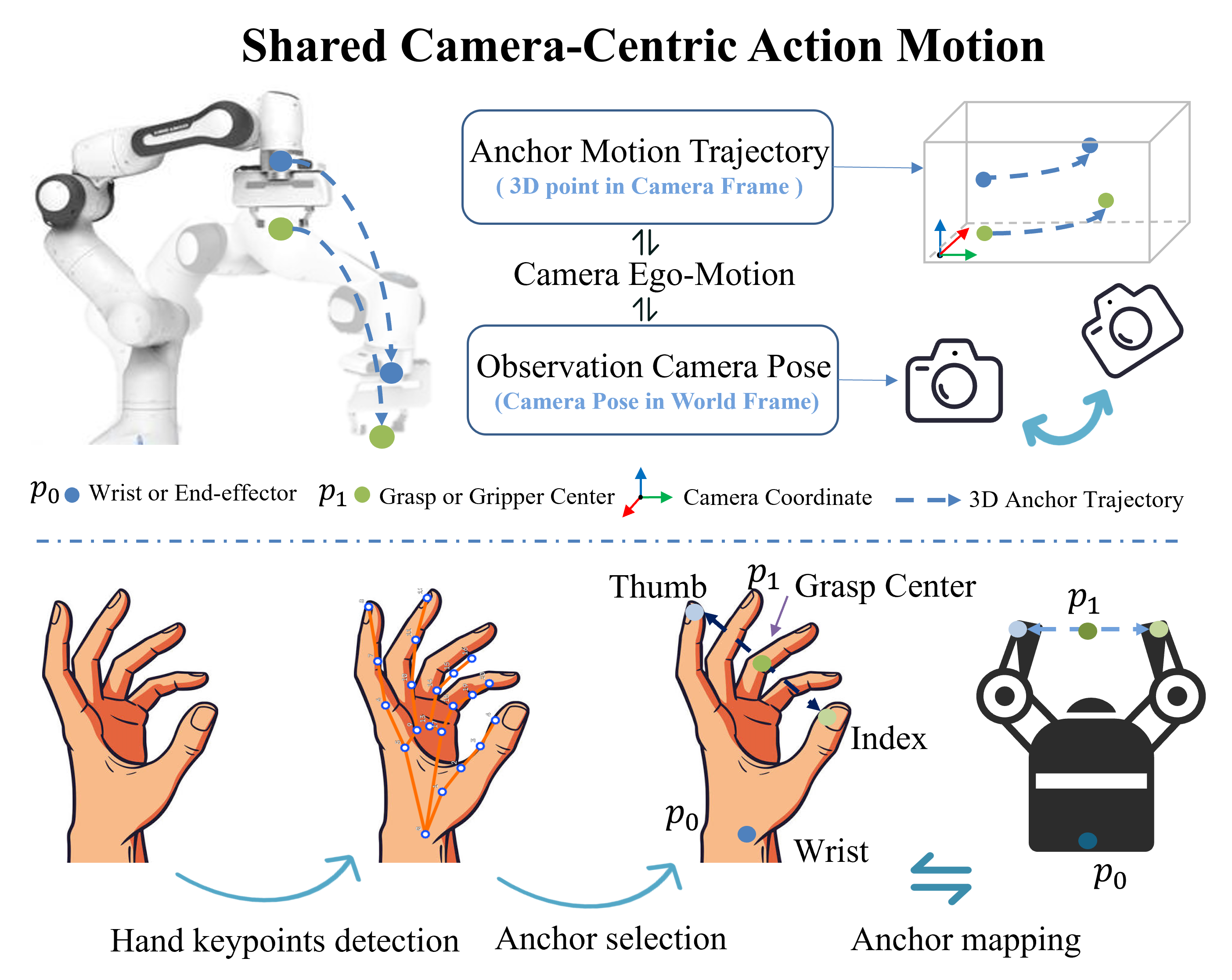
Regardless of whether it's a robot arm, a humanoid, or a human hand, a wrist-mounted or head-mounted camera will always observe the motion of the wrist tip and fingertip. This is exactly what UCAG-P exploits.
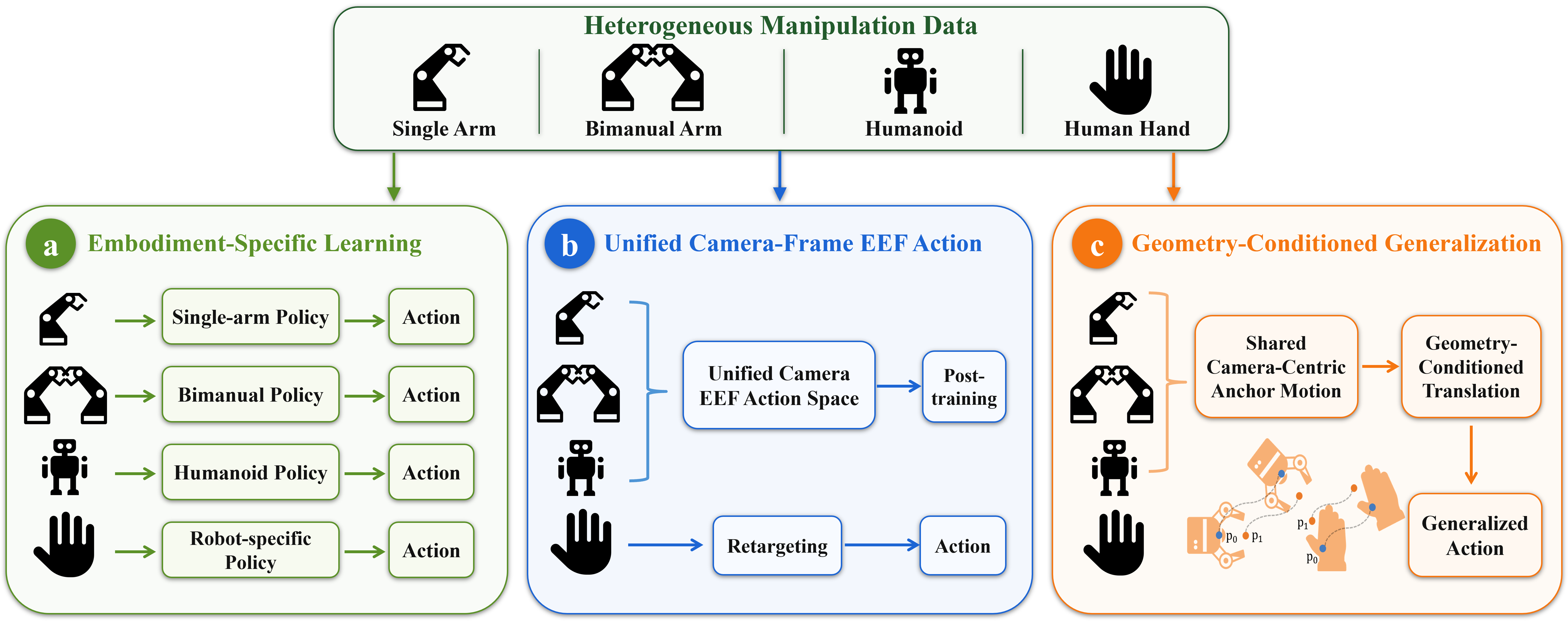
Instead of predicting joint angles or Cartesian velocity, UCAG-P predicts the motion of two anchor points in camera space:
- p₀: The wrist point or end-effector tip
- p₁: The gripper center or grasp center
These two points are always observable from the camera, whether it's a robot arm, a humanoid, or a human hand. A separate translator module then converts this geometric motion into embodiment-specific control commands.
This is a simple but powerful insight: camera-observable geometry serves as the bridge between embodiments.
UCAG-P Architecture: Three Components
UCAG-P consists of three main components:
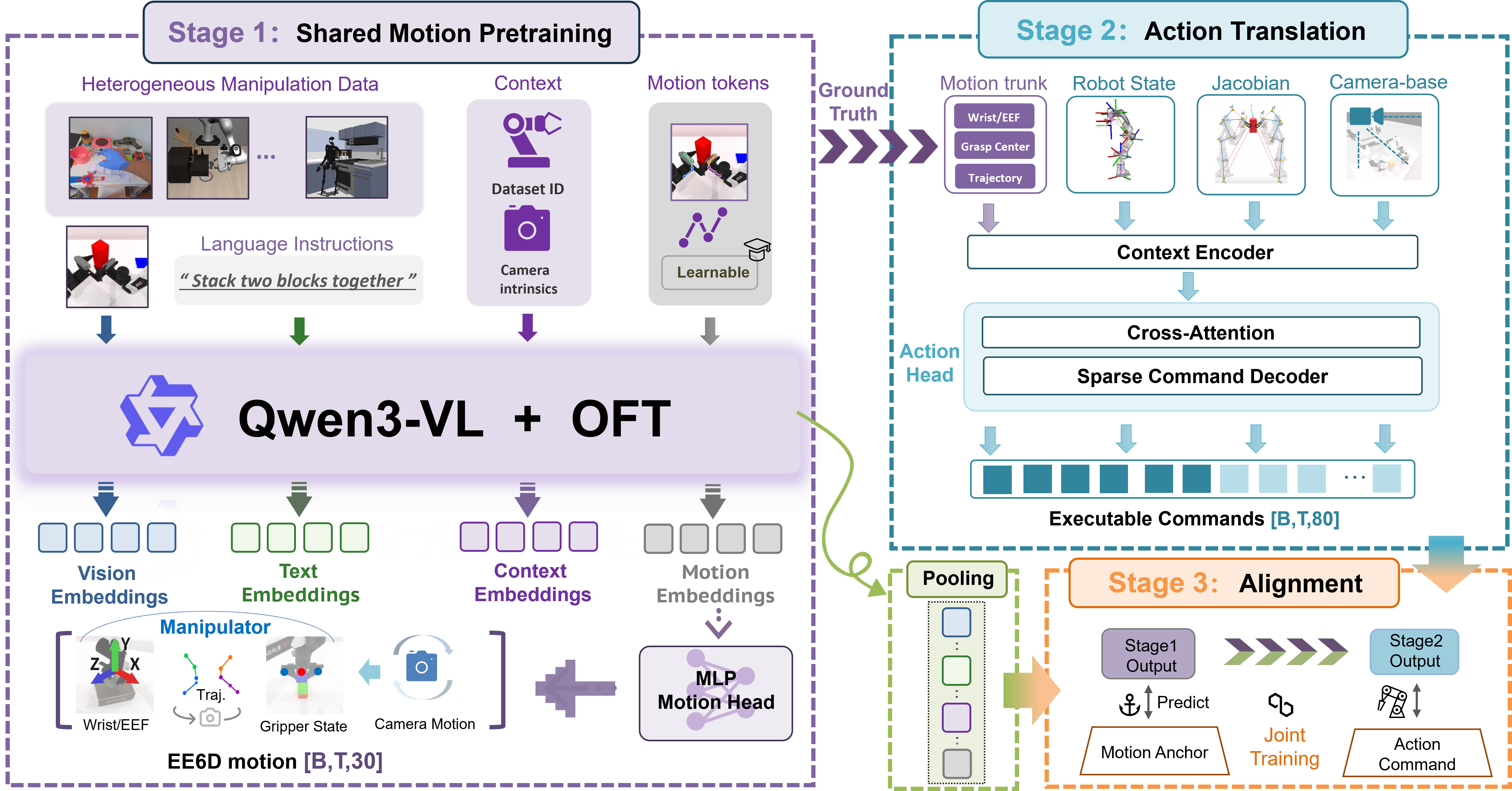
1. Vision-Language Backbone (Qwen3-VL-4B-Instruct)
UCAG-P uses Qwen3-VL-4B-Instruct as its backbone to encode multi-view RGB observations and language instructions. A key addition is learnable action-query tokens that extract compact features for action prediction, keeping the backbone from attending to the full visual context on every step.
The backbone processes:
- Multi-view RGB images from wrist and head cameras
- Language instructions as text tokens
- Outputs: hidden states + action-query features
2. Shared Camera-Centric Motion Head
This is the heart of UCAG-P — a shared motion head that predicts geometric action chunks for all embodiments.
The action vector has 30 dimensions per timestep:
- Left manipulator motion (10D): 3D displacement of p₀, 3D displacement of p₁, in-plane rotation, gripper state
- Right manipulator motion (10D): same structure
- Camera motion (10D): ego-motion of the camera
All displacements are measured relative to the first frame in the camera coordinate system — this ensures consistent representation across embodiments.
The motion head is trained with geometric supervision whenever camera-centric labels are available. Crucially, both robot data and human hand data can provide these labels — robots via forward kinematics, human hands via hand keypoint detection.
3. Geometry-Conditioned Action Translator
This is the "translation" module from geometric motion to embodiment-specific control commands. The translator receives:
- Predicted camera-frame motion (from the motion head)
- Camera-to-base transforms (from calibration)
- Local Jacobians (robot-specific kinematics)
- Geometry tokens: vectors encoding the embodiment structure
Geometry tokens tell the translator whether it's working with a robot arm, a humanoid, or a human hand. For robot arms, the translator applies Jacobian-based inverse kinematics to convert Cartesian motion to joint velocity. For humanoids, it processes both arms simultaneously.
Three-Stage Training Pipeline
UCAG-P doesn't train end-to-end in one shot. It follows a carefully ordered three-stage pipeline:
Stage 1: Camera-Centric Specialization
Train the VLM backbone + motion head on all data with geometric supervision. The goal: teach the model to predict camera-centric anchor motion accurately, regardless of embodiment.
At this stage, the translator is not involved — the model only learns "observe scene + instruction → predict p₀, p₁ motion in camera space."
Stage 2: Geometry-Conditioned Translation
Train the translator using ground-truth camera trajectories and executable command labels. This stage isolates the learning of the mapping from geometric motion to embodiment-specific commands.
The translator learns: "given this geometric motion and this robot's Jacobian → these joint velocities."
Stage 3: Joint Optimization
Jointly train the motion head + translator on mixed robot-human data. This mirrors inference-time conditions — the motion head predicts, the translator converts, and both are updated together.
The three-stage design matters: training everything from scratch simultaneously would allow gradients from the translator to corrupt the geometric representation being learned by the motion head.
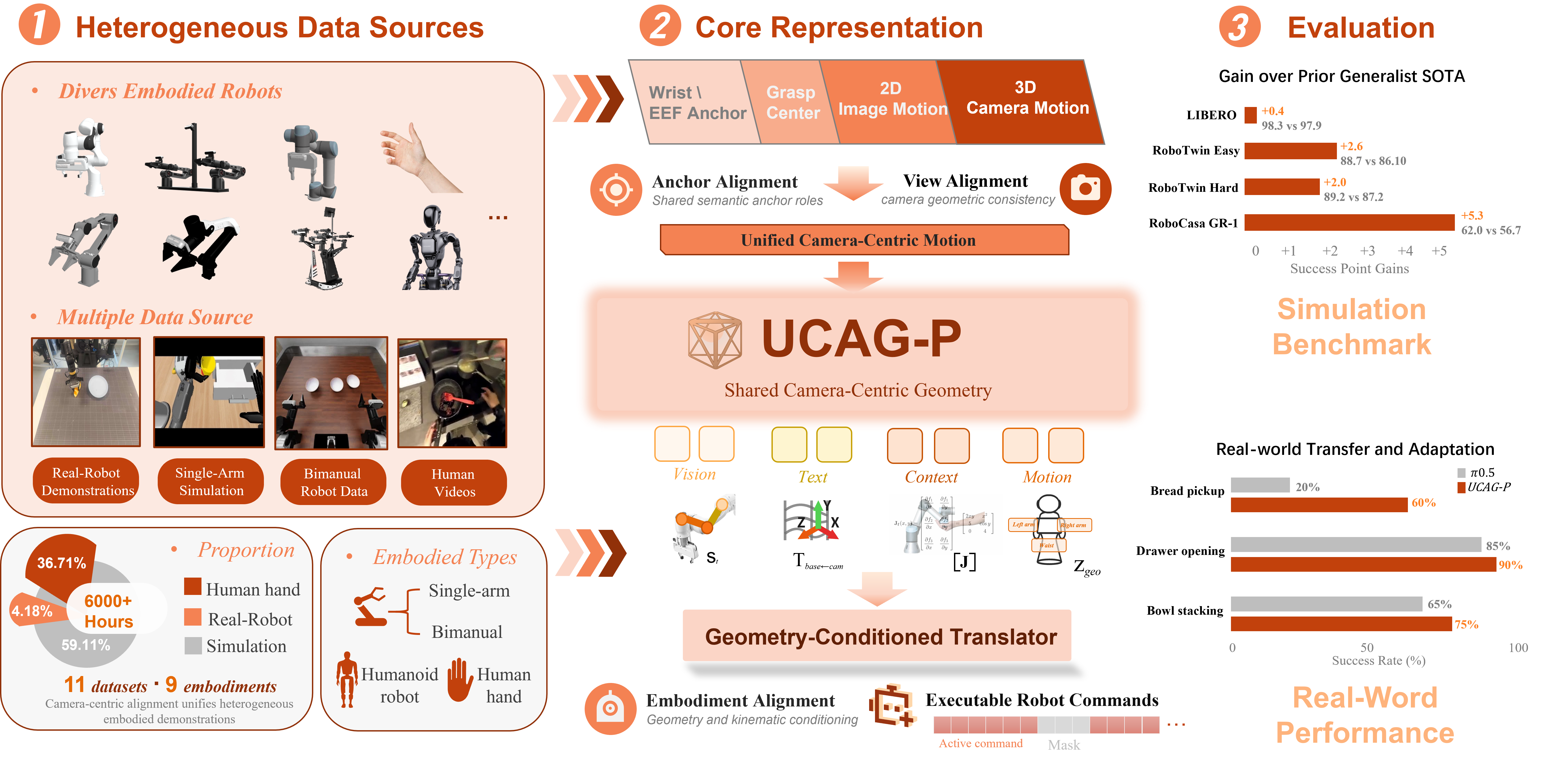
Training Data: 6,373 Hours from 11 Datasets
The scale of UCAG-P's training data is impressive:
| Type | Hours | Proportion | Sources |
|---|---|---|---|
| Real robot | 266.3h | 4.2% | RoboChallenge, RoboCoin, DROID |
| Simulation | 3,767.5h | 59.1% | RoboCasa GR-1, LIBERO, RoboTwin 2.0, InternData |
| Human hand | 2,339.7h | 36.7% | VITRA, EgoDex, EgoVerse |
| Total | 6,373.6h | 100% | 11 datasets, 9 embodiments |
The standout number is 36.7% from human hand data — not robot data at all. This is the key advantage of the camera-centric approach: egocentric hand videos from EgoVerse, EgoDex, and VITRA can be incorporated directly without teleoperation or complex annotation.
In the UCAG-P framework, human hands are treated as just another embodiment within the same geometric space. Human wrist keypoint → p₀, thumb-index midpoint → p₁. Their motion in camera frame is used identically to robot data.
Benchmark Results: State of the Art Across All Tests
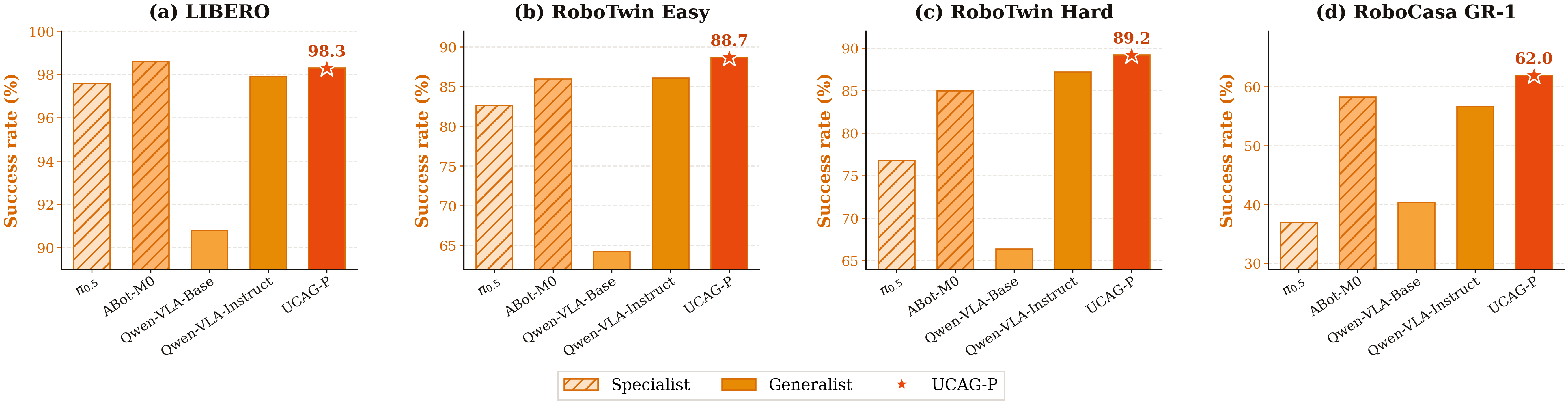
Single checkpoint, no benchmark-specific fine-tuning:
LIBERO (98.3% average):
| Subset | Score |
|---|---|
| LIBERO-Spatial | 98.8% |
| LIBERO-Object | 98.6% |
| LIBERO-Goal | 99.2% |
| LIBERO-Long | 96.4% |
| LIBERO Average | 98.3% |
Other benchmarks:
| Benchmark | Score |
|---|---|
| RoboTwin Easy | 88.7% |
| RoboTwin Hard | 89.2% |
| LIBERO-Plus (zero-shot) | 82.0% |
| RoboCasa GR-1 | 62.0% |
The most notable number is 82.0% zero-shot on LIBERO-Plus — a benchmark testing generalization with distractor objects and modified backgrounds. UCAG-P was never trained on LIBERO-Plus yet achieves 82%, demonstrating that camera-centric representation learns genuine geometric understanding, not just memorization.
On RoboTwin Hard (dual-arm manipulation with randomized distractor objects), UCAG-P achieves 89.2% — significantly higher than generalist baselines using native action spaces.
Real-World Results on Piper Robots
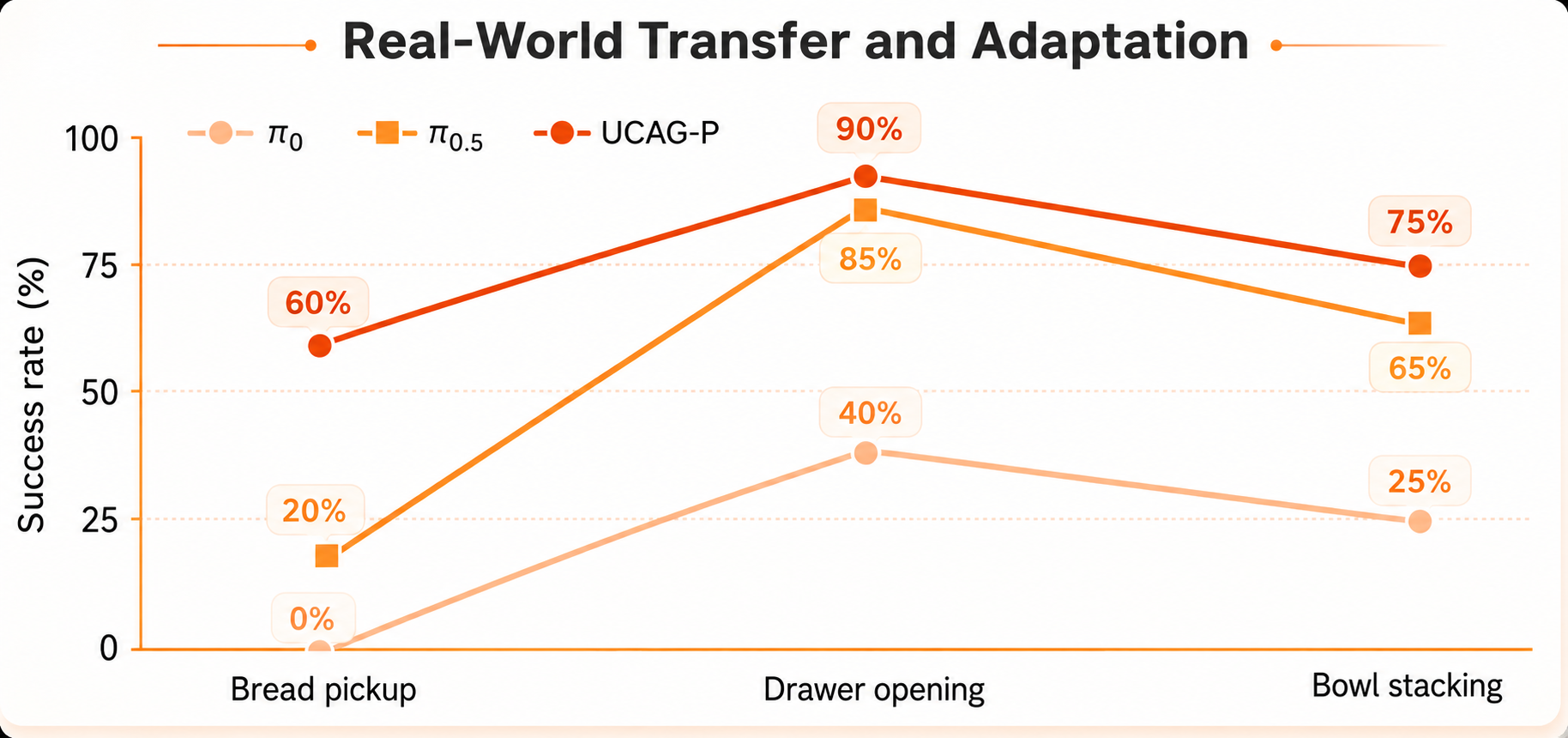
The authors also evaluate on physical Piper robots across three tasks:
| Task | Success Rate |
|---|---|
| Bread grasping | 60% |
| Drawer opening | 90% |
| Bowl stacking | 75% |
Drawer opening at 90% is particularly impressive — this task requires precise contact and force management, which is harder than picking up free objects. This validates that the geometric representation is accurate enough to handle contact-rich manipulation.
Cross-Embodiment Transfer
One of the most important tests: train on ALOHA, test zero-shot on ARX robot.
ALOHA and ARX are two bimanual robots with different kinematics — different workspace, different joint limits, different mechanical design. UCAG-P achieves 35% zero-shot success on ARX after training only on ALOHA data.
35% might sound low, but this is zero-shot — no ARX data in training whatsoever. A baseline using ALOHA's native joint angles would fail completely since the joints are incompatible. This demonstrates that camera-centric representation genuinely learns transferable manipulation geometry.
Human-to-robot transfer also works: UCAG-P can learn from human hand videos and transfer to a robot arm at 2× the data efficiency compared to using only robot demonstrations.
Limitations and Future Directions
The authors honestly acknowledge several limitations:
-
Camera calibration dependency: The geometry translator requires accurate camera-to-base transforms. If calibration is off, the translation is off too. This is a significant practical concern for deployment.
-
Hand keypoint detection quality: For human data, accurate wrist and finger keypoint detection is required. Dark videos or bad viewing angles cause keypoint failures → incorrect labels.
-
Extreme morphology mismatch: While the geometry translator helps, robots with very different kinematics (e.g., delta robots vs SCARA) remain challenging. 35% zero-shot is good but not yet production-ready.
-
Code not yet released: At the time of writing, code, model weights, and training scripts are not yet available. The authors have committed to releasing them at GitHub.
Comparison with Other Cross-Embodiment Approaches
UCAG-P isn't the first cross-embodiment approach. A quick comparison:
| Approach | Action Space | Human Data | Cross-embodiment Scope |
|---|---|---|---|
| DyPeS | Latent + Dynamics Prior | ❌ | Robot-to-robot |
| X-VLA | Embodiment token | ❌ | Robot-to-robot |
| HEX-VLA | Whole-body joint | Partial | Humanoid |
| UCAG-P | Camera-centric geometric | ✅ (36.7% of data) | Robot + Human + Humanoid |
UCAG-P's biggest advantage is leveraging human hand data — a massive corpus that almost every other cross-embodiment approach ignores. With 2,339 hours of EgoDex, EgoVerse, and VITRA, the model learns manipulation geometry from everyday egocentric videos without any teleoperation.
Preparing to Use UCAG-P
Code isn't released yet, but here's what to prepare:
Minimum hardware:
- GPU with 24GB+ VRAM for fine-tuning (RTX 3090/4090 or A100)
- Wrist camera at minimum 640×480 resolution
- Calibration setup to obtain accurate camera-to-base transforms
Data pipeline (4 steps):
- Episode indexing: Index all episodes by embodiment type
- Visual/language standardization: Normalize image formats, tokenize instructions
- Geometric alignment: Compute camera-centric anchor trajectories (p₀, p₁)
- Temporal windowing: Sliding window with masking for unavailable labels
Check out this guide on fine-tuning VLAs on LIBERO to get familiar with the training infrastructure before UCAG-P code drops.
Conclusion
UCAG-P represents an important paradigm shift in robot learning: instead of trying to align action spaces (which are hardware-specific), align through geometric observation (which the camera always provides).
The results — 98.3% LIBERO, 89.2% RoboTwin Hard, 82.0% zero-shot LIBERO-Plus from a single checkpoint — validate that camera-centric geometric representation is the right inductive bias for generalist robot policies.
But the most exciting insight isn't the benchmark numbers. It's the design philosophy: a human hand is just another embodiment. Once you erase that boundary, you unlock the ability to use millions of hours of ordinary egocentric video to train robots. That's a data leverage no other current cross-embodiment method has.
Paper: arXiv 2608.26058 — Project page: public-bots.github.io/UCAG-P