A humanoid lifting a box must coordinate much more than hand placement. Its feet need traction, its torso must remain balanced, and its arms must maintain contact while the object moves. When an arm blocks the camera for several frames, the controller still needs some understanding of what its previous action probably changed. A latent world model can help by retaining temporal information and predicting action consequences in a compact representation.
This tutorial examines DreamMimic: Learning Visuomotor Whole-Body Loco-Manipulation via World Model, by Jie Yin and Xingyu Lai, posted on arXiv in August 2026. The DreamMimic/DreamMimic repository contains implementation and training, testing and evaluation scripts. Its research angle is world-model-assisted policy distillation: transferring skills from a privileged teacher to a visual student. The controller is goal-conditioned; it is not a language-command VLA or a video diffusion WAM jointly generating actions and future video.
We will build the intuition first, inspect the released configuration, and then construct a staged reproduction workflow. Commands were checked against source available on October 8, 2026. This article does not claim that we retrained the model or independently measured its GPU benchmark results.
1. Why the current image is insufficient
Imagine two camera images that look almost identical: the humanoid's hands are beside a box. In one situation, the hands have not touched it. In the other, they are already pressing against it and carrying load. The appropriate next action can be different even though the visible geometry looks similar.
Partial observability means the available sensors do not reveal the complete system state. Proprioception describes the robot's own body, including joint configuration and motion. A latent state is a learned internal representation of information relevant to the task. Dynamics describes how a state changes when an action is applied.
A world model can combine sensor history with previous actions to maintain an internal state. For example, if the hand just pushed the box and the camera is now occluded, the action history provides evidence that the box may have moved. This is an uncertain prediction, not a replacement sensor that always knows the truth.
That distinction defines a useful research question: can predictive information help a visual student retain a teacher's contact skills over a long sequence? For a complementary approach to forecasting during loco-manipulation, see ω-0 and latent predictive world action models.
2. Connecting the teacher, student and world model
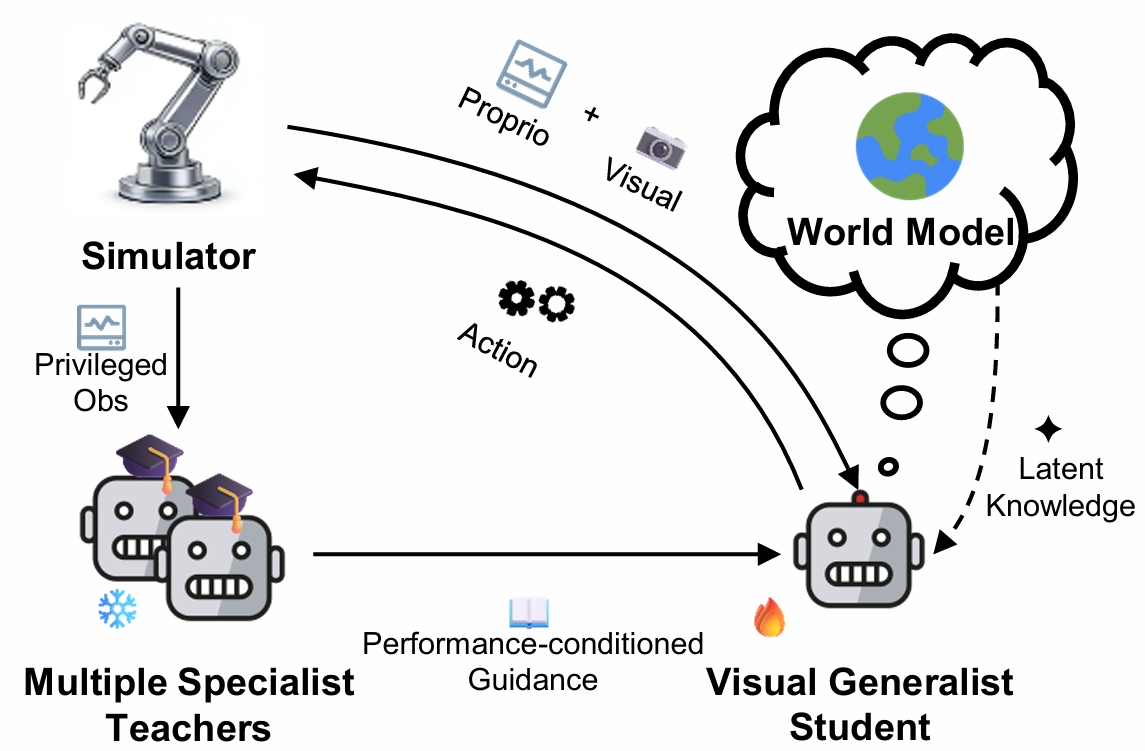
Source: the DreamMimic project page. Read the diagram as three components: teacher guidance, predictive world-model features and student action generation.
Think of the teacher as a coach with an overhead view of the entire practice area. Simulation makes information available that a robot camera cannot directly measure. The student must learn with a more limited sensor interface. Giving the student simulator ground truth would make training easier, but leave a missing input when the controller is deployed.
Separate goals from measurements. A goal specifies where an object should go or which trajectory the robot should track. A measurement estimates where the object is now. A target object pose in a task command is not the same as an exact current object pose supplied by the simulator. List these two input groups explicitly before building your observation tensor.
The released environment configuration uses depth and segmentation resized to 32 × 32 with two channels. Reference goals use horizons 1 and 16. Its RSSM has a 128-dimensional deterministic state and 32 categorical stochastic variables with 8 categories each. These values belong to this SMPL-X configuration; they are not universal dimensions for humanoid controllers.
Segmentation separates regions such as the robot, object and background, while depth provides distance structure. A physical-camera integration needs a pipeline that produces compatible inputs. Feeding ordinary RGB into a model trained on depth and segmentation changes the observation distribution rather than merely replacing the camera.
If you rent cloud GPUs for policy training, confirm Isaac Gym and the required graphics context work before selecting a larger instance. Parallel environments, sensor rendering, host RAM and binary compatibility all affect whether the system runs. VRAM alone does not answer that question.
3. RSSM: memory and prediction in latent space
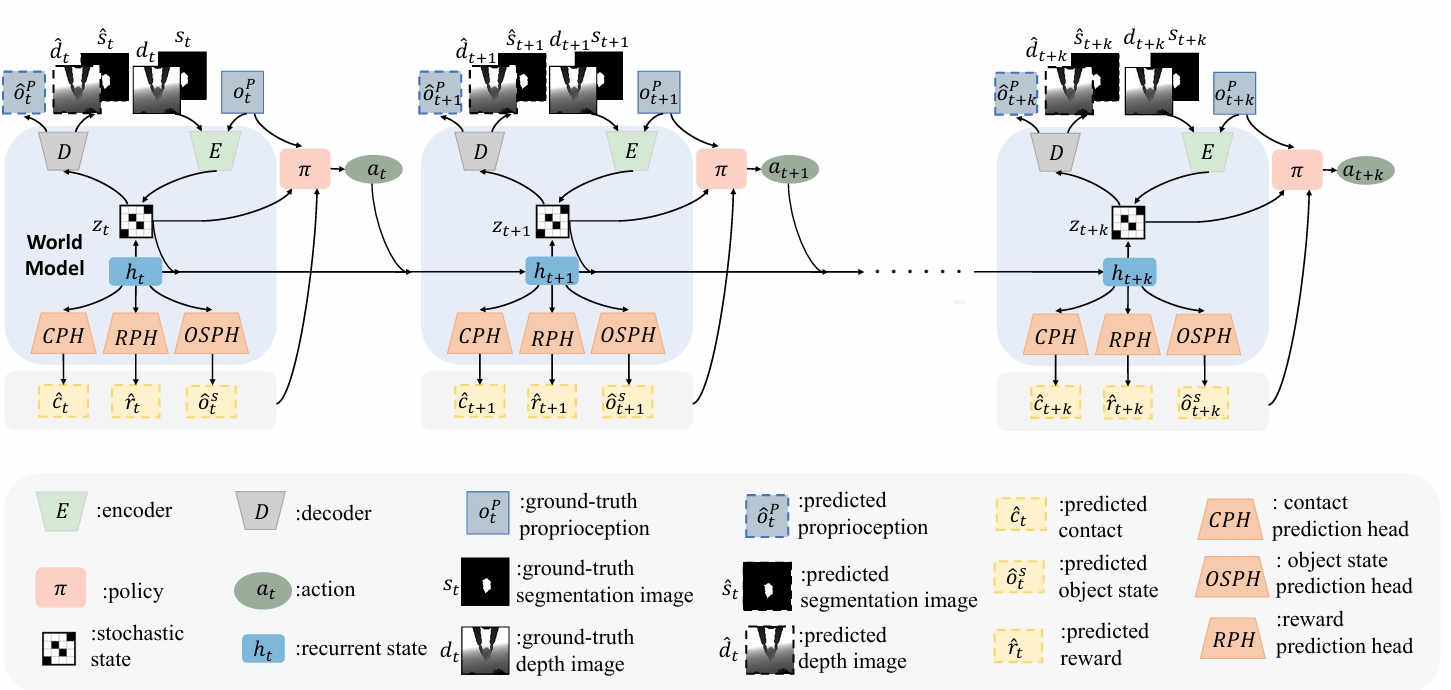
Source: the project's world-model diagram. Auxiliary heads provide learning signals and interaction features; reconstructed images are not control commands.
A Recurrent State-Space Model, or RSSM, combines deterministic memory with a stochastic representation. Call these components h and s. A recurrent transition updates memory using the previous state and action. A new observation then helps correct the internal estimate.
Current observation + previous action
                  |
                Encoder
                  |
         RSSM posterior update
                  |
     Memory h + prediction heads
                  |
 Proprioception/goal + feature fusion
                  |
            Student action
The posterior uses a new observation to update the latent state. The prior predicts without that new observation. These two operations explain how the same world model can follow incoming sensor data and also run a short prediction in latent space.
The student observation adapter constructs policy features from deterministic memory and predictions of reward, privileged state, contact and object state. The default dimension adds up to 128 + 1 + 164 + 1 + 13 = 307. The adapter caches previous actions, updates the latent state and resets memory for individual environments at episode boundaries.
Why add prediction heads? A representation trained to reconstruct images may preserve visual detail without preserving the interaction information that control needs. Predicting contact or object state supplies an additional reason to retain that information. However, a head's name is not evidence of its accuracy; its estimates still require evaluation.
The network builder processes feature groups before policy output. As a general design principle, separate projections help prevent one large feature vector from dominating another because of scale differences. When changing embodiments, check feature ordering and normalization as well as tensor dimensions.
4. Learning action consequences
Behavior cloning typically matches a student action to a teacher action at the current timestep. A small discrepancy during weight transfer can nevertheless produce a larger torso error later, causing the hands to lose contact. Action error can accumulate into state error.
The distillation agent adds multi-step latent supervision. Two predictions start from the same latent state, conditioned on student and teacher actions, and their resulting latents are compared. World-model parameters are frozen for this loss; gradients can still pass through the dynamics with respect to the student action. The default horizon is three steps.
For intuition, suppose the teacher lowers its torso before lifting a box, while the student lowers it slightly less. The immediate action difference might be small, yet predicted contact evolution could diverge. Latent supervision contributes a signal about that consequence. This example explains the algorithm; it is not a measured trajectory from the paper.
DAgger collects training examples at states the student actually visits. This matters because a weak policy can create situations absent from the original demonstrations. The teacher supplies reference actions at those new states instead of relying entirely on a fixed demonstration dataset.
Performance-Conditioned Guidance, or PCG, controls teacher involvement in rollouts. The released training configuration sets the teacher ratio between 0.30 and 0.80, performance target to 0.85 and imitation coefficient to 1. PPO has a 5,000-epoch warm-up, a 2,000-epoch ramp and final coefficient 0.10. These are release defaults, not training-time guarantees.
Monitor teacher and student rewards separately, alongside teacher environment ratio, action loss, latent loss and reset frequency. A mixed reward curve can improve because the teacher performs difficult segments while the student remains weak. A single aggregate scalar cannot distinguish those situations.
5. Installation: establish compatibility first
Start with the official README setup instructions. You need a suitable Linux NVIDIA GPU environment and Isaac Gym Preview 4. The dependency file pins many packages and includes isaacgym-stubs; stubs are not the simulator. Install Isaac Gym using the NVIDIA instructions linked from the README.
You can download the source archive without creating a Git checkout:
curl -L https://github.com/DreamMimic/DreamMimic/archive/refs/heads/main.tar.gz \
  -o dreammimic-main.tar.gz
tar -xzf dreammimic-main.tar.gz
cd DreamMimic-main
conda env create -f requirements.yaml
conda activate dreammimic
export LD_LIBRARY_PATH="$CONDA_PREFIX/lib${LD_LIBRARY_PATH:+:$LD_LIBRARY_PATH}"
The main archive can change. For reproducibility, download a commit archive and record the revision, dataset and configuration. The source tree inspected for this article had revision 36c81c83f4c271c04b38deb17ba5f13141395b59.
Inspect requirements.yaml: it pins Python 3.8.20, torch 2.4.1 and torchvision 0.19.1, and includes an absolute prefix from the author's machine. If dependency resolution or extension loading fails, preserve the first error and investigate driver, CUDA and Python compatibility. Upgrading everything simultaneously makes it harder to identify which component changed behavior.
After installing the simulator, test imports in the activated environment:
python -c "import isaacgym; import torch; print(torch.__version__); print(torch.cuda.is_available())"
A successful import does not establish that camera rendering works. Data replay is therefore a better next step than launching a long training run immediately.
6. Prepare data and checkpoints deliberately
The README links processed OMOMO motions, retargeting/correction data and teacher checkpoints. However, the student configuration inspected here uses InterAct/OMOMO and InterAct/OMOMO_retarget, while other configurations use InterAct/OMOMO_new. Match your selected configuration to the extracted files.
DreamMimic-main/
  InterAct/
    OMOMO/
    OMOMO_retarget/
  ckpts/
    teacher_omomo/
  dm_scripts/
  dreammimic/data/cfg/
This is an orientation diagram, not a complete dataset manifest. Renaming an unrelated directory to satisfy a path check does not make its motion and correction data compatible.
Run replay and inspect the teacher:
bash dm_scripts/data_replay_omomo.sh
bash dm_scripts/test_teacher_omomo.sh
For a custom checkpoint, use a real .pth path and the argument syntax in the script. Check object placement, body scale and contact timing before attempting student training. A teacher failing because assets are missing cannot provide useful supervision.
Checkpoint availability deserves a separate check. The README provides a teacher checkpoint link; a student testing script does not prove that every student weight is downloadable. Obtain a compatible checkpoint or train one. The fallback in common.sh copies an existing local legacy checkpoint into ckpts/. It does not fetch missing weights from the Internet.
7. Train the student in stages
Inspect the training wrapper before running:
# Pipeline smoke run; this is not a benchmark configuration.
bash dm_scripts/train_student_dreammimic.sh 64 checkpoints/dreammimic_smoke

# The wrapper defaults to 1024 parallel environments.
bash dm_scripts/train_student_dreammimic.sh 1024 checkpoints/dreammimic_full
The wrapper passes horizon length 16 and minibatch size 4096. The YAML contains minibatch size 2048, so read the command-line arguments and resolved configuration to identify the effective setting. Reducing environment count helps diagnose memory use, but also changes rollout volume. A small run is not automatically a paper reproduction.
During the first iterations, check that camera tensors are valid, the teacher loads, world-model learning starts after warm-up, and losses remain finite. Increase environment count only after these conditions hold. Record checkpoints, configuration, sample counts and seeds so later runs are comparable.
Organize validation around three questions. Does the student produce actions with the correct shape? Does the world model receive the correct previous action and episode reset? Does the student complete clips under its own control? Passing the first check does not establish the other two.
For an ablation, create a separate run with multi-step latent distillation disabled while holding other choices fixed. Compare multiple seeds on the same clip list. Comparing the best checkpoint of one method against an unconverged run of another gives a misleading result.
8. Inference and evaluation
Find the student checkpoint actually produced by your run. Replace the illustrative absolute path below with that file:
bash dm_scripts/test_student_dreammimic.sh \
  /absolute/path/to/student_checkpoint.pth 4 /tmp/dreammimic_test/custom

bash dm_scripts/eval_student_dreammimic.sh \
  /absolute/path/to/student_checkpoint.pth 64 /tmp/dreammimic_eval/custom false
The test wrapper defaults to mimic_best.pth; the evaluation wrapper defaults to mimic_bestv4.pth. Pass the same explicit checkpoint to avoid watching one model and evaluating another. The final false disables recording; use true to enable the wrapper's recording path.
Inference carries latent memory across observations and previous actions. Reset the corresponding memory when an episode starts. Otherwise, information about an object from the previous episode may contaminate the next one. A short selected video can make this bug surprisingly difficult to notice.
The agent checkpoint code stores a student_world_model field. When transferring checkpoints or writing a custom loader, verify that both the actor and world model are restored. Loading only the actor can produce correctly shaped actions while its input features no longer match training.
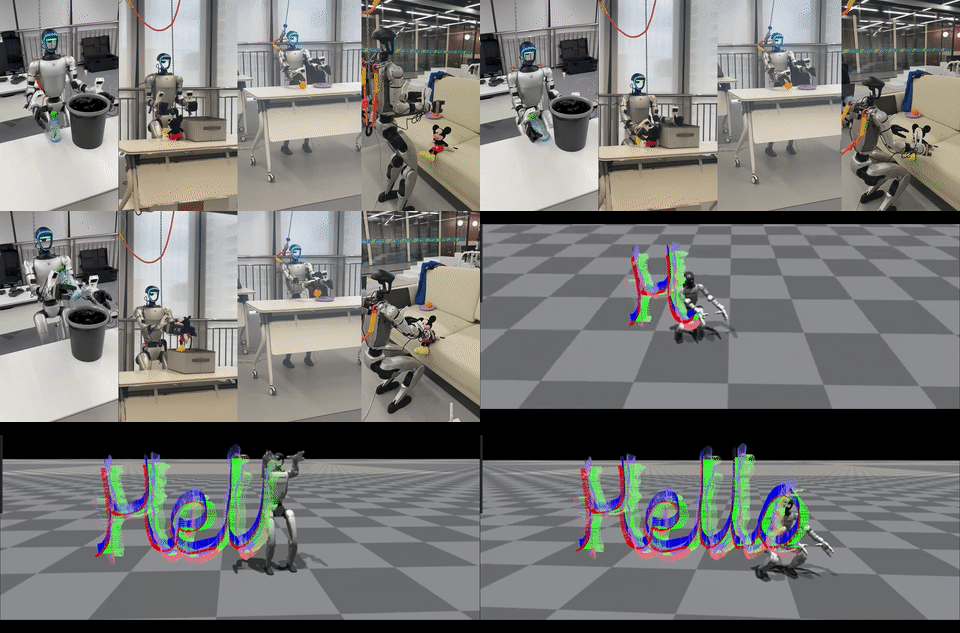
This video illustrates perception inputs in simulation. It is not evidence of execution on physical G1 hardware and does not replace quantitative evaluation.
9. Results and benchmark interpretation
Tables I and II in the paper report simulated reference tracking:
| Setting | Method | Success | Robot error | Object error |
|---|---|---|---|---|
| OMOMO | ResNet-18 + DAgger+RL | 72.6% | 7.8 cm | 9.7 cm |
| OMOMO | DreamMimic | 92.2% | 5.4 cm | 8.8 cm |
| OMOMO, mass ×5 | DreamMimic | 41.2% | 8.1 cm | 14.8 cm |
| BEHAVE, PCG | DreamMimic | 72.7% | 10.2 cm | 13.3 cm |
Success means successfully tracking a reference clip. For early termination, tracking errors cover executed frames only. Morphology and simulator changes are qualitative tests; these numbers do not establish physical-robot success rates.
As an evaluation principle, read success together with duration and error. A policy that stops before the hardest segment can have low error on the easy frames it completed. Similarly, a selected demonstration video does not reveal failure frequency across the complete clip set.
Mass stress testing has practical value because an object with unchanged appearance can require different coordination when heavier. In your own report, separate nominal and stress results. Combining them into one average can hide the controller's load limitations.
10. What comes before physical deployment?
A sensible next experiment reproduces the student on the original simulated embodiment, then measures sensor and controller changes individually. Changing camera inputs, action timing and actuators simultaneously makes failures difficult to attribute.
You need a deployment-time goal interface, a consistent depth–segmentation pipeline and an action mapping that matches the physical controller. Also verify normalization, joint ordering, observation frequency and memory reset when tasks change. These are integration requirements inferred from the system structure, not a sim-to-real recipe proven by this paper.
DreamMimic offers a useful design idea: a world model can support policy learning through interaction memory, action-conditioned prediction and supervision about consequences. For beginners, replaying data, checking the teacher, running a small student job and designing a controlled ablation form a productive sequence. Each stage produces concrete evidence before a larger training investment.