
You open a new autonomous driving paper. The title contains end-to-end. The abstract mentions BEV planning, VLA, world model, privileged distillation. All are labeled "autonomous driving," but they work in fundamentally different ways — and authors rarely explain why.
The problem is not that these terms are wrong. The problem is that we lack a shared framework for asking consistent questions when comparing systems.
This article builds that framework: a four-axis taxonomy borrowed from the survey Planning-Oriented End-to-End Autonomous Driving: Architectures, Evaluation, and Emerging Paradigms (Guan et al., arXiv:2608.20111, August 2026) — one of the most comprehensive surveys in this field to date — combined with VLA-specific taxonomy from Vision-Language-Action Models for Autonomous Driving: Past, Present, and Future (Hu et al., arXiv:2512.16760v2, December 2025).
No benchmark numbers in this article — that is the job of article 3. The value here is defining terminology so you do not get lost reading the next five articles.
Series Roadmap: End-to-End Autonomous Driving 2026
This series moves from foundations to research frontiers, structured as: vocabulary → runnable code → reading numbers correctly → flagship system → frontier research → real fleet data.
| Article | Content |
|---|---|
| Article 1 (this one) | Four-axis taxonomy — the vocabulary for reading any paper in this field |
| Article 2 | OpenDriveVLA on nuScenes — the first genuinely runnable academic VLA, step by step |
| Article 3 | NAVSIM E-PDM vs Bench2Drive — why these two numbers cannot be compared directly |
| Article 4 | NVIDIA Alpamayo — chain-of-causation reasoning and the 2026 VLA flagship |
| Article 5 | World models for driving — SUV, OmniDreams, WorldLens benchmark |
| Article 6 | Waymo 220.6M miles, Baidu 3.2M driverless rides — when real fleet data meets benchmarks |
Historical Context: UniAD and VAD
Before the four-axis framework, we need two historical anchors.
UniAD — Planning-Oriented Unified Architecture (CVPR 2023 Best Paper)
Hu et al. proposed a Transformer architecture that jointly handles multiple tasks in a single network: tracking, mapping, motion prediction, occupancy prediction, and ultimately planning. Rather than a modular pipeline — perception → prediction → planner — UniAD learns everything together, optimized toward the planning objective.
Two key insights from UniAD:
- Joint optimization improves planning more than optimizing each module separately. When perception and planning are trained together, perception learns to focus on what matters for planning — not every pixel.
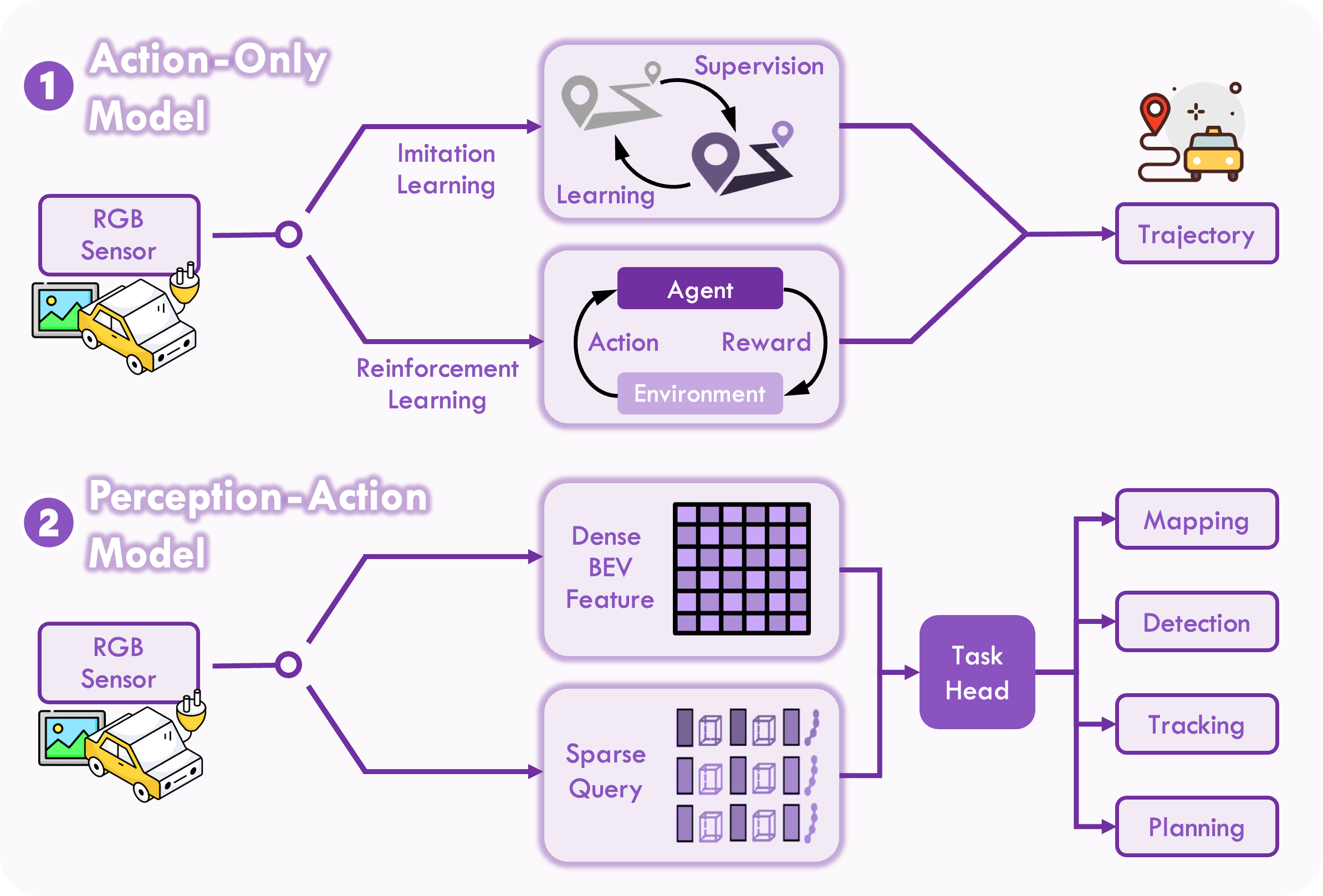
- BEV (Bird's Eye View) is a natural representation for fusing multi-camera information. From 2D images at multiple angles, the model learns to construct a top-down map in metric space.
VAD and VADv2 — Vectorized Scene Representation (ICCV 2023)
Jiang et al. inherited UniAD's philosophy but shifted from dense BEV to vectorized scene representation. Instead of maintaining a full BEV grid, VAD models the environment as entity vectors — dynamic agents, lane boundaries, forbidden zones. Simpler architecture, faster inference.
VADv2 pushed further with probabilistic planning: instead of outputting a single trajectory, it outputs a probability distribution over a set of candidate trajectories. This was an early step toward modeling uncertainty in driving decisions.
By 2024–2026, both UniAD and VAD had become baselines — the starting point, not the destination. The research question had shifted. To understand why, you need the four-axis taxonomy.
The Four Axes
Survey arXiv:2608.20111 organizes every end-to-end driving system along four axes. This is not an architecture classification (transformer vs CNN, BEV vs vector) — it is a classification by function in the decision-making process.
The authors deliberately chose functional classification because the same architecture (e.g., a transformer) can serve multiple roles depending on how it is trained and evaluated. Architectural labels alone do not tell you what the vehicle is actually learning or being measured on.
Axis 1: Input Representation — What Does the Car See?
This covers the raw sensor data and how it is encoded before being fed to the model.
| Type | Example Systems | Characteristics |
|---|---|---|
| Camera + BEV | BEVFormer, BEVDet | Multi-camera images, IPM/transformer builds 2D BEV |
| Tokenized scene | UniAD, VAD | Queries/vectors representing agents, lanes, regions |
| LiDAR point cloud | CenterPoint, BEVFusion | 3D point cloud, often fused with camera |
| Sensor fusion | BEVFusion, SparseFusion | Camera + LiDAR in a shared feature space |
| Language-augmented | DriveVLM, OpenDriveVLA | Visual tokens combined with text tokens from a VLM |
The key insight: input is not just raw sensor data. The encoding determines what the model can learn. A dense BEV grid carries information everywhere but is computationally expensive; sparse queries attend only to important entities but may miss ambient context. Language-augmented input opens up reasoning capabilities but requires vision-language alignment to work well.
No encoding is universally best — each choice is a tradeoff.
Axis 2: Planning Output (Output Space) — What Does the Car Decide?
This is what the model produces and how it gets converted to control commands.
| Output Type | Examples | Description |
|---|---|---|
| Low-level control | ALVINN (1989), vanilla BC | Direct steering angle, throttle, brake |
| Waypoints | UniAD, VAD, Senna | A sequence of (x, y) coordinates over time |
| Trajectory distribution | VADv2, DiffusionDrive | Probability distribution over candidate trajectories |
| Structured plan | PDM-Closed, Ego-MoE | High-level decisions (lane change, speed target) |
| Language action | DriveVLM, OpenDriveVLA | Action generated through a language decoder |
The 2025–2026 trend has moved from single waypoints → trajectory distributions → language-conditioned actions. The reason: single waypoints cannot represent uncertainty. At a complex intersection, the correct answer is not one trajectory — it is a distribution over safe trajectories, with the strongest mode selected after checking additional constraints.
Axis 3: Supervision Signal — What Does the Car Learn From?
This covers the objective function and label source during training.
| Supervision Type | Technique | Key Characteristic |
|---|---|---|
| Behavior Cloning (BC) | Imitation learning | Copies human driver trajectories |
| Conditional Imitation | CIL, CILRS | BC conditioned on commands (turn left/right/straight) |
| Privileged Distillation | Roach, TCP | Learns from a teacher with privileged info (GT lidar, HD map) |
| RL with reward function | InterFuser-RL | Optimizes a reward function in simulation |
| World model supervision | GAIA-1, DriveDreamer | Predicts future states to supervise planning |
| Language supervision | VLA models | Instruction following + reasoning chains |
The core problem with vanilla Behavior Cloning: Human drivers never show you what they would do if the car were about to hit a wall — because they do not let that happen. BC only has data from normal situations. The model is trained on easy cases and expected to handle hard ones. Privileged distillation addresses this partially by letting the student model learn from a teacher that has ground-truth access. World model supervision takes a different approach: forces the model to predict the future accurately, making good planning synonymous with predictions of a good future state.
Axis 4: Evaluation Protocol — How Are Results Measured?
This is the most commonly overlooked axis in paper comparisons — and the one that causes the most confusion.
| Protocol | Typical Metric | Core Limitation |
|---|---|---|
| Open-loop | L2 displacement error, log-based collision rate | Car never actually drives; trajectory is compared to human log |
| Closed-loop simulation | DrivingScore (DS) in CARLA | Car actually drives; other agents react |
| Non-reactive replay | nuPlan closed-loop | Real logs but other agents do not respond |
| Long-tail testing | NAVSIM E-PDM Score | Test set focused on rare, difficult scenarios |
| Human preference | Win-rate via pairwise comparison | Evaluated by humans or VLM-as-judge |
The central claim of survey 2608.20111: Low open-loop L2 error does not imply good closed-loop performance. There are documented cases of the opposite: models with excellent open-loop scores performing poorly in closed-loop evaluation because they never learned to respond to the actions of other agents — something that only emerges when the car actually drives. Article 3 of this series is dedicated entirely to reading benchmark numbers correctly.
VLA Taxonomy: The Fastest-Moving Segment
Survey arXiv:2512.16760v2 provides a dedicated taxonomy for the VLA (Vision-Language-Action) family — the group attracting the most research attention in 2025–2026.
VLA systems for autonomous driving split into two main branches:
1. End-to-End VLA: A single model handles everything from camera pixels to control commands. Vision, language instructions, and actions are processed within a single unified architecture. The advantage is uninterrupted information flow from perception to action. The disadvantages are difficulty enforcing safety constraints, high latency, and limited ability to fine-tune individual components.
2. Dual-System VLA: Two-layer separation. A heavy, slow VLM ("System 2" in cognitive science terminology) handles reasoning and high-level decision-making. A small, fast planner ("System 1") handles real-time control. This architecture mirrors how human driving works — slow deliberate thinking for complex situations, fast reflexes for emergency braking.
Dual-system examples: DriveVLM (VLM + motion planner), Senna (VLM advisor + IL planner).
Within each branch, further divisions exist by action generator type (textual vs numerical output) and guidance mechanism (explicit scene description vs implicit embedding fusion).
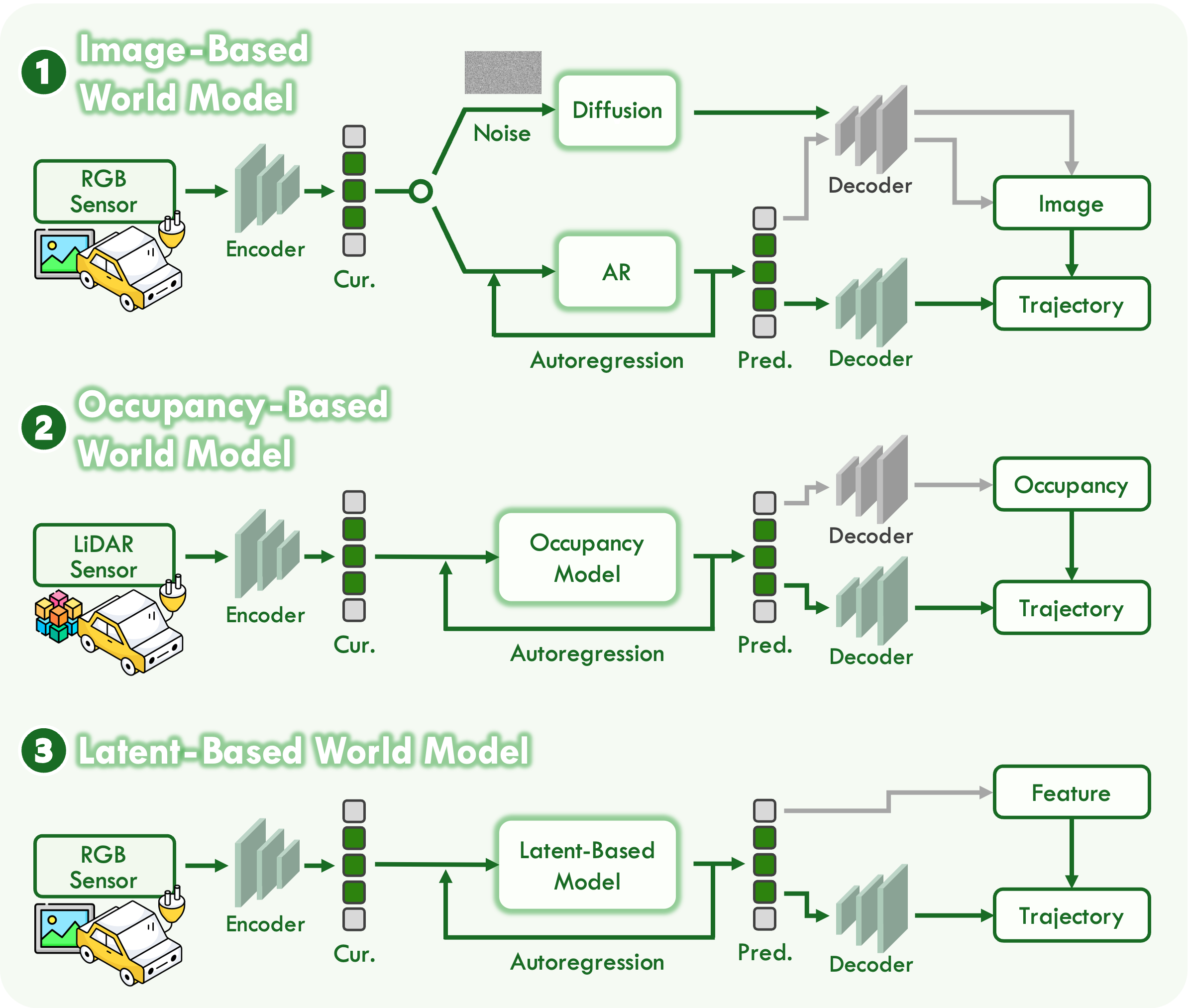
World models are emerging as a critical supervision component (Axis 3). Instead of relying solely on BC from human logs, the model is trained to predict future world states — and good planning is defined as planning that leads to good future states. Article 5 of this series covers this component in depth.
Why "Having Intermediate Representations" Is the Wrong Question
A common misconception: "truly end-to-end" means no intermediate representations — camera pixels go directly to steering angle.
Survey 2608.20111 argues the opposite: intermediate representations are not the issue — how they are learned and evaluated is.
UniAD has BEV representations, occupancy maps, motion predictions — all intermediate representations. But they are learned end-to-end alongside the planning objective, supervised by ground-truth perceptual labels, and the entire pipeline serves one ultimate goal: safe planning. This is "end-to-end" in the sense that matters.
Conversely, a model that outputs waypoints directly from cameras (no explicit intermediate representation) but is trained with vanilla open-loop BC and never tested in closed-loop — that model may look "more purely end-to-end" architecturally, but does not actually guarantee better safety.
The right question when reading any paper: Are the intermediate representations supervised to serve planning and evaluated under an appropriate protocol?
Community Catalog: awesome-vla-for-ad
If you want to track the full ecosystem, the community repository awesome-vla-for-ad (465 stars, updated 2026-08-21) is maintained by the team behind arXiv:2512.16760. It aggregates papers, datasets, benchmarks, and code following the survey taxonomy — useful as a navigational index when you want to locate a specific system within the broader landscape.
The Four Questions to Ask When Reading the Next Paper
Distilling the four-axis taxonomy into four practical questions:
1. Input: What does the car see and how is it encoded?
- Camera only or also LiDAR? Dense BEV or sparse tokens? Language input?
2. Output: What does the car decide and at what level?
- Direct control, waypoints, trajectory distribution, or language-conditioned action?
3. Supervision: What signal does the car learn from?
- Vanilla BC, privileged distillation, RL, world model, or language supervision?
4. Evaluation: Under what conditions are results measured?
- Open-loop or closed-loop? Which simulator? Long-tail or standard distribution?
These four questions — not the model name or parameter count — are what you should ask every time you encounter a new autonomous driving paper. And they are the shared vocabulary this series will use from Article 2 through Article 6.

