
Why the Old Metric Is Not Enough Anymore
Until roughly 2023–2024, a good autonomous driving world model was defined simply: generate video that looks like real footage. FID (Fréchet Inception Distance), FVD (Fréchet Video Distance), PSNR, SSIM — these metrics measure the distributional distance between generated and real frames. Whoever had the lowest FVD won the leaderboard.
The problem: low FVD does not mean you can use that world model to train or evaluate a driving policy. Imagine a model that generates stunningly textured rain-soaked streets — but when you ask "if the ego vehicle steers 5 degrees left, what happens to the truck ahead?", it might generate the same beautiful rain-soaked street, completely ignoring the causal link between steering and environment response.
That is the core question behind the conceptual shift this article examines: a world model is not a scene-generation tool — it is a policy-measurement tool. And these two requirements impose completely different constraints on architecture, training data, and evaluation criteria.
To generate pretty video, you need strong perceptual loss and a discriminator. To measure a policy, you need causal fidelity — the generated environment must react correctly to each agent decision, including counterfactual situations that never occurred in the real dataset.
Four 2026 works illustrate four facets of this shift: OmniDreams (NVIDIA, fully open-source — both policy and simulator), GAIA-4 (Wayve, no paper, industry tech report), Orbis 2 (University of Freiburg, reproducible academic work), and WorldLens (the necessary counterpoint: even the best model scores only 2–3/10 on human realism).
Pillar 1 — OmniDreams: A 2B-Parameter World-Action Model Beats a 10B-Parameter VLA
OmniDreams generates action-conditioned video sequences at 68 FPS in real time — source: arXiv:2606.03159
NVIDIA published OmniDreams (arXiv:2606.03159v2, released 2026-06-02, revised 2026-07-23) as a foundation generative world model mid/post-trained from the Cosmos diffusion model on 21,000 hours of driving scenarios. Training data includes extreme weather, unusual agent behavior, and rare road conditions that typical datasets underrepresent.
The most notable technical contribution is not video quality. It is the World-Action Model (WAM) — a variant of OmniDreams post-trained to simultaneously generate the environment and output driving actions in a single forward pass. Instead of separating "scene generation" and "action selection" into two distinct components, WAM handles both jointly and shares the same internal representation of world state.
Results on the Physical AI AV NuRec benchmark: WAM (≈2 billion parameters) outperforms Alpamayo 1.5 — NVIDIA's largest VLA research policy at approximately 10 billion parameters — using only 1/5 the parameter count:
| Collision Metric | Alpamayo 1.5 | OmniDreams WAM |
|---|---|---|
| Total collisions | 6.9% | 4.2% |
| Front collisions | 1.0% | 0.9% |
| Lateral collisions | 0.6% | 0.4% |
| Rear collisions | 5.3% | 3.0% |
What does this mean architecturally? When the world model and action head are trained jointly, the model is forced to learn world-state representations that serve decision-making, not just looking realistic. This is the difference between "representations to reconstruct" and "representations to plan from".
Real-Time Performance
Inference speed is not sacrificed: single-view runs at 68 FPS at 720p (704×1280) on a single GB300 GPU; four simultaneous cameras achieve 105 effective FPS per camera with 16 GB300 GPUs, using 2-step diffusion.
The architecture achieves this efficiency through factorized attention: splitting attention along temporal (per-view, within each camera stream) and spatial (cross-view, between cameras) dimensions, reducing complexity from O(N²T²) to O(NT²) + O(N²), where N is the number of cameras and T is the number of frames.
A Complete Closed Loop — All Three Components Open-Source
OmniDreams, combined with Alpamayo-R1 (policy with Chain-of-Causation reasoning) and AlpaSim (scenario orchestrator), forms a fully closed evaluation loop:
Policy (Alpamayo)
    ↓  driving actions
Orchestrator (AlpaSim)
    ↓  scenario + initial conditions
Generated Environment (OmniDreams)
    ↓  next frame
    └──────────────────────────────┘
All three components are open-sourced. In the AV industry, this is genuinely rare — typically only the policy model is shared while the simulator remains proprietary. The OmniDreams repo currently has 314 stars on GitHub: github.com/nv-tlabs/omni-dreams (renamed to Cosmos-Dreams); model weights are on HuggingFace at nvidia/omni-dreams-models.
Pillar 2 — GAIA-4: Wayve Redefines "Fidelity" Across Three Tiers
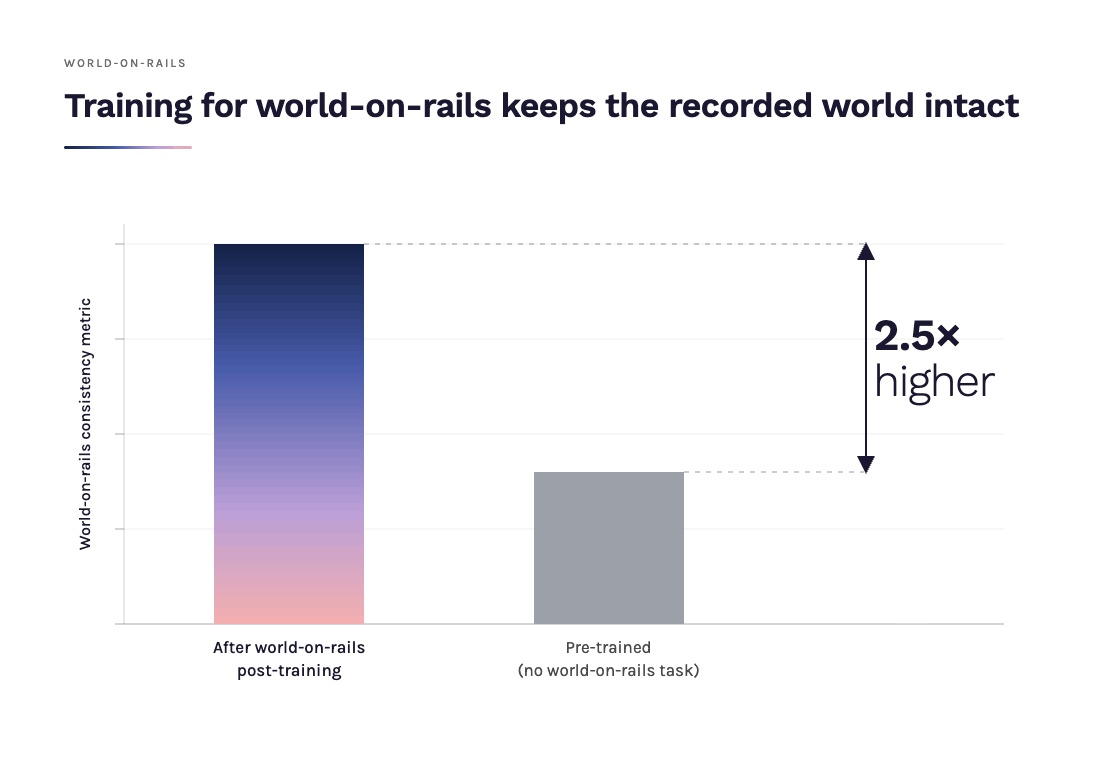
Wayve published GAIA-4 as a technical blog post on 2026-08-03. Before diving in: there is no accompanying paper and no code release. This is an industry technology report — not reproducible academic research. In the research community, these two types of disclosure require different treatment and citation practices.
With that said, GAIA-4 contains technically substantive observations, particularly around how Wayve thinks about simulator "fidelity".
The World-on-Rails Constraint
Core idea: when replaying a real-world scenario, all surrounding vehicles and pedestrians maintain exactly the behavior recorded in the real data log. Only the ego vehicle changes according to the model's actual decisions.
This sounds like a limitation, but it is intentional design. If you allow surrounding agents to react to the ego's decisions, you must model everyone's behavior simultaneously — doubling sources of uncertainty and obscuring the evaluation signal. World-on-rails isolates the control variable: only the ego policy changes; everything else is held fixed. Result: 2.5x fidelity improvement over a general-purpose world model without this constraint.
Industry-First: Synthetic Radar Synchronized with Camera
GAIA-4 is the first system in the AV space to generate synthetic radar alongside camera output, including Doppler velocity relative to the ego vehicle. This matters because real AV systems rely heavily on radar for estimating the relative speed of surrounding vehicles and tracking objects in low-light conditions. Evaluating a policy only on synthetic camera frames means testing a fundamentally different sensor stack from what runs on the actual vehicle — a gap that can create false confidence.
Three-Tier Fidelity Framework
Wayve defines three evaluation levels, from coarse to fine:
- Outcome fidelity — Do simulation outcomes (collision? avoidance?) match real-world results?
- Closed-loop fidelity — Are system outputs consistent with real on-road driving behavior?
- Component fidelity — Are individual simulator elements valid (3D realism, radar accuracy)?
This three-tier framework is really an answer to "what should we measure?" — not FVD, but policy behavior under controlled counterfactual conditions. It reflects the thinking of an engineering team deploying real systems, not researchers optimizing benchmark scores.
Pillar 3 — Orbis 2: The Reproducible Academic Recipe
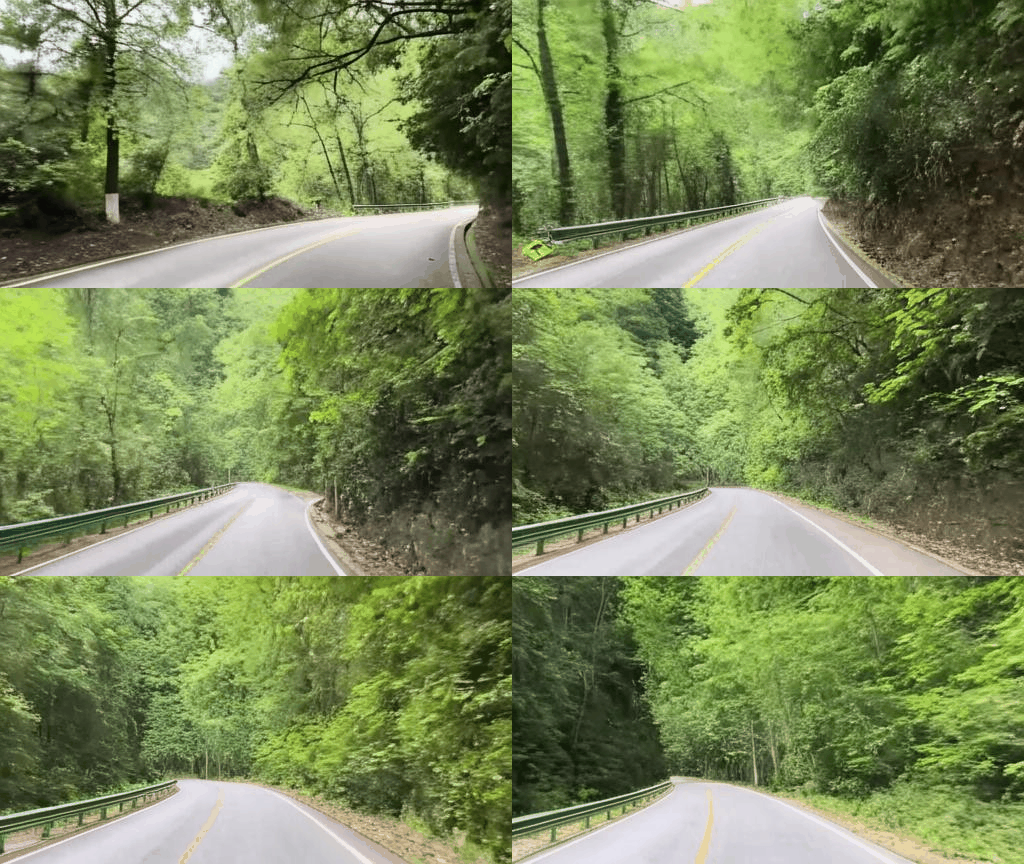
Orbis 2 (arXiv:2607.15898v1, 2026-07-17) comes from LMB — Laboratory for Machine Learning and Biometry, University of Freiburg. This is the reproducible academic counterpart: code, checkpoints, and quantitative results are all released — enough for any group to reproduce results and build on them.
The core technical contribution is a two-stage training pipeline combining two seemingly contradictory objectives:
Stage 1 — Diffusion Forcing Pretraining:
The model learns to predict future frames from a set of frames at varying noise levels (not just from clean frames). This forces the model to build rich internal representations of scene structure because it cannot "peek" at adjacent frames in order — it must understand the structure of the scene to predict a frame at any arbitrary timestep.
These rich representations are particularly valuable for counterfactual queries: "if the ego turns right instead of going straight, what does the scene look like?" — exactly the kind of question policy evaluation needs to ask repeatedly.
Stage 2 — Teacher Forcing Fine-Tuning:
The model is fine-tuned in the standard way: predict the next frame from clean context. This stabilizes long-horizon autoregressive rollout — the classic failure mode of diffusion-based models at inference time. When you need to generate 10 seconds of video (100+ frames) continuously, errors accumulate across each diffusion step and can cause the scene to "drift" from reality after a few seconds.
Combined: rich representations from diffusion forcing + stable rollout from teacher forcing = a world model suitable for long-horizon policy evaluation.
Hierarchical architecture:
- High-level predictor: forecasts coarse scene structure over long horizons (road layout, agent positions)
- Low-level generator: produces pixel-level detail conditioned on high-level predictor output
A note on numbers: The Orbis 2 project page does not display headline FVD/mIoU numbers. Specific quantitative results are in the PDF paper. This article does not quote those numbers because they have not been read directly from the primary source, and making up benchmark scores would be exactly the kind of practice that Part 3 of this series argued against.
Pillar 4 — WorldLens: The Necessary Counterpoint — Best Model Scores 2–3/10 on Human Realism
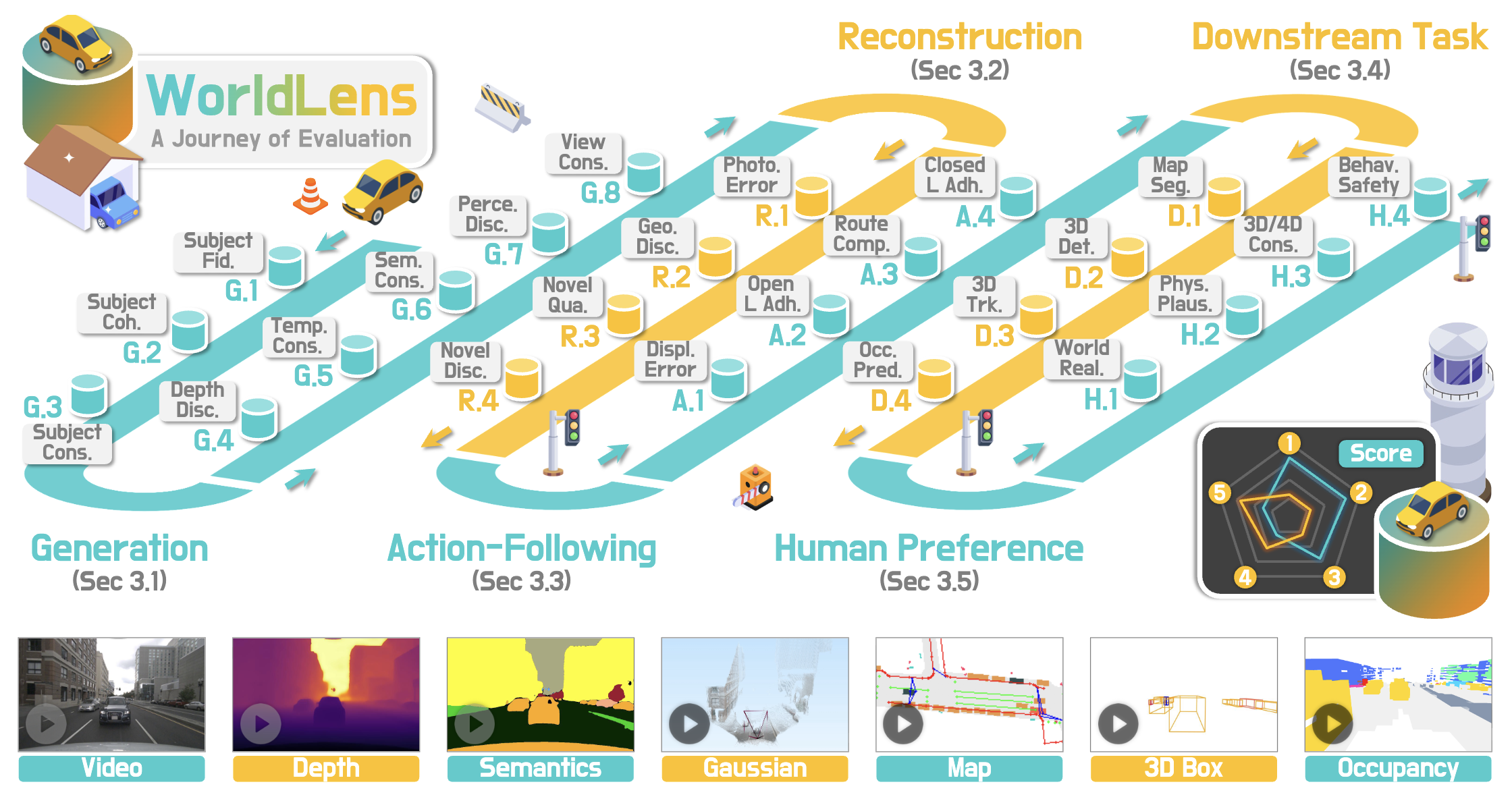
This article would be incomplete without a dose of humility: after all the progress above, where are we actually?
WorldLens (arXiv:2605.10858v1) asks that question systematically. The benchmark evaluates 6 representative driving world models across 5 aspects and 24 standardized dimensions, covering pixel quality, 4D geometry, closed-loop driving behavior, and human perception.
Results: No One Dominates All Axes
No model performs consistently well across all 24 dimensions. The strongest performer reaches only 2–3 out of 10 on human realism ratings. Qualitative analysis reveals two characteristic failure patterns:
- Texture-rich, physics-poor models: generate beautiful streets but vehicles clip through each other, shadows fall in wrong directions, water doesn't reflect correctly.
- Geometry-aware, behaviorally inauthentic models: correct 3D layout but pedestrians walk straight into oncoming traffic, vehicles don't yield despite red lights.
These two failure modes are orthogonal — improving texture doesn't fix behavioral problems, and vice versa.
WorldLens-26K and WorldLens-Agent
For human perception ground truth, the authors built WorldLens-26K: 26,808 human-annotated preference pairs, each combining a numerical score with a natural language explanation. From this dataset, they distilled WorldLens-Agent — a VLM evaluator fine-tuned to assess world models without requiring humans in the loop, while remaining aligned with human judgment.
On venue — a conflict to flag: The arXiv comment lists "CVPR 2026 VideoWorldModel Workshop"; the GitHub repo description says "[CVPR 2026 Oral]". There is a conflict between the two sources — it's unclear whether this is a workshop oral or a main conference oral. Flagging this so you don't cite it incorrectly.
Synthesis: Three Levels of the Conceptual Shift
The four works above illustrate a shift happening at three distinct levels:
Level 1 — Replacing the Evaluation Metric:
From "lowest FVD wins" to "which policy has fewer collisions when tested in this simulator?" OmniDreams measures collision rates. GAIA-4 measures outcome fidelity. No one reports FVD as a primary metric anymore.
Level 2 — Replacing Architecture to Support Counterfactuals:
The world model must react correctly to policy actions, not just generate the next frame based on historical momentum. OmniDreams uses action conditioning in the forward pass. Orbis 2 builds counterfactual representations through diffusion forcing pretraining. GAIA-4 uses world-on-rails to isolate the control variable.
Level 3 — Adding Meta-Evaluation:
WorldLens is a benchmark of benchmarks — measuring how trustworthy the world models used to evaluate policies actually are. This reflects that the entire evaluation stack (policy → world model → meta-benchmark) is still being built in parallel with the components it is meant to evaluate. There is no stable foundation yet.
The Rare Achievement: A Fully Open Closed Loop
For the first time in AV research history, an entire closed loop — policy + orchestrator + generated environment — is fully open-source (with NVIDIA's stack). This means:
- Small research groups can run serious evaluations without building a simulator from scratch
- Results can be reproduced and compared across labs
- The community can improve each component independently
That said, WorldLens reminds us that "open" does not mean "perfect". When the best world model scores only 2–3/10 on human realism, conclusions drawn from policy evaluation inside it should be interpreted with corresponding caution.
The final article in this series will ground these numbers in reality: robotaxis actually operating, real fleet data, and what the gap between "performs well in simulator" and "works on real roads" actually looks like.
Related Posts
- Verifiable Reasoning: Alpamayo-R1 and Chain-of-Causation — How the policy running inside the OmniDreams closed loop actually works
- Benchmarks Are Arguments: NAVSIM v2, Bench2Drive, WOD-E2E — Why open-loop FVD is insufficient for evaluating autonomous driving policy
- From UniAD to VLA: The End-to-End Driving Map for 2026 — The full landscape before going deep on world models

