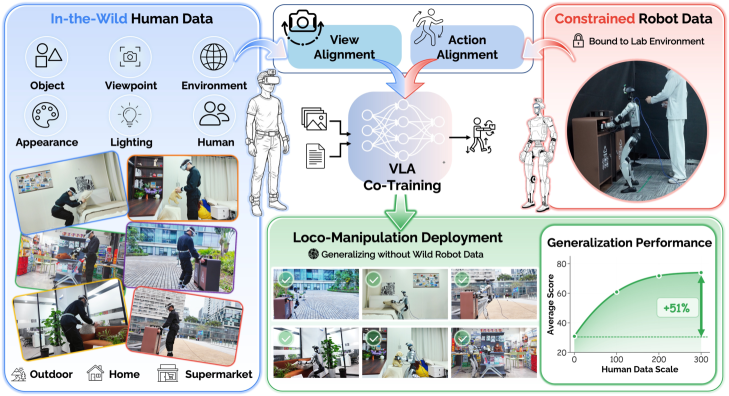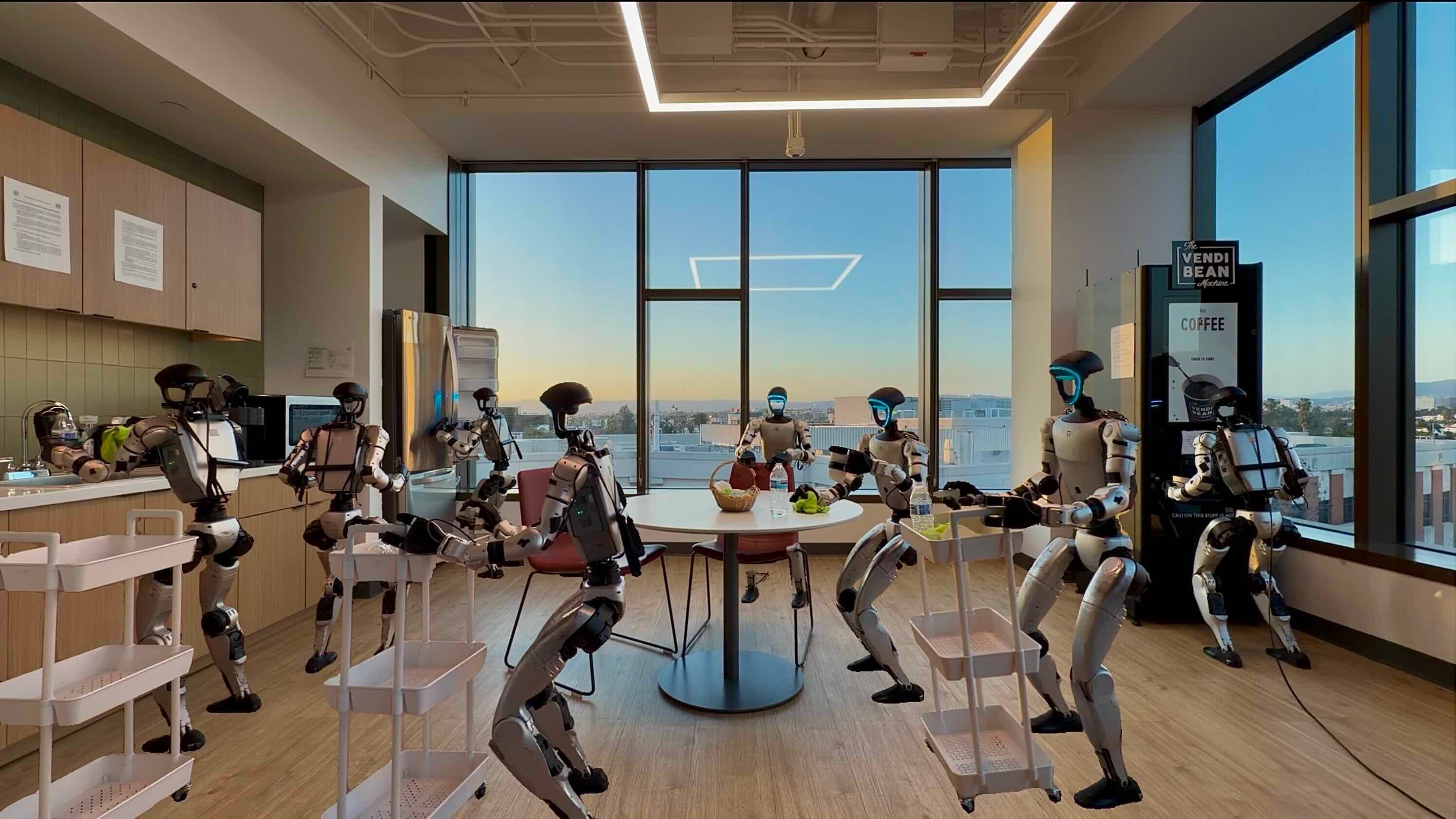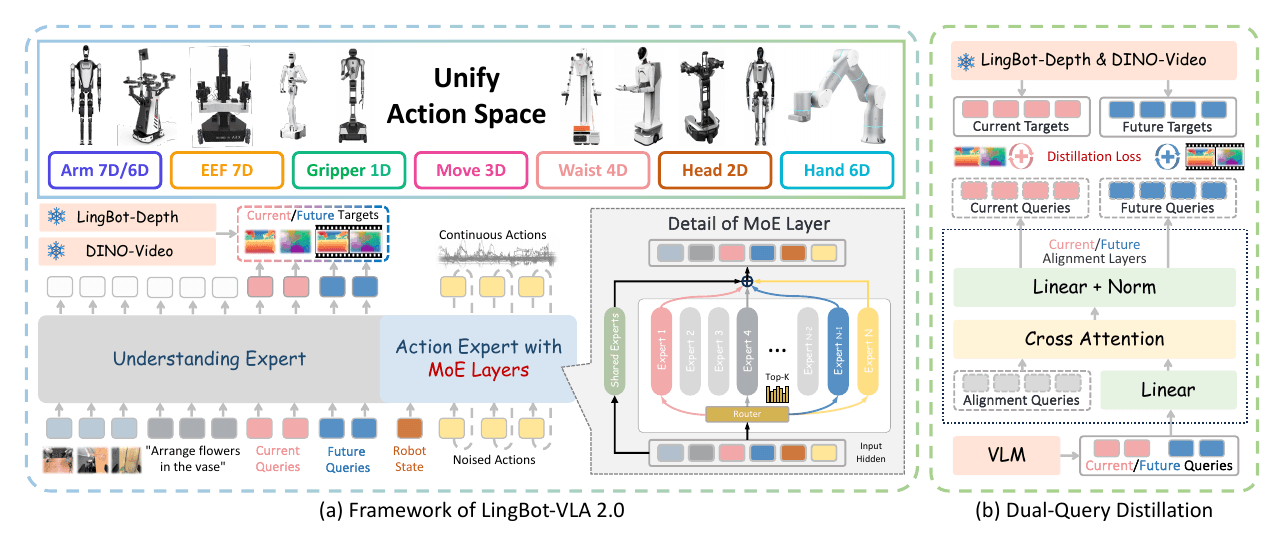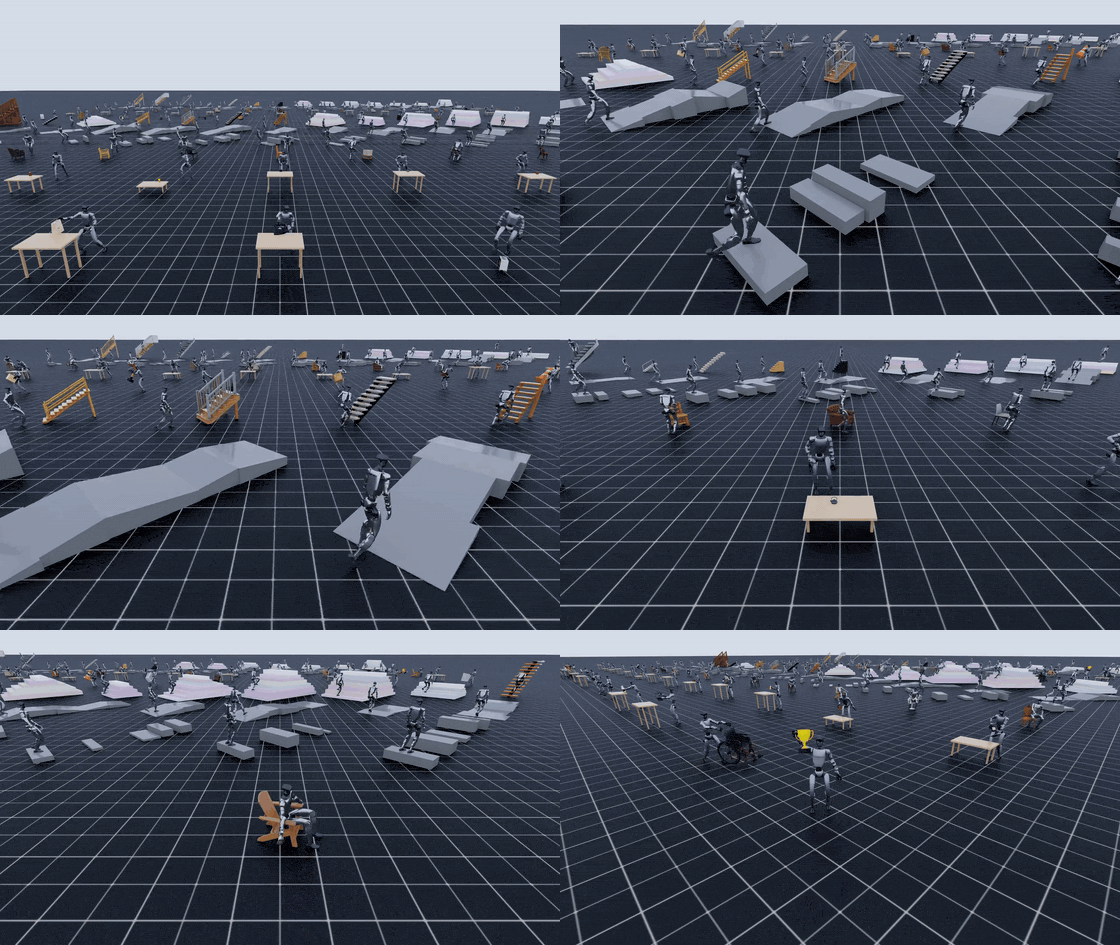
GRAIL giải quyết vấn đề gì?
Trong manipulation truyền thống, dữ liệu thường đến từ teleoperation, motion capture, hoặc robot thật được điều khiển lặp đi lặp lại. Cách này có giá trị vì dữ liệu nằm gần phân phối deployment, nhưng rất khó scale cho humanoid. Với Unitree G1, một episode không chỉ là quỹ đạo tay. Robot phải bước đến vị trí phù hợp, hạ trọng tâm, giữ cân bằng, dùng bàn tay, tránh va chạm với mặt bàn hoặc sàn, rồi quay về trạng thái ổn định. Nếu mỗi object, mỗi scene và mỗi kiểu thao tác đều cần thu bằng người thật, chi phí tăng rất nhanh.
GRAIL, viết tắt từ Generating Humanoid Loco-Manipulation from 3D Assets and Video Priors, đề xuất một hướng khác: tạo demonstration hoàn toàn trong không gian số cho đến lúc deploy. Paper gốc được công bố trên arXiv:2606.05160, project page nằm tại NVIDIA Research, code ở NVlabs/GRAIL, và dataset phát hành trên Hugging Face.
Điểm quan trọng nhất: GRAIL không cố reconstruct video ngoài đời một cách mù mờ. Nó bắt đầu từ một cấu hình 3D đã biết đầy đủ: object mesh, camera intrinsics/extrinsics, metric scale, environment depth, nhân vật SMPL-X được fit gần morphology của Unitree G1. Sau đó GRAIL dùng video foundation model để tạo video tương tác human-object, reconstruct thành 4D human-object interaction, retarget sang G1, rồi train tracker và visual policy.
Nếu bạn mới với VLA, hãy đọc trước mô hình VLA trong robotics. Bài này đi thẳng vào pipeline dữ liệu và cách dùng nó như nền để fine-tune policy cho whole-body manipulation.
Ý tưởng paper trong một sơ đồ
GRAIL có thể hiểu như một data factory cho humanoid loco-manipulation:
3D object / terrain asset
        |
        v
Known 3D scene + G1-proportioned human character
        |
        v
Blender render first frame + VLM prompt
        |
        v
Video foundation model creates human-object video
        |
        v
4D HOI reconstruction
  - SMPL-X body and hands
  - object 6-DoF pose
  - metric depth and contact optimization
        |
        v
Retarget SMPL-X -> Unitree G1
        |
        v
SONIC task-general tracking in Isaac Lab
        |
        v
Egocentric RGB policy / VLA fine-tuning
        |
        v
Real Unitree G1 deployment
Paper báo cáo hơn 20.000 sequences bao gồm pick-up trên bàn, pick-up dưới sàn, whole-body manipulation, sitting, curb, slope và stair traversal. Khi train policy chỉ từ dữ liệu GRAIL-generated, nhóm tác giả deploy trên Unitree G1 đạt 84% success cho object pick-up và 90% success cho stair-climbing. Với pick-up, họ train 200 approach-and-pick-up sequences cho mỗi object trong nhóm cube, apple, tea box, carrot và wet wipes; unseen objects vẫn đạt trung bình 80%.
Kiến trúc: ba tầng dữ liệu, hai tầng policy
GRAIL không phải một model đơn lẻ. Nó là một pipeline gồm nhiều module đã có sẵn trong computer vision, graphics, simulation và humanoid control.
| Tầng | Input | Output | Công cụ chính |
|---|---|---|---|
| Asset-conditioned video generation | 3D asset, scene, camera, prompt | Synthetic HOI video | Blender, VLM, Kling AI |
| 4D HOI reconstruction | Video + known scene context | SMPL-X motion + object 6-DoF | GEM-SMPL, WiLoR, FoundationPose, SAM2, MoGe |
| Robot retargeting | SMPL-X + object motion | G1 joint trajectory + USD assets | GMR, Isaac Lab |
| Task-general tracking | Retargeted motion library | Executable robot actions | SONIC |
| Visual/VLA policy | Egocentric RGB + proprioception | Latent tokens/actions | Diffusion/VLA-style policy, optional GR00T fine-tune |
1. Robot-centric human video generation
GRAIL dùng human video thay vì robot video vì video foundation model hiện vẫn có prior mạnh hơn về người: con người cầm đồ vật, ngồi xuống, bước qua bậc, kéo xe, nhấc hộp. Đồng thời, hệ sinh thái reconstruct human pose như SMPL-X, MANO, ViTPose, WiLoR cũng trưởng thành hơn robot pose reconstruction.
Để giảm morphology mismatch, nhân vật human asset được prefitted theo tỉ lệ của Unitree G1. Khi VFM tạo video, chuyển động giống người nhưng tỷ lệ cơ thể đã gần robot hơn, giúp retarget sang G1 ít méo hơn.
Pipeline tạo video thường có các bước:
# Ví dụ smoke test từ docs GRAIL
source .env   # OPENAI_API_KEY, KLING_ACCESS_KEY, KLING_SECRET_KEY, HF_TOKEN

python -m grail.pipelines.gen_terrain \
  --type stairs \
  --num 5 \
  --output_dir data/syn_stairs

python -m grail.pipelines.gen_2dhoi \
  --dataset ComAsset \
  --category cordless_drill \
  --character kid \
  --results_dir results \
  --video_model_api kling-ai
Ở đây, Blender render frame đầu với camera đã biết. Một VLM tạo prompt tương tác từ frame đó, rồi video foundation model sinh video. Vì camera static và scene 3D ban đầu đã biết, reconstruction sau đó không phải đoán lại mọi thứ từ đầu.
2. 4D human-object interaction reconstruction
Đây là phần kỹ thuật nhất của GRAIL. Output mong muốn không chỉ là video đẹp, mà là trajectory có thể đưa vào robot training:
sample = {
    "human": "SMPL-X pose per frame",
    "object": "6-DoF pose per frame",
    "contacts": "hand/object or body/scene contact labels",
    "camera": "known intrinsics and extrinsics",
    "scale": "metric scale aligned to rendered scene",
}
Human motion được estimate bằng GEM-SMPL/GENMO theo SMPL-X. Hands được refine bằng WiLoR/MANO, sau đó interpolate và smooth để giảm jitter. Object motion được track bằng FoundationPose, khởi tạo từ pose frame đầu đã biết. Vì FoundationPose có object mesh, texture và camera parameter, bài toán 6-DoF tracking ổn định hơn nhiều so với video in-the-wild.
GRAIL vẫn không tin hoàn toàn vào các estimator độc lập. Nó chạy joint optimization với các loss:
| Loss | Mục tiêu |
|---|---|
L_kp |
Giữ body/hand keypoints khớp với video |
L_proj |
Giữ object projection khớp FoundationPose |
L_depth |
Căn depth metric bằng MoGe + known background depth |
L_cont |
Ép contact hand-object/body-scene hợp lý |
L_reg |
Giảm foot skating, velocity drift và temporal jitter |
Điểm rất hay cho beginner: known 3D context biến một bài toán ambiguous thành bài toán constrained. Thay vì hỏi "video này đang ở scale nào?", GRAIL biết camera, biết object, biết mesh, biết background depth. Vì vậy depth alignment và contact alignment có cơ sở hình học rõ ràng.
3. Retarget sang Unitree G1
Sau reconstruction, dữ liệu vẫn ở dạng human SMPL-X. GRAIL dùng GMR để retarget sang Unitree G1. Output là các thư mục robot-ready:
data/motion_lib/<name>/
  robot/       # G1 joint trajectories, one pkl per motion
  objects/     # object 6-DoF trajectories
  object_usd/  # Isaac Lab-ready USD assets
  meta/        # table pose, object name, sequence metadata
  bps/         # shape encoding for multi-object manipulation
Lệnh retarget end-to-end:
conda activate sonic
export DISPLAY=:1

bash grail/retargeting/scripts/retarget_pipeline.sh \
  data/genhoi/benchmark_v3/generation/4dhoi_recon_valid/Hunyuan \
  benchmark_v3_0203
Nếu muốn chạy từng stage:
python -m grail.retargeting.retarget \
  --data_dir data/genhoi/benchmark_v3/generation/4dhoi_recon_valid/Hunyuan \
  --all \
  --robot unitree_g1 \
  --no_viewer \
  --output_dir data/motion_lib/benchmark_v3_0203

python -m grail.retargeting.process \
  --input data/motion_lib/benchmark_v3_0203 \
  --output data/motion_lib/benchmark_v3_0203_ha \
  --meta_pkl grail/retargeting/data/g1_skeleton_meta.pkl \
  --include_contact_points \
  --grasp_from_lift \
  --lift_threshold 0.02 \
  --grasp_anticipation_frames 10 \
  --skip_no_lift \
  --per_object

python -m grail.retargeting.compute_bps \
  --object_usd_dir data/motion_lib/benchmark_v3_0203/object_usd \
  --output_dir data/motion_lib/benchmark_v3_0203/bps
Với terrain hoặc sitting, GRAIL khuyến nghị --zero_out_wrist vì task không cần hand IK.
Cài đặt GRAIL
Repo được test trên Ubuntu 22.04+ với NVIDIA GPU như A6000, RTX 4090, RTX 5090 và RTX 6000 Ada. Có ba môi trường:
| Env | Python | Dùng cho |
|---|---|---|
grail |
3.10 | 2D generation, 4D reconstruction, optimization |
hunyuan |
3.10 | Hunyuan3D-2.1 asset generation |
sonic |
3.11 | retargeting, Isaac Lab, task-general tracking |
Cách nhanh nhất là Docker:
docker pull docker.io/nvgrail/grail:latest

docker run --gpus all -it --shm-size=16g \
  -v /path/to/grail:/workspace/grail \
  docker.io/nvgrail/grail:latest

cd /workspace/grail
bash scripts/setup/install_env_docker.sh
bash scripts/setup/download_checkpoints.sh
conda activate grail
source .env
Nếu bạn cần train SONIC hoặc retargeting đầy đủ:
bash scripts/setup/install_env_sonic.sh
Các biến môi trường tối thiểu:
export CUDA_HOME=/usr/local/cuda-12.1
export PYOPENGL_PLATFORM=egl
export OMNI_KIT_ACCEPT_EULA=Yes
export OPENAI_API_KEY=<your-key>
export KLING_ACCESS_KEY=<your-key>
export KLING_SECRET_KEY=<your-key>
export HF_TOKEN=<your-token>
Checkpoint khá lớn: GEM-SMPL khoảng 14 GB, GEM-SOMA khoảng 6.4 GB, FoundationPose khoảng 250 MB, cộng thêm SMPL-X body models và RealESRGAN. Hãy chuẩn bị disk trước, nhất là khi cài thêm Isaac Sim/Lab cho sonic.
Training: từ motion library đến policy
GRAIL train task-general tracking policy trên SONIC, không train một controller riêng cho từng object. Với manipulation, nó thêm object-aware latent adaptor: adaptor đọc object state và motion context, modulate latent token của controller, đồng thời xuất hand actions. Với terrain/sitting, nó dùng scene-aware tracker có height-map encoder để điều kiện hóa stepping và body alignment.
Smoke test cho pick-up:
conda activate sonic
export HYDRA_FULL_ERROR=1 PYTHONUNBUFFERED=1 WANDB_MODE=offline

cd imports/SONIC
python -u train_agent_trl.py \
  +exp=manager/universal_token/hoi/pnp_table \
  num_envs=4 \
  headless=True \
  ++algo.config.num_learning_iterations=3 \
  ++manager_env.config.gpu_collision_stack_size_exp=28 \
  ++manager_env.commands.motion.motion_lib_cfg.motion_file=${DATA_DIR}/robot \
  ++manager_env.commands.motion.motion_lib_cfg.object_motion_file=${DATA_DIR}/objects \
  ++manager_env.config.object_usd_path=${DATA_DIR}/object_usd \
  ++manager_env.commands.motion.motion_lib_cfg.bps_dir=${BPS_DIR}
Training thực tế trên 8 GPU:
conda activate sonic
export HYDRA_FULL_ERROR=1 PYTHONUNBUFFERED=1

cd imports/SONIC
accelerate launch --num_processes=8 train_agent_trl.py \
  +exp=manager/universal_token/hoi/pnp_table \
  num_envs=2048 \
  headless=True \
  ++manager_env.commands.motion.motion_lib_cfg.motion_file=${DATA_DIR}/robot \
  ++manager_env.commands.motion.motion_lib_cfg.object_motion_file=${DATA_DIR}/objects \
  ++manager_env.config.object_usd_path=${DATA_DIR}/object_usd \
  ++manager_env.commands.motion.motion_lib_cfg.bps_dir=${BPS_DIR}
Để fine-tune từ checkpoint public:
python -u train_agent_trl.py \
  +exp=manager/universal_token/hoi/pnp_table \
  num_envs=2048 \
  headless=True \
  ++resume=True \
  ++checkpoint=models/pnp_table/last.pt \
  experiment_dir=${FINETUNE_DIR} \
  ++algo.config.num_learning_iterations=10000 \
  ++manager_env.commands.motion.motion_lib_cfg.motion_file=${DATA_DIR}/robot \
  ++manager_env.commands.motion.motion_lib_cfg.object_motion_file=${DATA_DIR}/objects \
  ++manager_env.config.object_usd_path=${DATA_DIR}/object_usd \
  ++manager_env.commands.motion.motion_lib_cfg.bps_dir=${BPS_DIR}
Với VLA whole-body manipulation, có hai cách dùng GRAIL:
- Dùng GRAIL để train tracker trước, sau đó distill thành egocentric RGB policy giống paper.
- Export GRAIL episodes thành format VLA, trộn với một ít teleoperation thật, rồi fine-tune model như GR00T hoặc policy tương tự.
Project page cho biết nhóm tác giả có thử co-training GR00T với mixture 95% GRAIL + 5% teleoperation, giúp tăng grasping success so với chỉ dùng teleoperation và giảm tình trạng policy bị đứng trước object mà không reach tới target. Với production, bạn vẫn nên giữ một phần real teleop nhỏ để calibrate camera, latency, hand compliance và surface friction.
Một schema đơn giản để chuyển sang VLA:
def export_episode(grail_motion):
    return {
        "observation": {
            "rgb": render_egocentric(grail_motion),
            "proprio": grail_motion["robot_state"],
            "language": "pick up the object and place it on the table",
        },
        "action": {
            "base": grail_motion["base_velocity"],
            "joints": grail_motion["g1_joint_targets"],
            "hands": grail_motion["hand_dof_pos"],
        },
        "metadata": {
            "object_usd": grail_motion["object_asset"],
            "source": "GRAIL",
            "sim_fps": 25,
        },
    }
Nếu bạn đang dùng LeRobot hoặc một stack tự xây, hãy giữ cùng nguyên tắc: chuẩn hóa episode format, log đủ RGB/proprio/action, và kiểm tra sim-to-real trước khi chạy robot thật.
Inference trên Unitree G1
Trong paper, deployment dùng head-camera RGB và proprioceptive input stream về desktop có NVIDIA RTX 5090, rồi stream action ngược lại G1. Camera là Luxonis OAK-D W, inference chạy 10 Hz.
Runtime có thể mô tả như sau:
OAK-D W RGB frame
        |
        v
Visual policy / VLA
        |
        v
Latent token or action chunk
        |
        v
SONIC controller / low-level action decoder
        |
        v
Unitree G1 joints + hands
        |
        v
New proprioception and camera frame
Checklist trước khi chạy robot thật:
| Hạng mục | Vì sao quan trọng |
|---|---|
| Camera extrinsics | Sai camera pose làm policy reach lệch object |
| Joint limits | Synthetic action có thể vượt giới hạn hardware |
| Latency | 10 Hz cần buffer và watchdog rõ ràng |
| Hand calibration | G1 hand DOF và contact thực khác simulation |
| Emergency stop | Whole-body manipulation có rủi ro ngã và va chạm |
| Domain randomization | Cần randomize ánh sáng, texture, object pose, camera noise |
Beginner thường mắc lỗi deploy policy quá sớm. Hãy chạy từng lớp: visualize trajectory, replay trong Isaac Lab, test tracker headless, test visual policy trong sim, shadow mode trên G1, rồi mới cho robot exert force.
Kết quả và ý nghĩa
| Thí nghiệm | Kết quả chính |
|---|---|
| HOI generation trên 20 objects | GRAIL đạt tracking SR 88.9%, cao hơn HOIDiff, CHOIS và DAViD |
| Task-general tracking | Full model đạt SR 81.4%, tốt hơn HDMI 48.5% và ResMimic 49.2% |
| Real-world pick-up | 84% trung bình trên seen objects, 80% trên unseen objects |
| Real-world stair-climbing | 90% success |
| Dataset scale | Hơn 20.000 sequences, 1.000 object assets và 1.000 terrain configurations |
Điều đáng học từ GRAIL không chỉ là các con số. Ý tưởng cốt lõi là: nếu synthetic data được tạo từ geometry có kiểm soát, video prior có thể bổ sung motion realism, còn simulation đảm bảo physical feasibility. Đây là hướng thực dụng hơn so với việc tin tuyệt đối vào video generation hoặc tin tuyệt đối vào manual teleoperation.
GRAIL vẫn có giới hạn. Nó cần 3D asset, scene setup và VFM phải follow prompt đủ tốt. Reconstruction có thể hỏng khi occlusion nặng, chuyển động quá nhanh, object appearance thay đổi qua frame, hoặc FoundationPose mất tracking. Failure filter sẽ loại bỏ một phần sequence. Ngoài ra, task-general tracker vẫn cần fine-tune khi motion family đổi nhiều.
Nên bắt đầu từ đâu?
Nếu bạn muốn thử trên workstation:
- Cài Docker image và chạy quick start với
cordless_drill. - Visualize output
recon_result.mp4vàrecon_comparison.mp4. - Retarget một motion nhỏ sang G1.
- Chạy SONIC smoke test với
num_envs=4. - Export motion thành format episode cho policy của bạn.
- Chỉ deploy thật sau khi replay trong sim ổn định.
GRAIL phù hợp nhất khi bạn cần mở rộng dữ liệu cho humanoid manipulation nhưng không đủ thời gian thu teleoperation hàng nghìn episode. Với Unitree G1, pipeline này cho một công thức khá rõ: 3D asset tạo scene, video prior tạo behavior, 4D reconstruction tạo trajectory, SONIC biến trajectory thành control, và VLA học map từ perception sang action.