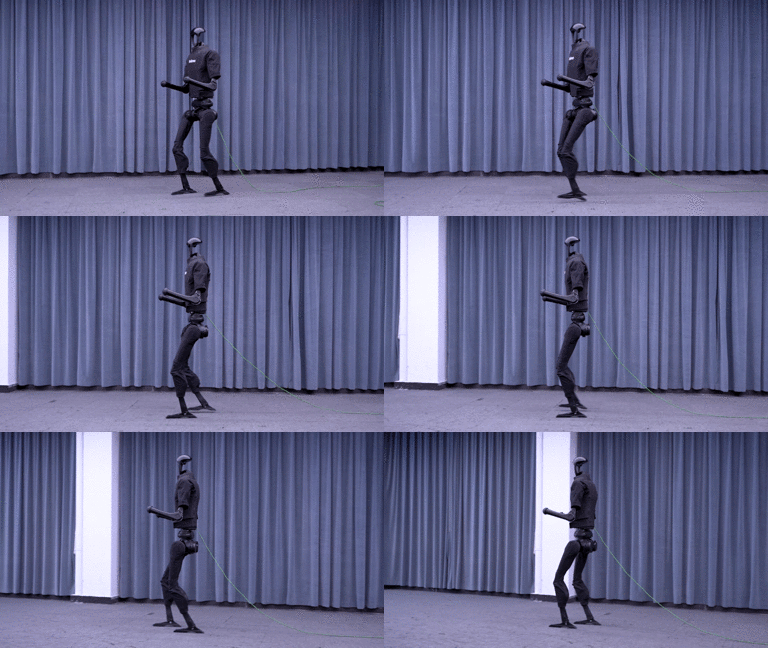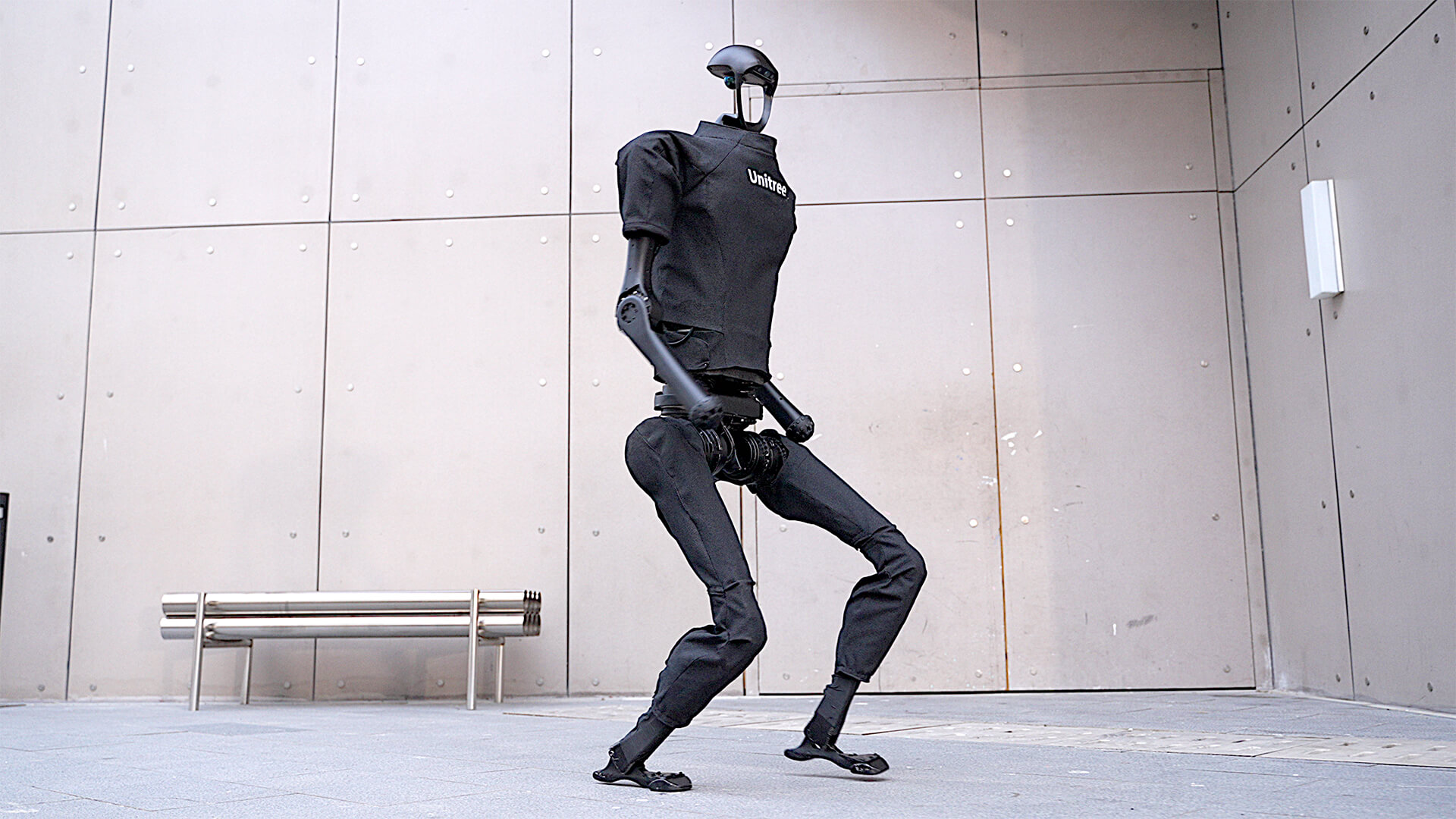
The Unitree H1-2 is a significant evolution from the H1 — not only improving locomotion but adding dexterous hands that transform it into a complete loco-manipulation platform. In this post, we analyze the hardware changes, adapt the locomotion policy, and begin co-training locomotion with arm tasks.
Building on H1 dynamic motions, this post extends into whole-body coordination.
H1-2 Hardware: What Changed from H1?
| Parameter | H1 | H1-2 | Improvement |
|---|---|---|---|
| Height | 1.80 m | 1.80 m | Same |
| Weight | 47 kg | 52 kg | +5kg (arms + hands) |
| Total DOF | 19 | 35+ | +16 DOF (hands) |
| Hands | Simple gripper | Dexterous 5-finger | 6 DOF per hand |
| Wrist DOF | 0 | 2 (roll + pitch) | Increased dexterity |
| Arm actuators | Standard | Upgraded | Torque + bandwidth |
| Leg actuators | Standard | Improved | +15% torque |
| Sensors | IMU, encoders | + force/torque sensors | At wrist |
| Payload | 5 kg | 8 kg | Carry heavier objects |
Why Hardware Changes Affect Locomotion
1. Added 5kg arm/hand mass:
- Center of mass shifts upward, making balance harder
- Inertia tensor changes, requiring retuned PD gains
- Arm motion creates disturbance forces on locomotion
2. Arm dynamics coupling:
- When hands carry objects, CoM shifts
- Arm swing pattern changes, affecting gait
- Policy needs to anticipate arm effects
3. Improved leg actuators:
- +15% torque allows more aggressive locomotion
- Higher bandwidth means faster response
- Can be exploited for high-speed gaits
"""
H1-2 robot configuration.
File: h1_2_env_cfg.py
"""
import omni.isaac.lab.sim as sim_utils
from omni.isaac.lab.assets import ArticulationCfg

class H1_2RobotCfg:
    """Unitree H1-2 with dexterous hands."""

    robot = ArticulationCfg(
        prim_path="/World/envs/env_.*/Robot",
        spawn=sim_utils.UsdFileCfg(
            usd_path="datasets/robots/unitree/h1_2/h1_2.usd",
            activate_contact_sensors=True,
        ),
        init_state=ArticulationCfg.InitialStateCfg(
            pos=(0.0, 0.0, 1.05),
            joint_pos={
                # Legs (same as H1)
                "left_hip_yaw": 0.0,
                "left_hip_roll": 0.0,
                "left_hip_pitch": -0.2,
                "left_knee": 0.4,
                "left_ankle": -0.2,
                "right_hip_yaw": 0.0,
                "right_hip_roll": 0.0,
                "right_hip_pitch": -0.2,
                "right_knee": 0.4,
                "right_ankle": -0.2,
                # Torso
                "torso": 0.0,
                # Arms (upgraded)
                "left_shoulder_pitch": 0.3,
                "left_shoulder_roll": 0.2,
                "left_shoulder_yaw": 0.0,
                "left_elbow": 0.5,
                "left_wrist_roll": 0.0,
                "left_wrist_pitch": 0.0,
                "right_shoulder_pitch": 0.3,
                "right_shoulder_roll": -0.2,
                "right_shoulder_yaw": 0.0,
                "right_elbow": 0.5,
                "right_wrist_roll": 0.0,
                "right_wrist_pitch": 0.0,
                # Hands
                "left_thumb.*": 0.0,
                "left_index.*": 0.0,
                "left_middle.*": 0.0,
                "right_thumb.*": 0.0,
                "right_index.*": 0.0,
                "right_middle.*": 0.0,
            },
        ),
        actuators={
            "legs": sim_utils.DCMotorCfg(
                joint_names_expr=[".*hip.*", ".*knee.*", ".*ankle.*"],
                stiffness={
                    ".*hip_pitch.*": 230.0,
                    ".*hip_roll.*": 210.0,
                    ".*hip_yaw.*": 170.0,
                    ".*knee.*": 290.0,
                    ".*ankle.*": 46.0,
                },
                damping={
                    ".*hip.*": 7.0,
                    ".*knee.*": 12.0,
                    ".*ankle.*": 3.0,
                },
                effort_limit={
                    ".*hip.*": 138.0,
                    ".*knee.*": 230.0,
                    ".*ankle.*": 46.0,
                },
            ),
            "arms": sim_utils.DCMotorCfg(
                joint_names_expr=[".*shoulder.*", ".*elbow.*", ".*wrist.*"],
                stiffness=120.0,
                damping=6.0,
                effort_limit=80.0,
            ),
            "hands": sim_utils.DCMotorCfg(
                joint_names_expr=[".*thumb.*", ".*index.*", ".*middle.*"],
                stiffness=5.0,
                damping=0.5,
                effort_limit=5.0,
            ),
        },
    )

Adapting the Locomotion Policy for H1-2
Extended Observation Space
import torch

class H1_2ObservationSpace:
    """Observation space for H1-2, including arm state."""

    def compute_observation(self, robot_state, command):
        obs_components = []

        # === Locomotion observations (same as H1) ===
        obs_components.append(robot_state["base_ang_vel"])
        obs_components.append(robot_state["projected_gravity"])
        obs_components.append(command["velocity"])

        # Leg joints only
        leg_joints = robot_state["leg_joint_positions"]
        obs_components.append(leg_joints - robot_state["leg_default_pos"])
        obs_components.append(robot_state["leg_joint_velocities"])
        obs_components.append(robot_state["prev_leg_actions"])

        # === NEW: Arm state (affects balance) ===
        arm_joints = robot_state["arm_joint_positions"]
        obs_components.append(arm_joints)

        arm_vel = robot_state["arm_joint_velocities"]
        obs_components.append(arm_vel * 0.05)

        # === NEW: Payload detection ===
        wrist_forces = robot_state["wrist_forces"]
        obs_components.append(wrist_forces * 0.1)

        obs = torch.cat(obs_components, dim=-1)
        return obs
Reward Adjustments for Added Mass
def compute_h1_2_loco_rewards(state, action, prev_action, command):
    """
    Locomotion rewards for H1-2.
    Different from H1: compensate for arm mass, wider stability margin.
    """
    rewards = {}

    vel_error = torch.sum(
        torch.square(command[:, :2] - state["base_lin_vel"][:, :2]),
        dim=1
    )
    rewards["vel_tracking"] = 1.5 * torch.exp(-vel_error / 0.25)

    # Slightly lower target height due to added weight
    height_error = torch.square(state["base_height"] - 0.96)
    rewards["height"] = -0.8 * height_error

    # Stronger upright reward (higher CoM + heavier)
    orientation_error = torch.sum(
        torch.square(state["projected_gravity"][:, :2]), dim=1
    )
    rewards["upright"] = -2.0 * orientation_error

    # NEW: Arm disturbance compensation
    arm_accel = state["arm_joint_accelerations"]
    rewards["arm_disturbance"] = -0.005 * torch.sum(
        torch.square(arm_accel), dim=1
    )

    # NEW: CoM stability
    com_vel_z = torch.abs(state["com_velocity"][:, 2])
    rewards["com_stability"] = -0.2 * com_vel_z

    # Standard rewards
    rewards["action_rate"] = -0.01 * torch.sum(
        torch.square(action - prev_action), dim=1
    )
    rewards["torque"] = -3e-5 * torch.sum(
        torch.square(state["leg_torques"]), dim=1
    )
    rewards["termination"] = -200.0 * state["terminated"].float()

    yaw_error = torch.square(command[:, 2] - state["base_ang_vel"][:, 2])
    rewards["yaw_tracking"] = 0.8 * torch.exp(-yaw_error / 0.25)

    total = sum(rewards.values())
    return total, rewards
Loco-Manipulation Basics
Hierarchical Control Architecture
class LocoManipulationController:
    """
    Hierarchical controller: locomotion + arm control.

    Architecture:
    - Lower level: Locomotion policy (pre-trained)
    - Upper level: Arm policy (trained new)
    - Coordination: Shared observation + reward coupling
    """

    def __init__(self, loco_policy, arm_policy):
        self.loco_policy = loco_policy
        self.arm_policy = arm_policy

        for param in self.loco_policy.parameters():
            param.requires_grad = False

    def forward(self, obs):
        loco_obs = obs[:, :61]
        arm_obs = obs[:, 61:]

        leg_actions = self.loco_policy(loco_obs)
        arm_actions = self.arm_policy(
            torch.cat([arm_obs, loco_obs[:, :6]], dim=1)
        )

        full_action = torch.cat([leg_actions, arm_actions], dim=1)
        return full_action

    def unfreeze_locomotion(self):
        """Phase 2: Fine-tune locomotion together with arm."""
        for param in self.loco_policy.parameters():
            param.requires_grad = True
Simple Arm Task: Walk + Reach
class WalkAndReachTask:
    """Simple task: walk to position + reach hand to target."""

    def __init__(self):
        self.walk_target = None
        self.reach_target = None

    def reset(self, num_envs, device="cuda"):
        self.walk_target = torch.zeros(num_envs, 3, device=device)
        self.walk_target[:, 0] = torch.empty(num_envs, device=device).uniform_(2, 5)

        self.reach_target = torch.zeros(num_envs, 3, device=device)
        self.reach_target[:, 0] = self.walk_target[:, 0]
        self.reach_target[:, 1] = torch.empty(num_envs, device=device).uniform_(-0.3, 0.3)
        self.reach_target[:, 2] = 0.8

    def compute_reward(self, state, ee_pos):
        rewards = {}

        dist_to_walk = torch.norm(
            state["base_pos"][:, :2] - self.walk_target[:, :2], dim=1
        )
        rewards["walk_progress"] = 0.5 * torch.exp(-dist_to_walk / 2.0)

        close_enough = (dist_to_walk < 0.5).float()
        reach_dist = torch.norm(ee_pos - self.reach_target, dim=1)
        rewards["reach"] = 0.8 * close_enough * torch.exp(-reach_dist / 0.1)

        far_from_target = (dist_to_walk > 1.0).float()
        arm_activity = torch.norm(state["arm_joint_velocities"], dim=1)
        rewards["phase_coupling"] = -0.1 * far_from_target * arm_activity

        total = sum(rewards.values())
        return total, rewards
Co-Training Pipeline
class CoTrainingPipeline:
    """3-phase co-training for loco-manipulation."""

    def train(self, env, total_iterations=20000):
        # Phase 1: Load pre-trained locomotion
        print("Phase 1: Loading pre-trained locomotion policy...")
        loco_policy = self.load_pretrained("h1_walking_policy.pt")
        controller = LocoManipulationController(loco_policy, self.arm_policy)

        # Phase 2: Train arm with frozen locomotion
        print("Phase 2: Training arm policy (frozen legs)...")
        for iteration in range(5000):
            obs = env.get_observations()
            actions = controller.forward(obs)
            obs, reward, done, info = env.step(actions)

            arm_loss = self.compute_arm_loss(reward, controller.arm_policy)
            arm_loss.backward()
            self.arm_optimizer.step()

            if iteration % 500 == 0:
                print(f"  Iter {iteration}: arm_reach_dist="
                      f"{info['reach_distance']:.3f}")

        # Phase 3: Fine-tune both
        print("Phase 3: Co-training legs + arms...")
        controller.unfreeze_locomotion()

        for iteration in range(15000):
            obs = env.get_observations()
            actions = controller.forward(obs)
            obs, reward, done, info = env.step(actions)

            total_loss = self.compute_total_loss(reward, controller)
            total_loss.backward()
            self.joint_optimizer.step()

            if iteration % 500 == 0:
                print(f"  Iter {iteration}: walk_dist={info['walk_distance']:.2f}, "
                      f"reach_dist={info['reach_distance']:.3f}, "
                      f"fall_rate={info['fall_rate']:.2f}")

        print("Co-training complete!")

Evaluation: Locomotion Quality with Active Arms
def evaluate_loco_with_arm_tasks(env, controller, num_episodes=50):
    """Compare locomotion quality: arms idle vs arms active."""

    conditions = {
        "arms_idle": {"arm_task": False},
        "arms_reaching": {"arm_task": True, "payload": 0},
        "arms_carrying_2kg": {"arm_task": True, "payload": 2.0},
        "arms_carrying_5kg": {"arm_task": True, "payload": 5.0},
    }

    results = {}
    for condition_name, cfg in conditions.items():
        env.configure(cfg)
        vel_errors = []
        fall_count = 0

        for ep in range(num_episodes):
            obs = env.reset()
            for step in range(500):
                action = controller.forward(obs)
                obs, _, done, info = env.step(action)
                vel_errors.append(info["vel_tracking_error"])
                if done and info["fell"]:
                    fall_count += 1
                    break

        results[condition_name] = {
            "vel_error": np.mean(vel_errors),
            "fall_rate": fall_count / num_episodes,
        }

    print(f"{'Condition':<25} {'Vel Error':>10} {'Fall Rate':>10}")
    print("-" * 47)
    for name, r in results.items():
        print(f"{name:<25} {r['vel_error']:>9.3f}m/s {r['fall_rate']*100:>8.1f}%")
Typical results:
| Condition | Vel Error | Fall Rate |
|---|---|---|
| Arms idle | 0.08 m/s | 2% |
| Arms reaching | 0.12 m/s | 5% |
| Arms carrying 2kg | 0.15 m/s | 8% |
| Arms carrying 5kg | 0.22 m/s | 15% |
For more on RL for humanoids, see RL for Humanoid Robots. For detailed manipulation, see the next post Loco-Manipulation.
Summary
The H1-2 brings new challenges to locomotion:
- +5kg arm/hand mass changes dynamics, requiring retuned PD gains and stronger upright rewards
- Arm state in observation helps the locomotion policy anticipate disturbances
- Hierarchical control allows reusing the locomotion policy while training arms separately
- 3-phase co-training: frozen legs, train arm, fine-tune both
- Locomotion quality degrades when arms are active, especially with payload > 2kg
Next post — Loco-Manipulation — dives deep into walking while carrying and manipulating objects.
References
- HumanPlus: Humanoid Shadowing and Imitation from Humans — Fu et al., 2024
- Humanoid Loco-Manipulation with Learned Whole-Body Control — Chen et al., CoRL 2024
- Expressive Whole-Body Control for Humanoid Robots — Cheng et al., RSS 2024
- Unitree H1-2 Technical Report — Unitree Robotics