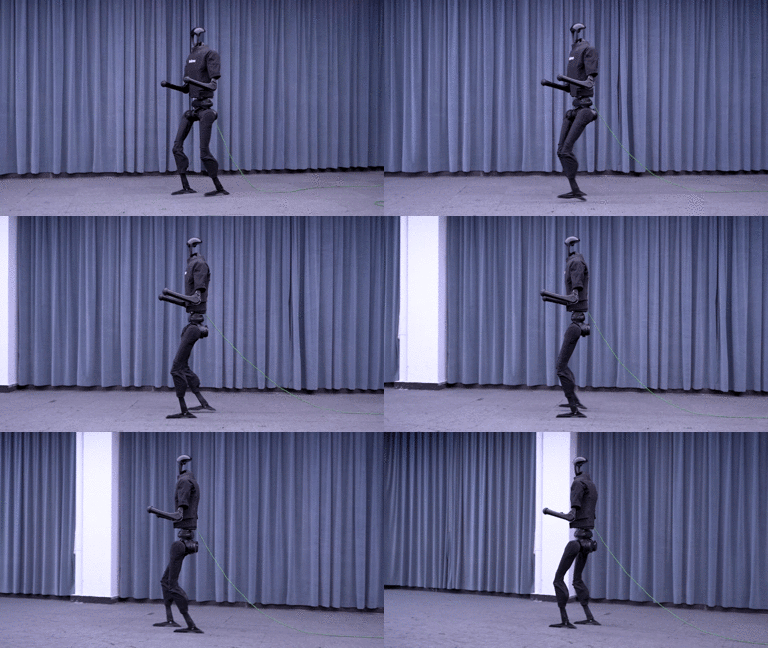
Walking is the foundation, but a truly useful humanoid needs much more. In this post, we push the Unitree H1 beyond walking to achieve running (2+ m/s), sharp turning, lateral walking, backward walking, and a command-conditioned policy that flexibly switches between gaits.
Building on the H1 basic training post, this post focuses on dynamic motions — where physics and control become truly interesting.
From Walking to Running: What Changes?
Physics of Running
Walking and running differ fundamentally in the flight phase:
| Characteristic | Walking | Running |
|---|---|---|
| Flight phase | None (at least 1 foot on ground) | Yes (both feet leave ground) |
| Ground contact | ~60% time per foot | ~30-40% time |
| Peak force | ~1.2x body weight | ~2.5-3x body weight |
| Speed | 0-1.5 m/s | 1.5-3.3+ m/s |
| Froude number | < 1 | > 1 |
| Energy mode | Inverted pendulum | Spring-mass |
import torch
import numpy as np

class RunningRewardExtension:
    """
    Extended reward function for running gaits.
    """

    def compute_running_rewards(self, state, command):
        rewards = {}

        # 1. Extended velocity tracking range
        vel_error = torch.sum(
            torch.square(command[:, :2] - state["base_lin_vel"][:, :2]),
            dim=1
        )
        sigma = torch.where(
            torch.abs(command[:, 0]) > 1.5,
            torch.tensor(0.5),   # Running: larger tolerance
            torch.tensor(0.25),  # Walking: tight tolerance
        )
        rewards["vel_tracking"] = torch.exp(-vel_error / sigma)

        # 2. Flight phase reward
        both_feet_air = (
            (state["foot_contact"][:, 0] < 0.5) &
            (state["foot_contact"][:, 1] < 0.5)
        ).float()
        running_command = (torch.abs(command[:, 0]) > 2.0).float()
        rewards["flight_phase"] = 0.3 * running_command * both_feet_air

        # 3. Ground reaction force symmetry
        left_grf = state["contact_forces"][:, 0, 2]
        right_grf = state["contact_forces"][:, 1, 2]
        grf_symmetry = 1.0 - torch.abs(
            left_grf.max() - right_grf.max()
        ) / (left_grf.max() + right_grf.max() + 1e-6)
        rewards["grf_symmetry"] = 0.1 * grf_symmetry

        # 4. Knee bend during stance (energy storage)
        stance_mask = state["foot_contact"] > 0.5
        knee_bend = torch.abs(state["joint_pos"][:, [3, 8]])
        running_knee_reward = stance_mask * torch.clamp(
            knee_bend - 0.2, min=0.0
        )
        rewards["knee_bend"] = 0.1 * torch.sum(running_knee_reward, dim=1)

        return rewards

Command-Conditioned Multi-Gait Policy
Instead of training multiple separate policies, we train a single policy that can walk, run, turn, and move laterally — depending on the velocity command.
Extended Command Space
class ExtendedVelocityCommand:
    """
    Extended velocity command for multi-gait policy.
    """

    def __init__(self):
        self.ranges = {
            "lin_vel_x": (-0.5, 3.5),    # Backward to Running
            "lin_vel_y": (-0.8, 0.8),     # Lateral walking
            "ang_vel_z": (-1.5, 1.5),     # Sharp turning
        }
        self.curriculum_factor = 0.0

    def sample_command(self, num_envs, device="cuda"):
        """Sample random velocity commands."""
        factor = self.curriculum_factor

        commands = torch.zeros(num_envs, 3, device=device)

        commands[:, 0] = torch.empty(num_envs, device=device).uniform_(
            self.ranges["lin_vel_x"][0] * factor,
            self.ranges["lin_vel_x"][1] * factor + (1 - factor) * 1.0,
        )

        commands[:, 1] = torch.empty(num_envs, device=device).uniform_(
            self.ranges["lin_vel_y"][0] * factor,
            self.ranges["lin_vel_y"][1] * factor,
        )

        commands[:, 2] = torch.empty(num_envs, device=device).uniform_(
            self.ranges["ang_vel_z"][0] * factor,
            self.ranges["ang_vel_z"][1] * factor,
        )

        # 20% chance of zero command (standing)
        zero_mask = torch.rand(num_envs, device=device) < 0.2
        commands[zero_mask] = 0.0

        return commands

    def update_curriculum(self, iteration, total_iterations=10000):
        """Gradually expand command range."""
        self.curriculum_factor = min(iteration / (total_iterations * 0.5), 1.0)
Multi-Gait Reward Function
class MultiGaitReward:
    """
    Speed-adaptive reward function.
    Low speed -> walking rewards. High speed -> running rewards.
    """

    def compute(self, state, action, prev_action, command):
        rewards = {}
        cmd_speed = torch.abs(command[:, 0])

        # === Velocity tracking (universal) ===
        vel_error = torch.sum(
            torch.square(command[:, :2] - state["base_lin_vel"][:, :2]),
            dim=1
        )
        rewards["vel_tracking"] = 1.5 * torch.exp(-vel_error / 0.25)

        # === Yaw tracking ===
        yaw_error = torch.square(command[:, 2] - state["base_ang_vel"][:, 2])
        rewards["yaw_tracking"] = 0.8 * torch.exp(-yaw_error / 0.25)

        # === Speed-adaptive rewards ===
        left_c = state["foot_contact"][:, 0]
        right_c = state["foot_contact"][:, 1]
        both_air = (1 - left_c) * (1 - right_c)

        # Walking (< 1.5 m/s): penalize both feet in air
        walk_mask = (cmd_speed < 1.5).float()
        rewards["walk_contact"] = -0.5 * walk_mask * both_air

        # Running (> 2.0 m/s): reward flight phase
        run_mask = (cmd_speed > 2.0).float()
        rewards["run_flight"] = 0.3 * run_mask * both_air

        # === Adaptive foot clearance ===
        target_clearance = torch.where(
            cmd_speed > 2.0,
            torch.tensor(0.12),
            torch.tensor(0.08),
        )
        swing = state["foot_contact"] < 0.5
        clearance = torch.where(
            swing,
            torch.clamp(state["foot_height"] - target_clearance.unsqueeze(1), min=0.0),
            torch.zeros_like(state["foot_height"]),
        )
        rewards["clearance"] = 0.3 * torch.sum(clearance, dim=1)

        # === Adaptive feet air time ===
        target_air = torch.where(
            cmd_speed > 2.0,
            torch.tensor(0.25),
            torch.tensor(0.35),
        )
        air_error = torch.abs(state["feet_air_time"] - target_air.unsqueeze(1))
        rewards["air_time"] = 0.2 * torch.sum(
            torch.exp(-air_error / 0.1), dim=1
        )

        # === Turning rewards ===
        cmd_yaw = torch.abs(command[:, 2])
        turning_mask = (cmd_yaw > 0.5).float()
        vel_x_error_turning = torch.abs(
            state["base_lin_vel"][:, 0] - command[:, 0] * 0.7
        )
        rewards["turning_vel"] = 0.3 * turning_mask * torch.exp(
            -vel_x_error_turning
        )

        # === Regularization ===
        rewards["action_rate"] = -0.01 * torch.sum(
            torch.square(action - prev_action), dim=1
        )
        rewards["torque"] = -3e-5 * torch.sum(
            torch.square(state["torques"]), dim=1
        )
        rewards["upright"] = -1.5 * torch.sum(
            torch.square(state["projected_gravity"][:, :2]), dim=1
        )
        rewards["termination"] = -200.0 * state["terminated"].float()

        total = sum(rewards.values())
        return total, rewards
Sharp Turning
Turning is challenging for humanoids because it requires coordinated hip yaw and lateral weight shift simultaneously:
class TurningAnalysis:
    """Analyze turning performance."""

    def evaluate_turning(self, env, policy, yaw_rates=[0.5, 1.0, 1.5]):
        """Evaluate turning at multiple yaw rates."""

        results = {}
        for target_yaw in yaw_rates:
            command = torch.tensor([[0.5, 0.0, target_yaw]])

            actual_yaws = []
            turning_radii = []
            obs = env.reset()

            for step in range(500):
                action = policy(obs)
                obs, _, done, info = env.step(action)

                actual_yaw = info["base_ang_vel"][:, 2].mean().item()
                actual_yaws.append(actual_yaw)

                linear_vel = info["base_lin_vel"][:, 0].mean().item()
                if abs(actual_yaw) > 0.01:
                    radius = abs(linear_vel / actual_yaw)
                    turning_radii.append(radius)

            results[target_yaw] = {
                "tracking_error": abs(
                    np.mean(actual_yaws[-100:]) - target_yaw
                ),
                "avg_turning_radius": np.mean(turning_radii[-100:])
                    if turning_radii else float('inf'),
                "stability": np.std(actual_yaws[-100:]),
            }

        print(f"{'Target (rad/s)':<16} {'Error':>8} {'Radius (m)':>11} {'Stability':>10}")
        for yaw, r in results.items():
            print(f"{yaw:<16.1f} {r['tracking_error']:>8.3f} "
                  f"{r['avg_turning_radius']:>10.2f}m {r['stability']:>10.4f}")

        return results
Adversarial Motion Prior (AMP)
To achieve natural-looking running gaits, we can use AMP — using motion capture data as a prior:
class AMPReward:
    """
    Adversarial Motion Prior for natural-looking gaits.
    Discriminator distinguishes policy motion vs reference motion.
    """

    def __init__(self, reference_motions, obs_dim):
        import torch.nn as nn

        self.discriminator = nn.Sequential(
            nn.Linear(obs_dim * 2, 1024),
            nn.ReLU(),
            nn.Linear(1024, 512),
            nn.ReLU(),
            nn.Linear(512, 1),
        )

        self.reference_motions = reference_motions
        self.optimizer = torch.optim.Adam(
            self.discriminator.parameters(), lr=1e-5
        )

    def compute_style_reward(self, current_obs, next_obs):
        """
        Compute AMP style reward.
        High reward = policy motion looks like reference.
        """
        transition = torch.cat([current_obs, next_obs], dim=1)

        with torch.no_grad():
            d_output = self.discriminator(transition)

        style_reward = -torch.log(
            1 - torch.sigmoid(d_output) + 1e-6
        ).squeeze()

        return style_reward

    def update_discriminator(self, policy_transitions, reference_transitions):
        """Train discriminator: policy = fake, reference = real."""
        real_output = self.discriminator(reference_transitions)
        fake_output = self.discriminator(policy_transitions.detach())

        real_loss = torch.mean(torch.square(real_output - 1))
        fake_loss = torch.mean(torch.square(fake_output))
        loss = 0.5 * (real_loss + fake_loss)

        alpha = torch.rand(reference_transitions.shape[0], 1,
                          device=reference_transitions.device)
        interp = alpha * reference_transitions + (1 - alpha) * policy_transitions
        interp.requires_grad_(True)
        interp_output = self.discriminator(interp)
        grad = torch.autograd.grad(
            interp_output, interp,
            grad_outputs=torch.ones_like(interp_output),
            create_graph=True
        )[0]
        gp = torch.mean(torch.square(grad.norm(dim=1) - 1))
        loss += 10.0 * gp

        self.optimizer.zero_grad()
        loss.backward()
        self.optimizer.step()

        return loss.item()

Emergent Behaviors
With a multi-gait policy, the robot often develops emergent behaviors — not directly designed but naturally appearing:
| Behavior | Trigger condition | Explanation |
|---|---|---|

| Arm swing | Running > 2 m/s | Policy uses arm momentum for balance |
| Head bob | Walking 0.5-1.0 m/s | Natural vertical oscillation |
| Foot rotation | Sharp turning | Pivot foot rotates to reduce friction |
| Stance widening | Lateral walking | Wider stance for stability |
| Deep knee bend | Running acceleration | Energy storage during stance phase |
Full Training Config
# Multi-gait training — ~3h on RTX 4090
python source/standalone/workflows/rsl_rl/train.py \
    --task=Isaac-Velocity-Rough-H1-MultiGait-v0 \
    --num_envs=4096 \
    --max_iterations=15000 \
    --headless \
    --logger wandb \
    --wandb_project h1-multigait

# Evaluate multi-gait
python source/standalone/workflows/rsl_rl/play.py \
    --task=Isaac-Velocity-Rough-H1-MultiGait-v0 \
    --num_envs=4 \
    --checkpoint=logs/h1_multigait/model_15000.pt
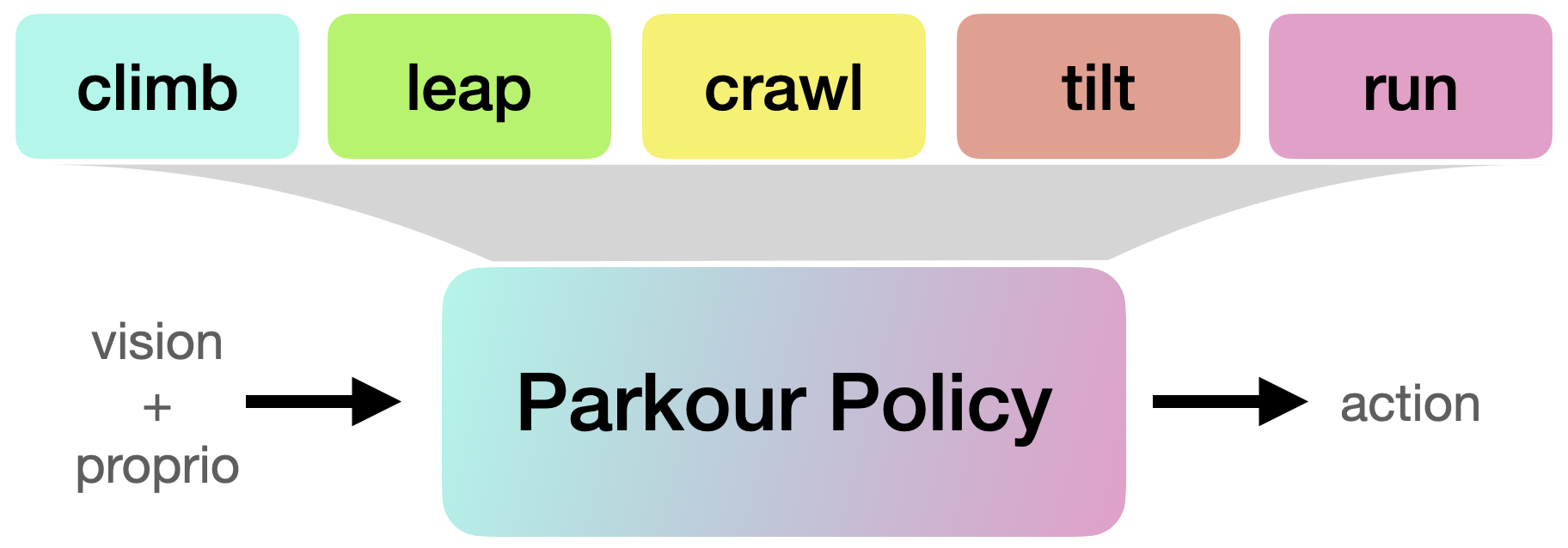
For more on humanoid control methods, see Humanoid Control Methods. For parkour with legged robots, see Parkour Learning.
Summary
In this post, we extended the H1 policy to dynamic motions:
- Running gaits with flight phase, GRF management, and elastic knee energy
- Command-conditioned policy for walk/run/turn/lateral in a single policy
- Sharp turning with coordinated hip yaw and lateral weight shift
- AMP for natural-looking gaits using motion capture references
- Emergent behaviors like arm swing and stance widening
Next post — Unitree H1-2: Enhanced Locomotion — explores the H1-2 with new hardware and loco-manipulation basics.
References
- AMP: Adversarial Motion Priors for Stylized Physics-Based Character Animation — Peng et al., SIGGRAPH 2021
- Expressive Whole-Body Control for Humanoid Robots — Cheng et al., RSS 2024
- Walk These Ways: Tuning Robot Control for Generalization — Margolis & Agrawal, CoRL 2023
- Learning Humanoid Locomotion with Transformers — Radosavovic et al., 2024