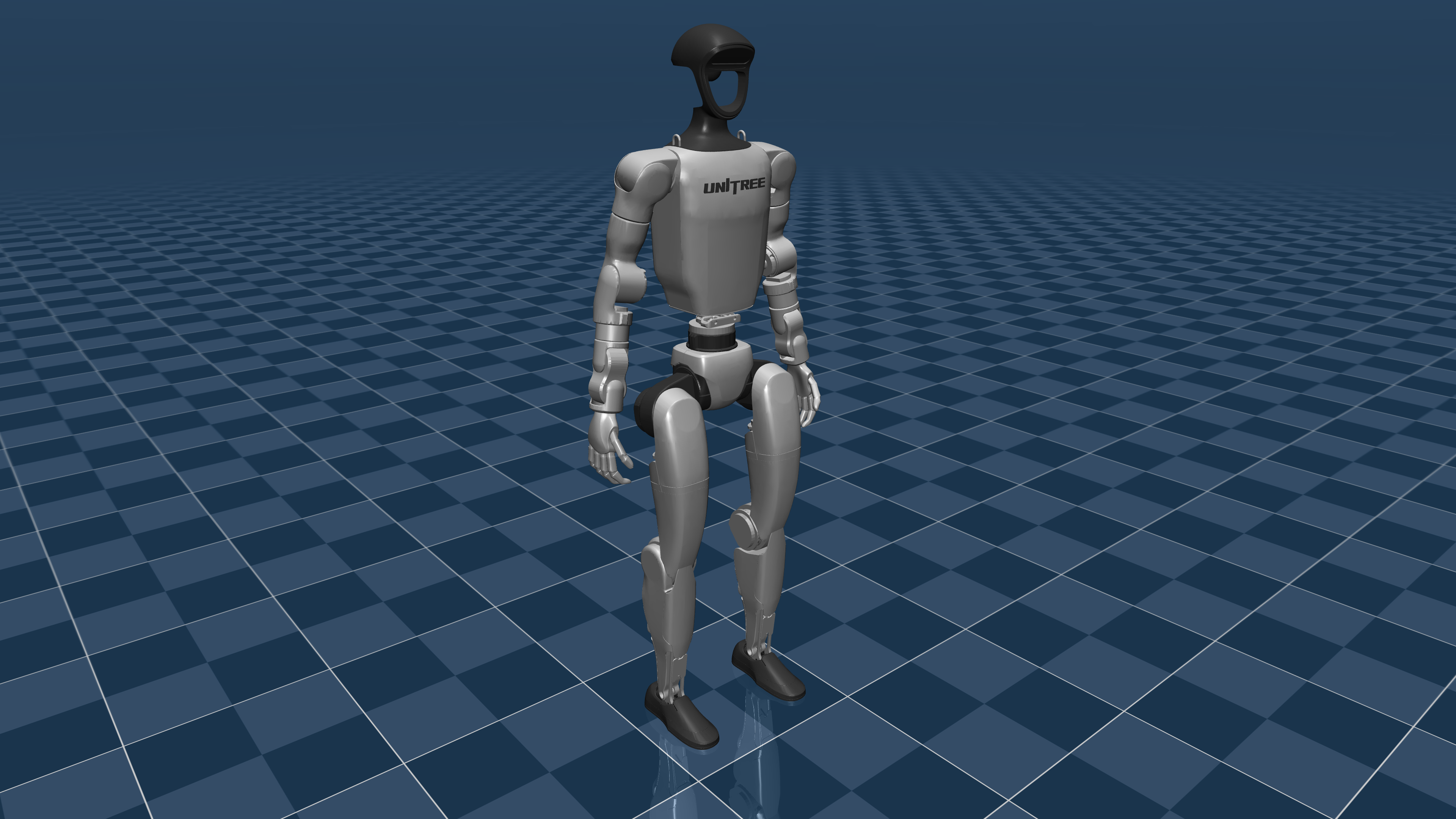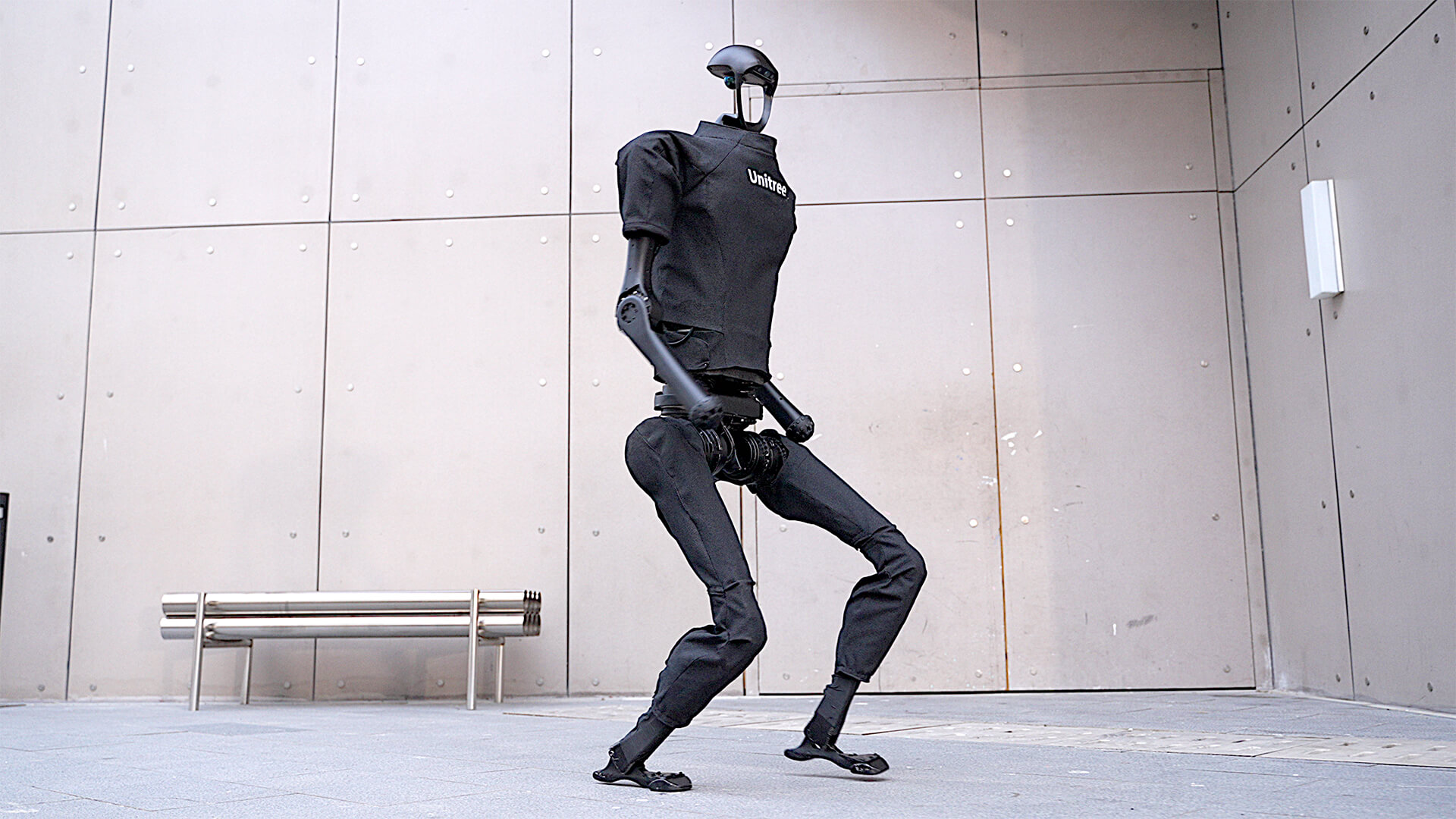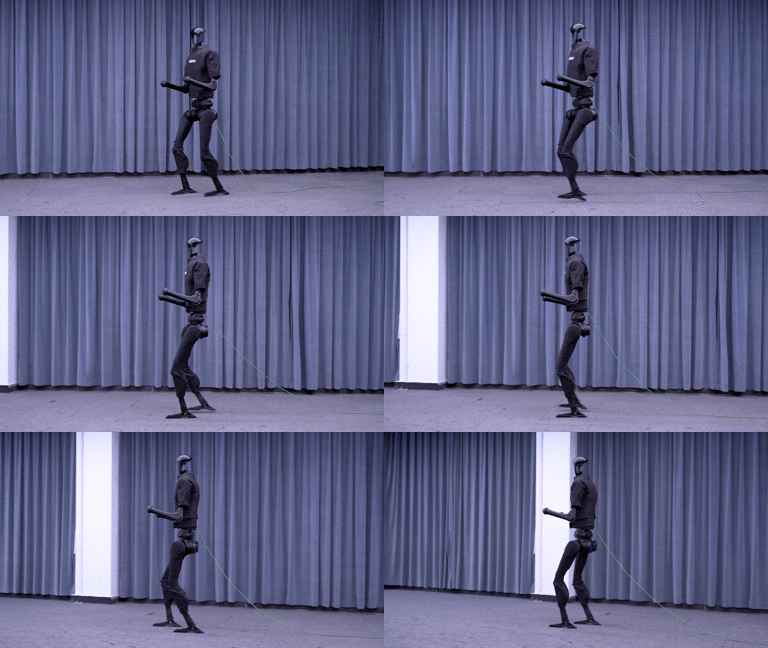
The Unitree H1 is a significant leap from the G1 — from 1.27m to 1.8m, from 35kg to 47kg. This size change is not simply a "scale up" — it fundamentally alters the dynamics, requiring a new reward function, new PD gains, and a different training strategy. In this post, we train a walking policy for the H1 and compare it in detail with the G1.
Unitree H1 vs G1: Detailed Comparison
| Parameter | G1 | H1 | Impact |
|---|---|---|---|
| Height | 1.27 m | 1.80 m | Higher CoM = harder to balance |
| Weight | 35 kg | 47 kg | Larger inertia = slower reactions |
| Leg DOF | 12 (6 per side) | 10 (5 per side) | H1 fewer DOF but stronger actuators |
| Ankle DOF | 2 (roll + pitch) | 1 (pitch only) | H1 harder lateral balance |
| Hip range | +/-30 deg | +/-25 deg | H1 more limited |
| Max torque (hip) | 88 Nm | 120 Nm | H1 stronger but heavier |
| Max torque (knee) | 139 Nm | 200 Nm | Needed to support weight |
| Max speed | ~2 m/s | ~3.3 m/s | H1 faster when well-trained |
H1-Specific Challenges
1. Higher center of mass: At 1.8m, the moment arm from CoM to feet is much longer. The same small push creates larger torques, requiring faster reactions to maintain balance.
2. Limited ankle design: H1 only has 1 DOF at the ankle (pitch) — no ankle roll. This means the robot cannot push laterally with the ankle and must use hip motion to compensate for lateral balance.
3. Longer swing leg: Longer legs have greater inertia during swing. More torque and precise timing are needed for adequate foot clearance.
Configuring H1 in Isaac Lab
"""
Unitree H1 environment configuration.
File: h1_env_cfg.py
"""
import omni.isaac.lab.sim as sim_utils
from omni.isaac.lab.assets import ArticulationCfg
from omni.isaac.lab.utils import configclass

@configclass
class H1RobotCfg:
    """Unitree H1 robot configuration."""

    robot = ArticulationCfg(
        prim_path="/World/envs/env_.*/Robot",
        spawn=sim_utils.UsdFileCfg(
            usd_path="datasets/robots/unitree/h1/h1.usd",
            activate_contact_sensors=True,
        ),
        init_state=ArticulationCfg.InitialStateCfg(
            pos=(0.0, 0.0, 1.05),       # Higher than G1 (0.75)
            joint_pos={
                # === Left leg (5 DOF) ===
                "left_hip_yaw": 0.0,
                "left_hip_roll": 0.0,
                "left_hip_pitch": -0.2,
                "left_knee": 0.4,
                "left_ankle": -0.2,
                # === Right leg (5 DOF) ===
                "right_hip_yaw": 0.0,
                "right_hip_roll": 0.0,
                "right_hip_pitch": -0.2,
                "right_knee": 0.4,
                "right_ankle": -0.2,
                # === Torso ===
                "torso": 0.0,
                # === Arms ===
                "left_shoulder_pitch": 0.3,
                "left_shoulder_roll": 0.0,
                "left_shoulder_yaw": 0.0,
                "left_elbow": 0.3,
                "right_shoulder_pitch": 0.3,
                "right_shoulder_roll": 0.0,
                "right_shoulder_yaw": 0.0,
                "right_elbow": 0.3,
            },
        ),
        actuators={
            "legs": sim_utils.DCMotorCfg(
                joint_names_expr=[
                    ".*hip.*", ".*knee.*", ".*ankle.*"
                ],
                stiffness={
                    ".*hip_yaw.*": 150.0,
                    ".*hip_roll.*": 150.0,
                    ".*hip_pitch.*": 200.0,
                    ".*knee.*": 250.0,
                    ".*ankle.*": 40.0,
                },
                damping={
                    ".*hip_yaw.*": 5.0,
                    ".*hip_roll.*": 5.0,
                    ".*hip_pitch.*": 8.0,
                    ".*knee.*": 10.0,
                    ".*ankle.*": 2.0,
                },
                effort_limit={
                    ".*hip.*": 120.0,
                    ".*knee.*": 200.0,
                    ".*ankle.*": 40.0,
                },
            ),
            "torso": sim_utils.DCMotorCfg(
                joint_names_expr=["torso"],
                stiffness=300.0,
                damping=10.0,
                effort_limit=200.0,
            ),
            "arms": sim_utils.DCMotorCfg(
                joint_names_expr=[".*shoulder.*", ".*elbow.*"],
                stiffness=100.0,
                damping=5.0,
                effort_limit=50.0,
            ),
        },
    )
Adapting Reward Function for H1
Key Changes from G1
"""
H1-specific reward adjustments.
File: h1_rewards.py
"""

class H1RewardsCfg:
    """Rewards for H1 — adjusted from G1."""

    # === Different target height ===
    base_height = {
        "target_height": 0.98,    # G1: 0.72, H1: 0.98
        "weight": -0.8,
    }

    # === Higher foot clearance ===
    foot_clearance = {
        "min_height": 0.08,        # G1: 0.06, H1: 0.08
        "weight": 0.4,
    }

    # === Lateral balance penalty (missing ankle roll) ===
    lateral_velocity_penalty = {
        "weight": -0.3,
    }

    # === Hip roll compensation reward ===
    hip_roll_balance = {
        "weight": 0.2,
    }

    # === Stride length ===
    stride_length = {
        "target": 0.6,             # G1: 0.4, H1: 0.6
        "weight": 0.15,
    }

    # === Longer feet air time ===
    feet_air_time = {
        "target": 0.35,            # G1: 0.3, H1: 0.35
        "weight": 0.2,
    }
Complete Implementation
import torch

def compute_h1_rewards(state, action, prev_action, command):
    """
    Optimized reward function for H1.
    Key differences from G1 are commented.
    """
    rewards = {}

    # 1. Velocity tracking (same as G1)
    vel_error = torch.sum(
        torch.square(command[:, :2] - state["base_lin_vel"][:, :2]),
        dim=1
    )
    rewards["vel_tracking"] = 1.5 * torch.exp(-vel_error / 0.25)

    # 2. Angular velocity tracking
    yaw_error = torch.square(command[:, 2] - state["base_ang_vel"][:, 2])
    rewards["yaw_tracking"] = 0.8 * torch.exp(-yaw_error / 0.25)

    # 3. Base height (DIFFERENT: higher target, larger weight)
    height_error = torch.square(state["base_height"] - 0.98)
    rewards["height"] = -0.8 * height_error

    # 4. Upright (same concept but more important for H1)
    orientation_error = torch.sum(
        torch.square(state["projected_gravity"][:, :2]), dim=1
    )
    rewards["upright"] = -1.5 * orientation_error  # G1: -1.0

    # 5. Lateral velocity penalty (NEW for H1)
    lat_vel = torch.abs(state["base_lin_vel"][:, 1])
    rewards["lateral_penalty"] = -0.3 * lat_vel

    # 6. Hip roll balance (NEW for H1)
    hip_roll_activity = torch.abs(state["joint_pos"][:, [1, 6]])
    gravity_lateral = torch.abs(state["projected_gravity"][:, 1])
    rewards["hip_roll_balance"] = 0.2 * torch.sum(
        hip_roll_activity * gravity_lateral.unsqueeze(1), dim=1
    )

    # 7. Foot clearance (DIFFERENT: higher threshold)
    swing_mask = state["foot_contact"] < 0.5
    foot_height = state["foot_height"]
    clearance = torch.where(
        swing_mask,
        torch.clamp(foot_height - 0.08, min=0.0),
        torch.zeros_like(foot_height)
    )
    rewards["clearance"] = 0.4 * torch.sum(clearance, dim=1)

    # 8. Stride length (NEW)
    stride = torch.abs(
        state["foot_positions"][:, 0, 0] - state["foot_positions"][:, 1, 0]
    )
    stride_error = torch.square(stride - 0.6)
    rewards["stride"] = 0.15 * torch.exp(-stride_error / 0.1)

    # 9-13. Regularization (similar to G1, scaled for H1)
    rewards["action_rate"] = -0.01 * torch.sum(
        torch.square(action - prev_action), dim=1
    )
    rewards["torque"] = -3e-5 * torch.sum(
        torch.square(state["torques"]), dim=1
    )
    rewards["joint_accel"] = -1e-4 * torch.sum(
        torch.square(state["joint_accel"]), dim=1
    )
    rewards["termination"] = -200.0 * state["terminated"].float()
    rewards["lin_vel_z"] = -0.5 * torch.square(state["base_lin_vel"][:, 2])

    total = sum(rewards.values())
    return total, rewards
PD Gains Tuning for H1
PD gains for H1 require careful tuning due to different moments of inertia:
class H1PDGainsTuner:
    """
    Guide for tuning PD gains for H1.
    Principle: Kp ~ proportional to mass * gravity * lever_arm
    """

    def compute_recommended_gains(self):
        """Compute PD gains based on physics."""

        mass_ratio = 47.0 / 35.0
        leg_ratio = 0.9 / 0.6

        gains = {
            "hip_pitch": {
                "kp": 200.0,
                "kd": 8.0,
            },
            "hip_roll": {
                "kp": 180.0,   # Higher than G1 for lateral stability
                "kd": 6.0,
            },
            "hip_yaw": {
                "kp": 150.0,
                "kd": 5.0,
            },
            "knee": {
                "kp": 250.0,
                "kd": 10.0,
            },
            "ankle": {
                "kp": 50.0,
                "kd": 3.0,
            },
        }

        print("=== H1 PD Gains (recommended) ===")
        for joint, g in gains.items():
            kd_ratio = g["kd"] / g["kp"] * 100
            print(f"  {joint}: Kp={g['kp']:.0f}, Kd={g['kd']:.1f} "
                  f"(Kd/Kp={kd_ratio:.1f}%)")

        return gains
Training Pipeline for H1
# Training H1 — takes longer than G1 (~1.5h on RTX 4090)
python source/standalone/workflows/rsl_rl/train.py \
    --task=Isaac-Velocity-Flat-H1-v0 \
    --num_envs=4096 \
    --max_iterations=8000 \
    --headless \
    --logger wandb \
    --wandb_project h1-locomotion

Comparing Learning Curves: H1 vs G1
import matplotlib.pyplot as plt
import numpy as np

def compare_learning_curves():
    """Compare H1 vs G1 training progress."""

    iterations = np.arange(0, 8000, 100)

    g1_reward = 20 * (1 - np.exp(-iterations / 1500)) + \
                np.random.normal(0, 0.5, len(iterations))
    g1_reward = np.clip(g1_reward, -50, 25)

    h1_reward = 22 * (1 - np.exp(-iterations / 2500)) + \
                np.random.normal(0, 0.8, len(iterations))
    h1_reward = np.clip(h1_reward, -50, 25)

    fig, axes = plt.subplots(1, 3, figsize=(18, 5))

    axes[0].plot(iterations, g1_reward, label="G1", color="blue", alpha=0.7)
    axes[0].plot(iterations, h1_reward, label="H1", color="red", alpha=0.7)
    axes[0].set_xlabel("Iteration")
    axes[0].set_ylabel("Total Reward")
    axes[0].set_title("Learning Curve Comparison")
    axes[0].legend()
    axes[0].grid(True, alpha=0.3)

    g1_ep = 20 * (1 - np.exp(-iterations / 800))
    h1_ep = 20 * (1 - np.exp(-iterations / 1200))
    axes[1].plot(iterations, g1_ep, label="G1", color="blue")
    axes[1].plot(iterations, h1_ep, label="H1", color="red")
    axes[1].set_xlabel("Iteration")
    axes[1].set_ylabel("Episode Length (s)")
    axes[1].set_title("Survival Time")
    axes[1].legend()

    g1_vel = 1.5 * (1 - np.exp(-iterations / 2000))
    h1_vel = 2.0 * (1 - np.exp(-iterations / 3000))
    axes[2].plot(iterations, g1_vel, label="G1 (max 2.0)", color="blue")
    axes[2].plot(iterations, h1_vel, label="H1 (max 3.3)", color="red")
    axes[2].set_xlabel("Iteration")
    axes[2].set_ylabel("Max Velocity (m/s)")
    axes[2].set_title("Velocity Achievement")
    axes[2].legend()

    plt.tight_layout()
    plt.savefig("h1_vs_g1_learning.png", dpi=150)

compare_learning_curves()
Key Observations
| Metric | G1 | H1 | Explanation |
|---|---|---|---|
| First stable walk | ~500 iter | ~800 iter | H1 harder to balance |
| Convergence | ~3000 iter | ~5000 iter | H1 needs more exploration |
| Max velocity | ~2.0 m/s | ~3.3 m/s | H1 has longer stride |
| CoT | 0.65 | 0.72 | H1 uses more energy (heavier) |
| Fall recovery | Medium | Hard | High CoM makes recovery difficult |
For more on the humanoid landscape, see Humanoid Robotics Landscape. For RL locomotion on quadrupeds (a simpler problem), see Quadruped RL Locomotion.
Summary
Training H1 differs from G1 in several important ways:
- 1.8m height means higher CoM, requiring stronger upright rewards and larger PD gains
- Missing ankle roll must be compensated by hip roll, requiring new reward terms
- Longer legs mean 0.6m stride (G1: 0.4m) and 8cm foot clearance (G1: 6cm)
- Slower training at 8000 iterations (~1.5h) vs 5000 iterations (1h) for G1
- Higher max velocity of 3.3 m/s (G1: 2.0 m/s) when well-trained
Next post — Unitree H1: Running, Turning & Dynamic Motions — pushes the H1 to its limits with running, turning, and dynamic movements.
References
- Unitree H1 Technical Documentation — Unitree Robotics, 2024
- Expressive Whole-Body Control for Humanoid Robots — Cheng et al., RSS 2024
- Humanoid-Gym: Zero-Shot Sim-to-Real Transfer — Gu et al., 2024
- Learning Humanoid Locomotion with Transformers — Radosavovic et al., 2024