Introduction: Two Hands in Action
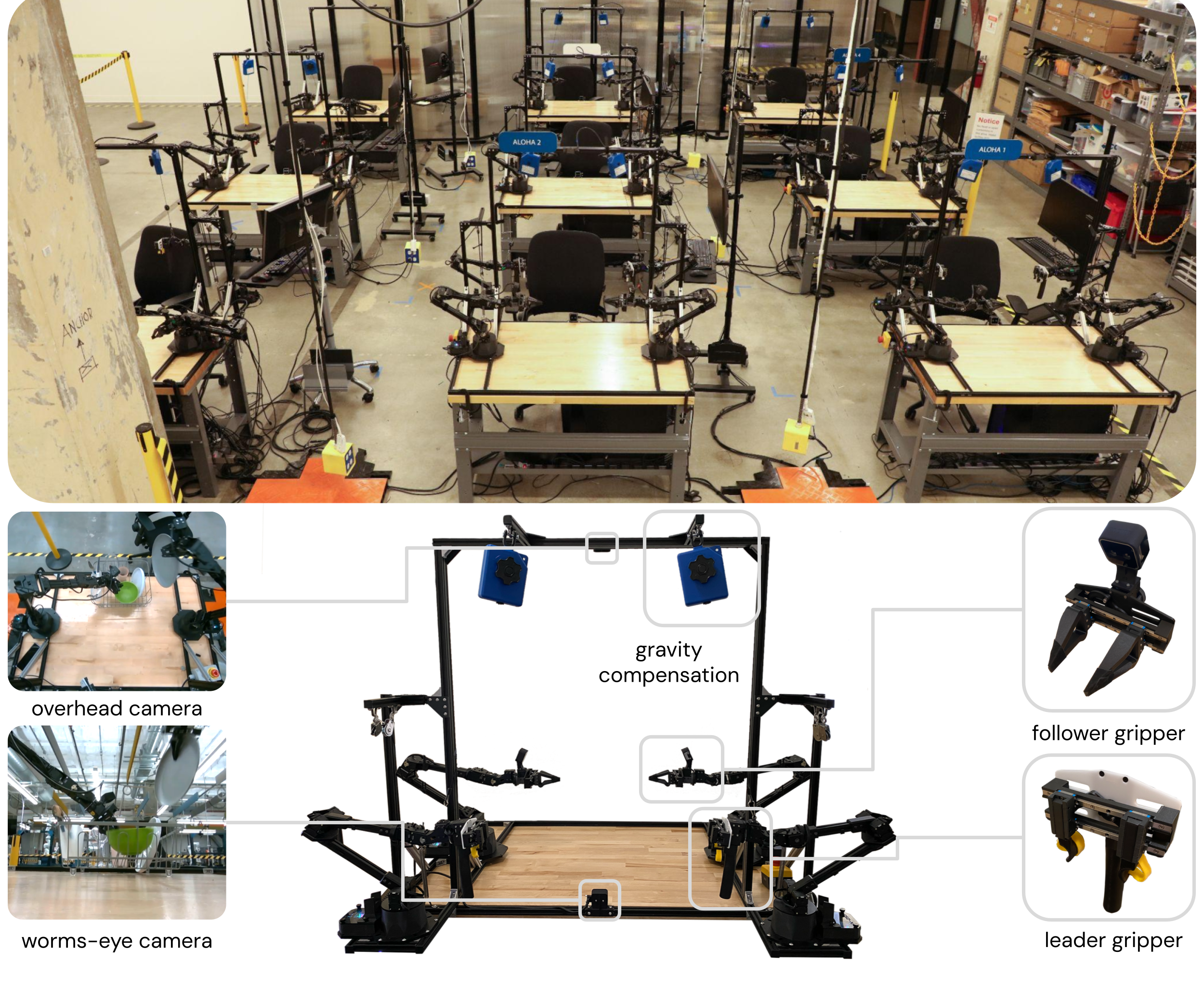
In the previous post, we set up and calibrated a dual-arm system. Now it's time to put it to work with practical bimanual tasks. These are tasks that single-arm robots simply cannot do — and the very reason dual-arm robots are attracting enormous attention in the robotics community.
This post will guide you through training bimanual policies for three classic tasks: towel folding, water pouring, and assembly. We'll also compare the performance of ACT and Diffusion Policy on bimanual tasks, analyze failure modes, and provide solutions.

Task 1: Towel Folding
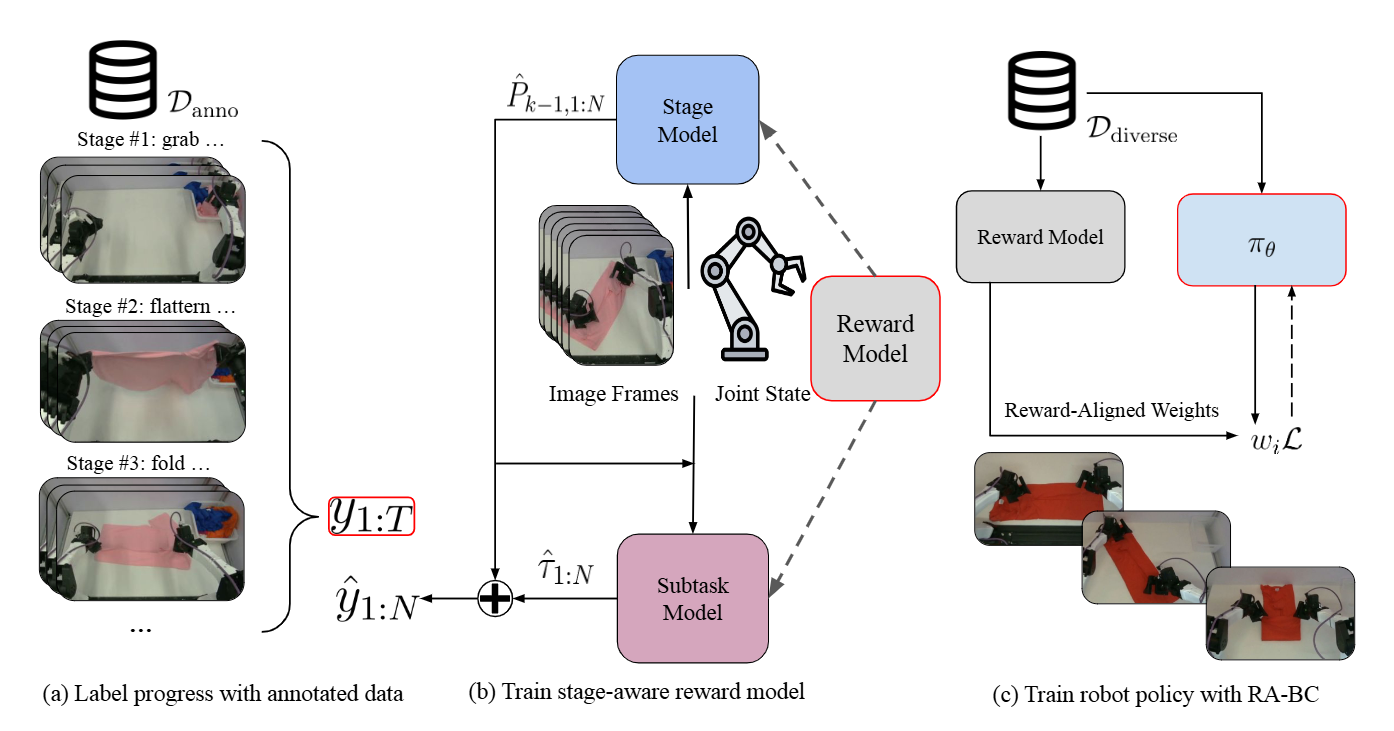
Towel folding is a classic benchmark for bimanual manipulation because it requires:
- Coordination: Both hands must move synchronously
- Deformable object handling: Towels are soft, hard to predict
- Precision: Towel edges must align properly
Towel Folding Task Setup
import numpy as np
from dataclasses import dataclass
from typing import List

@dataclass
class TowelFoldingTask:
    """Configuration for towel folding task.

    Phases:
    1. Approach: Both hands approach 2 corners
    2. Grasp: Firmly grip 2 corners
    3. Lift: Lift the towel
    4. Fold: Fold in half (left folds to right or vice versa)
    5. Release: Release the folded towel
    """
    towel_size: tuple = (0.3, 0.3)  # 30x30 cm
    towel_position: np.ndarray = None
    fold_type: str = "half"  # "half", "quarter", "triangle"

    def __post_init__(self):
        if self.towel_position is None:
            self.towel_position = np.array([0.3, 0.0, 0.01])

    @property
    def corner_positions(self) -> dict:
        """Positions of 4 towel corners."""
        cx, cy, cz = self.towel_position
        w, h = self.towel_size
        return {
            "top_left": np.array([cx - w/2, cy + h/2, cz]),
            "top_right": np.array([cx + w/2, cy + h/2, cz]),
            "bottom_left": np.array([cx - w/2, cy - h/2, cz]),
            "bottom_right": np.array([cx + w/2, cy - h/2, cz]),
        }

    def get_grasp_points(self) -> tuple:
        """Return 2 grasp points for the fold type."""
        corners = self.corner_positions
        if self.fold_type == "half":
            return corners["top_left"], corners["top_right"]
        elif self.fold_type == "triangle":
            return corners["top_left"], corners["bottom_right"]
        return corners["top_left"], corners["top_right"]

def collect_towel_folding_data(robot, dataset, num_episodes=100):
    """Collect data for towel folding task.

    Tips:
    - Use thin, square towel, not too large (30x30cm)
    - Lay towel flat before each episode
    - Fold slowly and smoothly for easier policy learning
    - Record at least 100 episodes
    """
    task = TowelFoldingTask()

    for ep in range(num_episodes):
        print(f"\nEpisode {ep+1}/{num_episodes}")
        print("Lay towel flat, press Enter to start...")
        input()

        step = 0
        recording = True

        while recording:
            obs = robot.get_observation()

            left_target = robot.leader_arms["left"].read("Present_Position")
            right_target = robot.leader_arms["right"].read("Present_Position")

            robot.follower_arms["left"].write("Goal_Position", left_target)
            robot.follower_arms["right"].write("Goal_Position", right_target)

            left_state = robot.follower_arms["left"].read("Present_Position")
            right_state = robot.follower_arms["right"].read("Present_Position")

            dataset.add_frame({
                "observation.images.top": obs["top_camera"],
                "observation.images.left_wrist": obs["left_wrist_camera"],
                "observation.images.right_wrist": obs["right_wrist_camera"],
                "observation.state": np.concatenate([left_state, right_state]),
                "action": np.concatenate([left_target, right_target]),
            })

            step += 1
            if step > 400:
                recording = False

        dataset.save_episode()

    return dataset
Training Bimanual Folding Policy
from lerobot.common.policies.act.configuration_act import ACTConfig
from lerobot.common.policies.act.modeling_act import ACTPolicy
import torch

def train_folding_policy(dataset_repo_id, num_epochs=300):
    """Train ACT policy for towel folding."""
    from lerobot.common.datasets.lerobot_dataset import LeRobotDataset

    dataset = LeRobotDataset(dataset_repo_id)

    config = ACTConfig(
        input_shapes={
            "observation.images.top": [3, 480, 640],
            "observation.images.left_wrist": [3, 480, 640],
            "observation.images.right_wrist": [3, 480, 640],
            "observation.state": [14],
        },
        output_shapes={"action": [14]},
        input_normalization_modes={
            "observation.images.top": "mean_std",
            "observation.images.left_wrist": "mean_std",
            "observation.images.right_wrist": "mean_std",
            "observation.state": "min_max",
        },
        output_normalization_modes={"action": "min_max"},

        # Folding needs large chunks for smooth trajectories
        chunk_size=100,
        n_action_steps=100,
        dim_model=512,
        n_heads=8,
        n_layers=4,
        use_vae=True,
        latent_dim=32,
        kl_weight=10.0,
    )

    policy = ACTPolicy(config)
    device = torch.device("cuda")
    policy.to(device)

    optimizer = torch.optim.AdamW(policy.parameters(), lr=1e-5, weight_decay=1e-4)
    scheduler = torch.optim.lr_scheduler.CosineAnnealingLR(
        optimizer, T_max=num_epochs, eta_min=1e-6
    )
    dataloader = torch.utils.data.DataLoader(
        dataset, batch_size=8, shuffle=True, num_workers=4
    )

    best_loss = float('inf')

    for epoch in range(num_epochs):
        epoch_loss = 0
        n_batches = 0

        for batch in dataloader:
            batch = {k: v.to(device) for k, v in batch.items()}
            output = policy.forward(batch)
            loss = output["loss"]

            optimizer.zero_grad()
            loss.backward()
            torch.nn.utils.clip_grad_norm_(policy.parameters(), 10.0)
            optimizer.step()

            epoch_loss += loss.item()
            n_batches += 1

        scheduler.step()
        avg_loss = epoch_loss / n_batches

        if avg_loss < best_loss:
            best_loss = avg_loss
            torch.save(policy.state_dict(), "best_folding_policy.pt")

        if (epoch + 1) % 25 == 0:
            print(f"Epoch {epoch+1}/{num_epochs} | Loss: {avg_loss:.4f} | "
                  f"Best: {best_loss:.4f}")

    return policy
Task 2: Water Pouring
Pouring requires precise temporal coordination — one hand holds the cup while the other tilts the pitcher:
@dataclass
class PouringTask:
    """Configuration for water pouring task.

    Right arm: Holds pitcher
    Left arm: Holds cup

    Phases:
    1. Grasp pitcher (right) and cup (left)
    2. Lift both
    3. Align pitcher above cup
    4. Tilt pitcher gradually (30 -> 60 -> 75 degrees)
    5. Return pitcher upright
    6. Place both down
    """
    pitcher_volume_ml: float = 500
    cup_capacity_ml: float = 250
    pour_angle_deg: float = 75
    pour_speed: float = 0.5

    def get_pour_trajectory(self, n_steps=100):
        """Generate trajectory for pouring phase."""
        up_steps = n_steps // 2
        tilt_up = np.linspace(0, np.deg2rad(self.pour_angle_deg), up_steps)

        down_steps = n_steps - up_steps
        tilt_down = np.linspace(np.deg2rad(self.pour_angle_deg), 0, down_steps)

        return np.concatenate([tilt_up, tilt_down])

def evaluate_pouring(policy, env, n_episodes=30):
    """Evaluate pouring policy.

    Metrics:
    - Pour accuracy: Water in cup / total water poured
    - Spill rate: Water spilled outside
    - Cup stability: Whether cup was dropped
    """
    results = {
        "pour_accuracy": [],
        "spill_count": 0,
        "cup_dropped": 0,
        "success": 0,
    }

    for ep in range(n_episodes):
        obs, info = env.reset()
        done = False

        while not done:
            action = policy.predict(obs)
            obs, reward, terminated, truncated, info = env.step(action)
            done = terminated or truncated

        water_in_cup = info.get("water_in_cup", 0)
        water_spilled = info.get("water_spilled", 0)
        total_water = water_in_cup + water_spilled

        if total_water > 0:
            accuracy = water_in_cup / total_water
            results["pour_accuracy"].append(accuracy)

        if info.get("cup_dropped", False):
            results["cup_dropped"] += 1
        if water_spilled > 10:
            results["spill_count"] += 1
        if accuracy > 0.9 and not info.get("cup_dropped", False):
            results["success"] += 1

    avg_accuracy = np.mean(results["pour_accuracy"]) if results["pour_accuracy"] else 0
    print(f"Success rate: {results['success']/n_episodes:.1%}")
    print(f"Pour accuracy: {avg_accuracy:.1%}")

    return results

Task 3: Assembly
Assembly tasks require contact coordination — one hand holds, the other manipulates:
@dataclass
class AssemblyTask:
    """Configuration for assembly task.

    Example: Screwing a bottle cap
    Left arm: Holds bottle
    Right arm: Screws cap
    """
    task_type: str = "screw_cap"

    def get_subtasks(self) -> List[str]:
        if self.task_type == "screw_cap":
            return [
                "grasp_bottle_left",
                "grasp_cap_right",
                "align_cap_to_bottle",
                "screw_clockwise",
                "verify_tight",
                "release_both",
            ]
        elif self.task_type == "peg_in_hole":
            return [
                "grasp_base_left",
                "grasp_peg_right",
                "align_peg_to_hole",
                "insert_peg",
                "verify_inserted",
                "release_both",
            ]
        return []

def train_assembly_policy(dataset_repo_id):
    """Train policy for assembly task.

    Assembly needs:
    - Smaller chunk_size (high precision)
    - Wrist cameras are critical (close-up contact)
    - Force feedback if available
    """
    from lerobot.common.policies.diffusion.configuration_diffusion import DiffusionConfig
    from lerobot.common.policies.diffusion.modeling_diffusion import DiffusionPolicy

    config = DiffusionConfig(
        input_shapes={
            "observation.images.top": [3, 480, 640],
            "observation.images.left_wrist": [3, 480, 640],
            "observation.images.right_wrist": [3, 480, 640],
            "observation.state": [14],
        },
        output_shapes={"action": [14]},
        input_normalization_modes={
            "observation.images.top": "mean_std",
            "observation.images.left_wrist": "mean_std",
            "observation.images.right_wrist": "mean_std",
            "observation.state": "min_max",
        },
        output_normalization_modes={"action": "min_max"},

        num_inference_steps=50,
        down_dims=[256, 512, 1024],
        n_obs_steps=2,
        horizon=16,
        n_action_steps=8,
        noise_scheduler_type="DDIM",
        vision_backbone="resnet18",
        crop_shape=[84, 84],
    )

    policy = DiffusionPolicy(config)
    return policy
ACT vs Diffusion Policy for Bimanual: Comparison
Benchmark Results (Typical)
| Task | ACT | Diffusion Policy | Notes |
|---|---|---|---|
| Towel Folding | 65% | 72% | Diffusion better with deformable |
| Pouring | 78% | 75% | ACT better with smooth trajectories |
| Assembly (cap) | 55% | 68% | Diffusion better with contact-rich |
| Cube Transfer | 85% | 82% | ACT better with simple tasks |
| Inference | 8ms | 25ms (DDIM) | ACT 3x faster |
Failure Modes and Fixes
Common Bimanual Failure Modes
BIMANUAL_FAILURE_MODES = {
    "temporal_desync": {
        "description": "Arms are not synchronized — one moves faster",
        "frequency": "30% of failures",
        "fix": [
            "Increase chunk_size for longer planning horizon",
            "Add temporal sync loss penalty",
            "Collect data with more consistent speed",
        ],
    },
    "grasp_slip": {
        "description": "One arm drops object mid-task",
        "frequency": "25% of failures",
        "fix": [
            "Add force observation if sensor available",
            "Train separate grasp maintenance policy",
            "Increase gripper action frequency",
        ],
    },
    "contact_collision": {
        "description": "Arms collide with each other",
        "frequency": "20% of failures",
        "fix": [
            "Add self-collision penalty during training",
            "Use workspace separation constraints",
            "Collect data more carefully, avoiding collisions",
        ],
    },
    "wrong_sequence": {
        "description": "Sub-tasks executed in wrong order",
        "frequency": "15% of failures",
        "fix": [
            "Use hierarchical policy (post 5)",
            "Add sub-task indicator in observation",
            "Curriculum learning from simple to complex",
        ],
    },
    "overshoot": {
        "description": "Excessive movement — pours too much, folds too hard",
        "frequency": "10% of failures",
        "fix": [
            "Reduce action magnitude during training",
            "Use action smoothing (EMA)",
            "Add boundary constraints",
        ],
    },
}

def analyze_failures(episodes, success_threshold=0.8):
    """Analyze failure modes from evaluation episodes."""
    failures = {mode: 0 for mode in BIMANUAL_FAILURE_MODES}
    total_failures = 0

    for ep in episodes:
        if ep["success_rate"] < success_threshold:
            total_failures += 1

            if ep.get("arm_desync", 0) > 0.1:
                failures["temporal_desync"] += 1
            if ep.get("grasp_lost", False):
                failures["grasp_slip"] += 1
            if ep.get("self_collision", False):
                failures["contact_collision"] += 1

    print(f"Total failures: {total_failures}/{len(episodes)}")
    for mode, count in sorted(failures.items(), key=lambda x: -x[1]):
        if count > 0:
            pct = count / total_failures * 100
            print(f"  {mode}: {count} ({pct:.0f}%)")
Temporal Synchronization
class TemporalSyncModule:
    """Module for synchronizing actions between 2 arms.

    Ensures left and right arms move synchronously,
    especially critical for contact-rich tasks.
    """

    def __init__(self, sync_weight=0.1):
        self.sync_weight = sync_weight

    def compute_sync_loss(self, left_actions, right_actions):
        """Compute sync loss between arms.

        Penalizes when velocity difference is too large.
        """
        left_vel = left_actions[:, 1:] - left_actions[:, :-1]
        right_vel = right_actions[:, 1:] - right_actions[:, :-1]

        left_speed = torch.norm(left_vel, dim=-1)
        right_speed = torch.norm(right_vel, dim=-1)

        speed_ratio = (left_speed + 1e-6) / (right_speed + 1e-6)
        sync_loss = torch.mean((speed_ratio - 1.0) ** 2)

        return self.sync_weight * sync_loss
Reference Papers
- ALOHA 2: An Enhanced Low-Cost Hardware for Bimanual Teleoperation — Aldaco et al., 2024 — Hardware upgrades and results
- Bi-KVIL: Keypoints-based Visual Imitation Learning for Bimanual Manipulation — Grotz et al., CoRL 2024 — Keypoint-based bimanual approach
- ACT: Learning Fine-Grained Bimanual Manipulation — Zhao et al., RSS 2023 — Foundation paper for bimanual ACT
Conclusion and Next Steps
Bimanual manipulation unlocks tasks that single-arm robots cannot perform. Key insights:
- Towel folding: Deformable objects need more data, Diffusion Policy often better
- Pouring: Temporal precision favors ACT with smooth chunks
- Assembly: Contact-rich tasks favor Diffusion Policy + wrist cameras
- Failure analysis matters more than just looking at success rates
The next post — Mobile Manipulation — adds a new dimension: movement. The robot not only manipulates but must also navigate + manipulate.
Related Posts
- Dual-Arm Setup & Calibration — Setup before running tasks
- Bimanual Manipulation Overview — Bimanual theory overview
- Long-Horizon Tasks — Planning for multi-step tasks