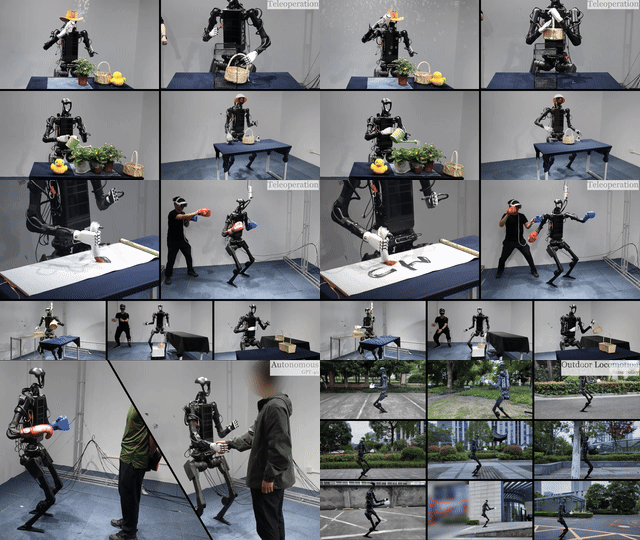
Pure locomotion is only half the problem. A humanoid robot becomes truly useful when it can walk and work simultaneously — carry boxes from storage to trucks, push carts in factories, open doors and walk through. This is the loco-manipulation problem: combining locomotion quality with task completion in a single policy.
Building on H1-2 loco-manipulation basics, this post dives deep into complex tasks and training strategies.
Why Loco-Manipulation Is Harder Than the Sum of Its Parts
Challenges
| Challenge | Explanation |
|---|---|
| Dynamic CoM shift | Carrying a 5kg object shifts CoM, invalidating locomotion policy |
| Multi-objective | Balance + track velocity + hold object + reach target simultaneously |
| Contact richness | Feet-ground + hands-object + object-environment = many contact modes |
| Temporal coupling | Must coordinate timing: step, reach, grasp, lift, step again |
| Observation complexity | Object pose, contact forces, task state + locomotion state |
Hierarchical vs End-to-End
# === Approach 1: Hierarchical (easier, modular) ===
class HierarchicalLocoManip:
    """
    High-level task planner -> Mid-level: loco + arm commands
    -> Low-level: joint torques
    """
    def forward(self, task_obs):
        walk_cmd, arm_cmd = self.task_planner(task_obs)
        leg_actions = self.loco_policy(self.loco_obs, walk_cmd)
        arm_actions = self.arm_policy(self.arm_obs, arm_cmd)
        return torch.cat([leg_actions, arm_actions], dim=1)

# === Approach 2: End-to-End (harder, higher potential) ===
class EndToEndLocoManip:
    """Single policy: full observation -> all joint actions."""
    def forward(self, full_obs):
        all_actions = self.policy(full_obs)
        return all_actions
| Hierarchical | End-to-End | |
|---|---|---|
| Pros | Modular, reuse loco policy, easy debug | Optimal coordination, emergent behaviors |
| Cons | Sub-optimal coupling, hand-designed interface | Needs more data, hard to train and debug |
| Training time | ~5h | ~20h+ |
| Best for | Production, clear task structure | Research, complex interactions |
Task 1: Carry Box While Walking
import torch

class CarryBoxTask:
    """
    Task: pick up box from table, carry to destination, place down.
    """

    def __init__(self, num_envs, device="cuda"):
        self.num_envs = num_envs
        self.device = device
        self.box_size = [0.3, 0.3, 0.2]
        self.box_mass_range = [1.0, 8.0]

        self.APPROACH = 0
        self.GRASP = 1
        self.CARRY = 2
        self.PLACE = 3

    def reset(self, env_ids):
        n = len(env_ids)

        self.box_mass = torch.empty(n, device=self.device).uniform_(
            self.box_mass_range[0], self.box_mass_range[1]
        )

        self.box_start = torch.zeros(n, 3, device=self.device)
        self.box_start[:, 0] = torch.empty(n, device=self.device).uniform_(1, 2)
        self.box_start[:, 2] = 0.8

        self.place_target = torch.zeros(n, 3, device=self.device)
        self.place_target[:, 0] = torch.empty(n, device=self.device).uniform_(3, 5)
        self.place_target[:, 2] = 0.8

        self.phase = torch.zeros(n, dtype=torch.long, device=self.device)

    def compute_observation(self, robot_state, box_state):
        """Task-specific observations."""
        obs = []

        box_rel = box_state["position"] - robot_state["base_pos"]
        obs.append(box_rel)

        obs.append(box_state["orientation"])

        target_rel = self.place_target - robot_state["base_pos"]
        obs.append(target_rel)

        phase_onehot = torch.nn.functional.one_hot(
            self.phase, num_classes=4
        ).float()
        obs.append(phase_onehot)

        obs.append(robot_state["grasp_force"].unsqueeze(1))

        for hand in ["left", "right"]:
            hand_pos = robot_state[f"{hand}_hand_pos"]
            dist = torch.norm(hand_pos - box_state["position"], dim=1)
            obs.append(dist.unsqueeze(1))

        return torch.cat(obs, dim=1)

    def compute_reward(self, robot_state, box_state, action):
        """Multi-phase reward."""
        rewards = {}

        hand_box_dist = torch.min(
            torch.norm(robot_state["left_hand_pos"] - box_state["position"], dim=1),
            torch.norm(robot_state["right_hand_pos"] - box_state["position"], dim=1),
        )

        # Phase 0: APPROACH
        approach_mask = (self.phase == self.APPROACH).float()
        robot_box_dist = torch.norm(
            robot_state["base_pos"][:, :2] - self.box_start[:, :2], dim=1
        )
        rewards["approach"] = 0.5 * approach_mask * torch.exp(
            -robot_box_dist / 1.0
        )

        close_to_box = (robot_box_dist < 0.5) & (self.phase == self.APPROACH)
        self.phase[close_to_box] = self.GRASP

        # Phase 1: GRASP
        grasp_mask = (self.phase == self.GRASP).float()
        rewards["reach"] = 0.8 * grasp_mask * torch.exp(
            -hand_box_dist / 0.1
        )

        grasped = (hand_box_dist < 0.05) & (self.phase == self.GRASP)
        self.phase[grasped] = self.CARRY

        # Phase 2: CARRY
        carry_mask = (self.phase == self.CARRY).float()
        box_target_dist = torch.norm(
            box_state["position"][:, :2] - self.place_target[:, :2], dim=1
        )
        rewards["carry_progress"] = 1.0 * carry_mask * torch.exp(
            -box_target_dist / 2.0
        )

        box_tilt = torch.norm(box_state["angular_velocity"], dim=1)
        rewards["box_stability"] = -0.3 * carry_mask * box_tilt

        box_height_error = torch.abs(box_state["position"][:, 2] - 0.9)
        rewards["box_height"] = -0.5 * carry_mask * box_height_error

        near_target = (box_target_dist < 0.3) & (self.phase == self.CARRY)
        self.phase[near_target] = self.PLACE

        # Phase 3: PLACE
        place_mask = (self.phase == self.PLACE).float()
        place_dist = torch.norm(
            box_state["position"] - self.place_target, dim=1
        )
        rewards["place"] = 2.0 * place_mask * torch.exp(
            -place_dist / 0.05
        )

        task_complete = (place_dist < 0.1) & (self.phase == self.PLACE)
        rewards["completion_bonus"] = 10.0 * task_complete.float()

        total = sum(rewards.values())
        return total, rewards

Task 2: Push Cart
class PushCartTask:
    """
    Task: push a cart from point A to B.
    Challenge: maintain contact while walking.
    """

    def __init__(self):
        self.cart_friction = 0.3
        self.cart_mass = 15.0

    def compute_reward(self, robot_state, cart_state, target_pos):
        rewards = {}

        cart_target_dist = torch.norm(
            cart_state["position"][:, :2] - target_pos[:, :2], dim=1
        )
        rewards["cart_progress"] = 1.0 * torch.exp(-cart_target_dist / 3.0)

        left_contact = robot_state["left_hand_contact_force"]
        right_contact = robot_state["right_hand_contact_force"]
        contact_reward = torch.min(left_contact, right_contact)
        rewards["contact"] = 0.3 * torch.clamp(contact_reward, max=1.0)

        cart_heading = cart_state["heading"]
        target_heading = torch.atan2(
            target_pos[:, 1] - cart_state["position"][:, 1],
            target_pos[:, 0] - cart_state["position"][:, 0],
        )
        heading_error = torch.abs(cart_heading - target_heading)
        rewards["heading"] = 0.2 * torch.exp(-heading_error / 0.3)

        cart_accel = torch.norm(cart_state["acceleration"][:, :2], dim=1)
        rewards["smooth_push"] = -0.1 * cart_accel

        total = sum(rewards.values())
        return total, rewards
Task 3: Open Door + Walk Through
class OpenDoorTask:
    """
    Most complex task: open door + walk through.
    Requires precise coordination between arm and legs.
    """

    def __init__(self):
        self.door_width = 0.9
        self.handle_height = 1.0
        self.door_mass = 8.0

        self.APPROACH_DOOR = 0
        self.REACH_HANDLE = 1
        self.TURN_HANDLE = 2
        self.PUSH_DOOR = 3
        self.WALK_THROUGH = 4

    def compute_reward(self, robot_state, door_state):
        rewards = {}

        approach_mask = (self.phase == self.APPROACH_DOOR).float()
        door_dist = torch.norm(
            robot_state["base_pos"][:, :2] - door_state["handle_pos"][:, :2],
            dim=1
        )
        rewards["approach"] = 0.3 * approach_mask * torch.exp(
            -door_dist / 1.0
        )

        reach_mask = (self.phase == self.REACH_HANDLE).float()
        hand_handle_dist = torch.norm(
            robot_state["right_hand_pos"] - door_state["handle_pos"],
            dim=1
        )
        rewards["reach_handle"] = 0.5 * reach_mask * torch.exp(
            -hand_handle_dist / 0.05
        )

        turn_mask = (self.phase == self.TURN_HANDLE).float()
        handle_angle = door_state["handle_angle"]
        rewards["turn_handle"] = 0.5 * turn_mask * (
            handle_angle / (torch.pi / 4)
        )

        push_mask = (self.phase == self.PUSH_DOOR).float()
        door_angle = door_state["door_angle"]
        rewards["push_door"] = 1.0 * push_mask * (
            door_angle / (torch.pi / 2)
        )

        walk_mask = (self.phase == self.WALK_THROUGH).float()
        through_door = robot_state["base_pos"][:, 0] > door_state["frame_pos"][:, 0] + 0.5
        rewards["walk_through"] = 5.0 * walk_mask * through_door.float()

        upright = torch.sum(
            torch.square(robot_state["projected_gravity"][:, :2]), dim=1
        )
        rewards["upright"] = -1.5 * upright
        rewards["termination"] = -200.0 * robot_state["terminated"].float()

        total = sum(rewards.values())
        return total, rewards
Full Training Pipeline
class LocoManipTrainer:
    """End-to-end training pipeline for loco-manipulation tasks."""

    def __init__(self, env, task, device="cuda"):
        self.env = env
        self.task = task
        self.device = device

        import torch.nn as nn
        self.policy = nn.Sequential(
            nn.Linear(78 + 17, 512),
            nn.ELU(),
            nn.Linear(512, 512),
            nn.ELU(),
            nn.Linear(512, 256),
            nn.ELU(),
            nn.Linear(256, 35),
        ).to(device)

        self.optimizer = torch.optim.Adam(self.policy.parameters(), lr=3e-4)

    def train(self, num_iterations=20000):
        for iteration in range(num_iterations):
            obs = self.env.get_observations()
            task_obs = self.task.compute_observation(
                self.env.robot_state, self.env.object_state
            )
            full_obs = torch.cat([obs, task_obs], dim=1)

            actions = self.policy(full_obs)
            next_obs, base_reward, done, info = self.env.step(actions)

            task_reward, task_reward_terms = self.task.compute_reward(
                self.env.robot_state, self.env.object_state, actions
            )

            total_reward = base_reward + task_reward

            loss = -total_reward.mean()
            self.optimizer.zero_grad()
            loss.backward()
            torch.nn.utils.clip_grad_norm_(self.policy.parameters(), 1.0)
            self.optimizer.step()

            if iteration % 500 == 0:
                success_rate = info.get("task_success_rate", 0)
                print(f"Iter {iteration}: reward={total_reward.mean():.2f}, "
                      f"success={success_rate:.1%}")
For locomotion fundamentals, see Locomotion Basics. For RL basics, see RL for Robotics.

Summary
Loco-manipulation is a significant step beyond pure locomotion:
- Multi-phase tasks (approach, grasp, carry, place) require complex reward design
- Dynamic CoM shift when carrying objects forces the locomotion policy to adapt online
- Hierarchical vs end-to-end: hierarchical is easier for production, end-to-end has more potential
- 3 task examples: carry box, push cart, open door — each with unique challenges
- Training time: 10-20h for loco-manipulation vs 1-2h for pure locomotion
Next post — Humanoid Parkour — tackles jumping, climbing, and obstacle courses.
References
- HumanPlus: Humanoid Shadowing and Imitation from Humans — Fu et al., 2024
- OmniH2O: Universal and Dexterous Human-to-Humanoid Whole-Body Teleoperation and Learning — He et al., 2024
- Humanoid Loco-Manipulation with Learned Whole-Body Control — Chen et al., CoRL 2024
- Learning Whole-Body Manipulation for Quadrupedal Robot — Ha et al., 2024