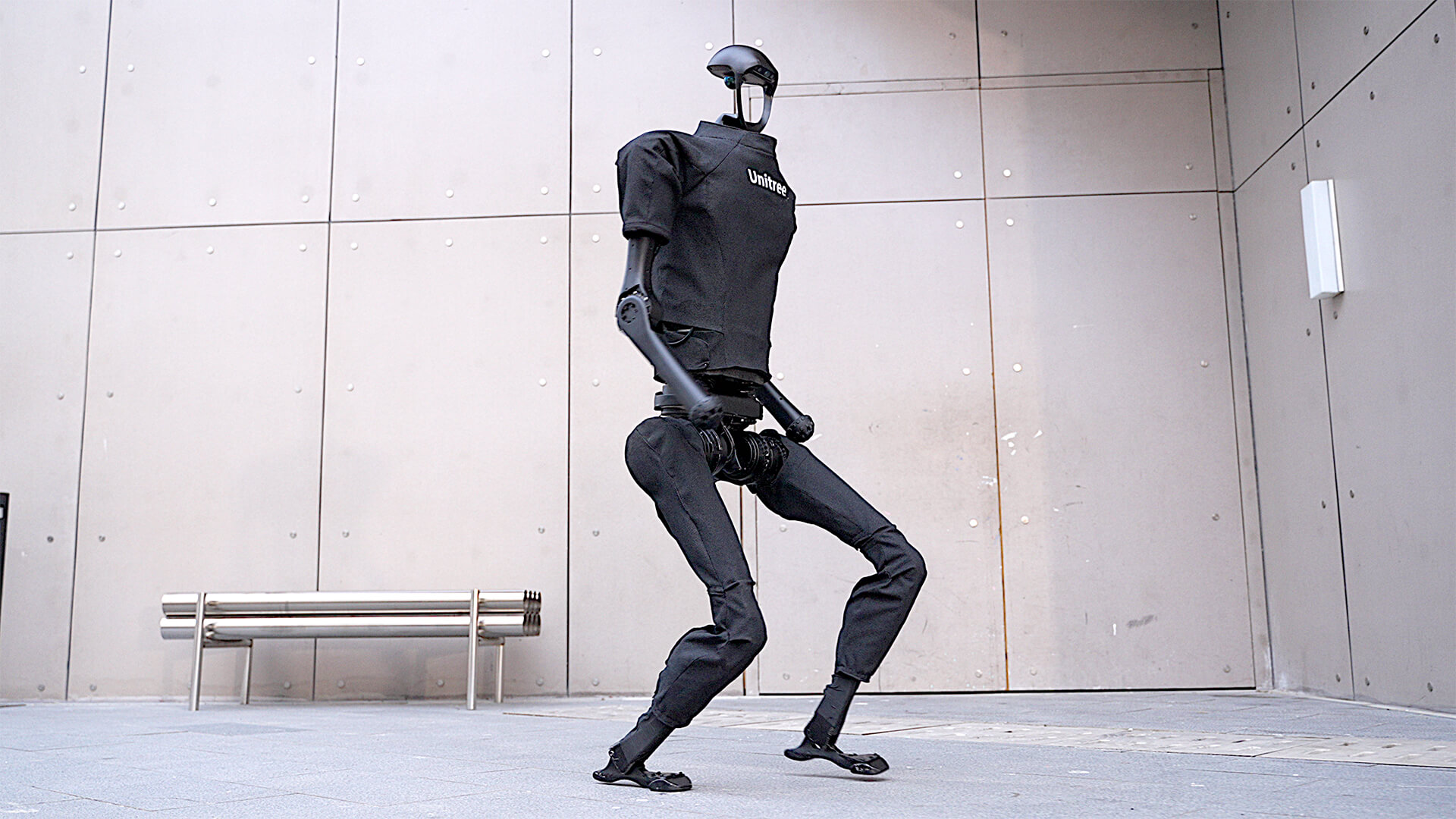
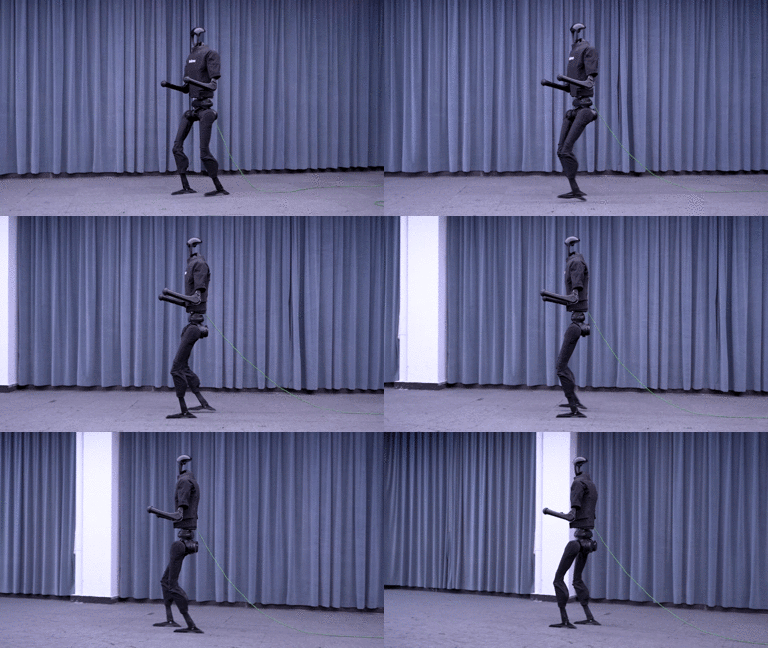
A walking policy that only works on flat ground is insufficient for the real world. Robots need to traverse uneven tiles, climb stairs, descend slopes, and navigate around obstacles. In this post, we extend the policy from the G1 basic training post to complex terrains using three key techniques: terrain curriculum, domain randomization, and teacher-student training.
Terrain Curriculum: From Flat to Complex
Why Do We Need a Curriculum?
If we start training immediately on difficult terrain (stairs, rough rocks), the policy will never learn — the robot falls immediately and there are no useful gradients. Curriculum learning solves this by gradually increasing difficulty.
Designing Terrain Levels
"""
Terrain curriculum configuration for G1.
File: g1_terrain_cfg.py
"""
from omni.isaac.lab.terrains import TerrainImporterCfg, TerrainGeneratorCfg
from omni.isaac.lab.terrains.height_field import HfTerrainBaseCfg

class G1TerrainCurriculumCfg:
    """4 terrain difficulty levels, progressively harder."""

    terrain = TerrainImporterCfg(
        prim_path="/World/ground",
        terrain_type="generator",
        terrain_generator=TerrainGeneratorCfg(
            size=(8.0, 8.0),
            border_width=20.0,
            num_rows=10,
            num_cols=20,
            horizontal_scale=0.1,
            vertical_scale=0.005,
            slope_threshold=0.75,
            sub_terrains={
                # Level 0: Flat (25%)
                "flat": HfTerrainBaseCfg(
                    function="flat_terrain",
                    proportion=0.25,
                ),
                # Level 1: Rough ground (25%)
                "rough": HfTerrainBaseCfg(
                    function="random_uniform_terrain",
                    proportion=0.25,
                    noise_range=(0.01, 0.06),     # 1-6cm bumps
                    noise_step=0.005,
                ),
                # Level 2: Slopes (25%)
                "slopes": HfTerrainBaseCfg(
                    function="pyramid_sloped_terrain",
                    proportion=0.25,
                    slope_range=(0.0, 0.3),       # 0-17 degrees
                ),
                # Level 3: Stairs (25%)
                "stairs": HfTerrainBaseCfg(
                    function="pyramid_stairs_terrain",
                    proportion=0.25,
                    step_height_range=(0.05, 0.18),  # 5-18cm steps
                    step_width=0.31,
                ),
            },
        ),
    )
Curriculum Progression Logic
class TerrainCurriculumManager:
    """
    Manage terrain curriculum based on performance.
    Good robot -> harder terrain. Poor robot -> easier terrain.
    """

    def __init__(self, num_envs, num_levels=4, num_terrains_per_level=5):
        self.num_envs = num_envs
        self.num_levels = num_levels
        self.num_terrains_per_level = num_terrains_per_level

        # Each env starts at level 0
        self.terrain_levels = torch.zeros(num_envs, dtype=torch.long)
        self.terrain_types = torch.randint(
            0, num_terrains_per_level, (num_envs,)
        )

        # Performance tracking
        self.success_threshold = 0.8
        self.failure_threshold = 0.3
        self.episode_successes = torch.zeros(num_envs)
        self.episode_counts = torch.zeros(num_envs)

    def update(self, env_ids, episode_length, max_episode_length):
        """
        Update level after each episode reset.

        episode_length: how long the robot survived
        max_episode_length: maximum episode length
        """
        success = (episode_length[env_ids] / max_episode_length) > 0.8
        self.episode_successes[env_ids] += success.float()
        self.episode_counts[env_ids] += 1

        # Check upgrade/downgrade every 50 episodes
        ready = self.episode_counts[env_ids] >= 50
        if ready.any():
            ready_ids = env_ids[ready]
            success_rate = (
                self.episode_successes[ready_ids]
                / self.episode_counts[ready_ids]
            )

            # Level up
            upgrade = success_rate > self.success_threshold
            self.terrain_levels[ready_ids[upgrade]] = torch.clamp(
                self.terrain_levels[ready_ids[upgrade]] + 1,
                max=self.num_levels - 1,
            )

            # Level down
            downgrade = success_rate < self.failure_threshold
            self.terrain_levels[ready_ids[downgrade]] = torch.clamp(
                self.terrain_levels[ready_ids[downgrade]] - 1,
                min=0,
            )

            # Reset counters
            self.episode_successes[ready_ids] = 0
            self.episode_counts[ready_ids] = 0

            avg_level = self.terrain_levels.float().mean().item()
            print(f"Terrain curriculum: avg level = {avg_level:.2f}")

        return self.terrain_levels[env_ids], self.terrain_types[env_ids]

Domain Randomization: Making the Policy Robust
Domain randomization randomizes physical parameters in simulation so the policy learns to handle uncertainty. This is critical for sim-to-real transfer.
Parameters to Randomize
class G1DomainRandomizationCfg:
    """Domain randomization for G1 terrain walking."""

    # === Physics randomization ===
    friction = {
        "range": [0.3, 2.0],
        "operation": "scale",
        "distribution": "uniform",
    }

    restitution = {
        "range": [0.0, 0.5],
        "operation": "abs",
        "distribution": "uniform",
    }

    # === Mass randomization ===
    added_mass = {
        "range": [-2.0, 5.0],          # kg added/removed from torso
        "body_names": ["torso"],
        "operation": "add",
    }

    # === Center of mass shift ===
    com_displacement = {
        "range": [-0.05, 0.05],         # +/-5cm
        "body_names": ["torso"],
    }

    # === Motor strength ===
    motor_strength = {
        "range": [0.8, 1.2],            # +/-20% motor strength
        "operation": "scale",
    }

    # === External perturbations ===
    push_robots = {
        "toggle": True,
        "interval_s": 8.0,
        "max_vel": 0.5,
        "max_ang_vel": 0.3,
    }

    # === Sensor noise ===
    joint_pos_noise = {
        "range": [-0.01, 0.01],         # +/-0.01 rad
        "operation": "add",
    }
    joint_vel_noise = {
        "range": [-0.1, 0.1],          # +/-0.1 rad/s
        "operation": "add",
    }
    imu_noise = {
        "ang_vel_noise": 0.05,
        "gravity_noise": 0.02,
    }

    # === Latency simulation ===
    action_delay = {
        "range": [0, 2],                # 0-2 timestep delay
        "distribution": "uniform_int",
    }
Implementation in Isaac Lab
import torch
import numpy as np

class DomainRandomizer:
    """Apply domain randomization at each episode reset."""

    def __init__(self, cfg, num_envs, device="cuda"):
        self.cfg = cfg
        self.num_envs = num_envs
        self.device = device

        # Pre-allocate buffers
        self.friction_coeffs = torch.ones(num_envs, device=device)
        self.mass_offsets = torch.zeros(num_envs, device=device)
        self.motor_strengths = torch.ones(num_envs, device=device)
        self.action_delays = torch.zeros(num_envs, dtype=torch.long, device=device)

        # Action delay buffer (circular)
        self.max_delay = 3
        self.action_buffer = torch.zeros(
            num_envs, self.max_delay, 23,
            device=device
        )

    def randomize(self, env_ids):
        """Randomize parameters for reset environments."""
        n = len(env_ids)

        self.friction_coeffs[env_ids] = torch.empty(n, device=self.device).uniform_(
            self.cfg.friction["range"][0],
            self.cfg.friction["range"][1],
        )

        self.mass_offsets[env_ids] = torch.empty(n, device=self.device).uniform_(
            self.cfg.added_mass["range"][0],
            self.cfg.added_mass["range"][1],
        )

        self.motor_strengths[env_ids] = torch.empty(n, device=self.device).uniform_(
            self.cfg.motor_strength["range"][0],
            self.cfg.motor_strength["range"][1],
        )

        self.action_delays[env_ids] = torch.randint(
            self.cfg.action_delay["range"][0],
            self.cfg.action_delay["range"][1] + 1,
            (n,), device=self.device,
        )

    def apply_action_delay(self, actions, step):
        """Apply action delay using circular buffer."""
        idx = step % self.max_delay
        self.action_buffer[:, idx, :] = actions

        delayed_idx = (step - self.action_delays) % self.max_delay
        delayed_actions = self.action_buffer[
            torch.arange(self.num_envs, device=self.device),
            delayed_idx,
        ]
        return delayed_actions

    def apply_push(self, base_velocities, step, dt):
        """Apply random push perturbation."""
        push_interval = int(self.cfg.push_robots["interval_s"] / dt)
        if step % push_interval == 0:
            push_vel = torch.empty_like(base_velocities[:, :3]).uniform_(
                -self.cfg.push_robots["max_vel"],
                self.cfg.push_robots["max_vel"],
            )
            base_velocities[:, :3] += push_vel
        return base_velocities
Teacher-Student Training
Why Teacher-Student?
On complex terrain, the robot needs to know what the terrain ahead looks like (height map) to step correctly. But on the real robot, this information is not readily available (requires depth camera + processing). Solution: teacher-student framework.
| Teacher | Student | |
|---|---|---|
| Observations | Proprioception + terrain height map | Proprioception only |
| Training | Trained first with privileged info | Distilled from teacher |
| Deployment | Not deployed | Deployed on real robot |
class TeacherStudentTrainer:
    """
    Two-phase training: Teacher (privileged) -> Student (deployable).
    """

    def __init__(self, env, teacher_cfg, student_cfg):
        self.env = env
        self.teacher = self._build_network(teacher_cfg)
        self.student = self._build_network(student_cfg)

    def _build_network(self, cfg):
        """Build actor-critic network."""
        import torch.nn as nn

        class PolicyNetwork(nn.Module):
            def __init__(self, obs_dim, act_dim, hidden_dims):
                super().__init__()
                layers = []
                prev_dim = obs_dim
                for h_dim in hidden_dims:
                    layers.extend([
                        nn.Linear(prev_dim, h_dim),
                        nn.ELU(),
                    ])
                    prev_dim = h_dim
                layers.append(nn.Linear(prev_dim, act_dim))
                self.network = nn.Sequential(*layers)

            def forward(self, obs):
                return self.network(obs)

        return PolicyNetwork(
            cfg["obs_dim"], cfg["act_dim"], cfg["hidden_dims"]
        )

    def train_teacher(self, num_iterations=5000):
        """
        Teacher receives: proprioception (78) + height map (187) = 265 dims
        Height map: 11x17 grid, 10cm resolution, centered at robot
        """
        print("=== Phase 1: Training Teacher ===")
        for iteration in range(num_iterations):
            obs = self.env.get_observations()
            privileged_obs = self.env.get_privileged_observations()

            teacher_obs = torch.cat([obs, privileged_obs], dim=1)
            actions = self.teacher(teacher_obs)

            if iteration % 100 == 0:
                print(f"Teacher iter {iteration}: "
                      f"reward={self.env.episode_reward_mean:.2f}")

    def distill_to_student(self, num_iterations=2000):
        """
        Student receives only: proprioception (78 dims)
        Objective: minimize ||student_action - teacher_action||^2
        """
        print("=== Phase 2: Distilling to Student ===")
        optimizer = torch.optim.Adam(self.student.parameters(), lr=3e-4)

        for iteration in range(num_iterations):
            obs = self.env.get_observations()
            privileged_obs = self.env.get_privileged_observations()

            teacher_obs = torch.cat([obs, privileged_obs], dim=1)
            with torch.no_grad():
                teacher_actions = self.teacher(teacher_obs)

            student_actions = self.student(obs)
            loss = torch.nn.functional.mse_loss(
                student_actions, teacher_actions
            )

            optimizer.zero_grad()
            loss.backward()
            optimizer.step()

            if iteration % 100 == 0:
                print(f"Student iter {iteration}: distill_loss={loss:.4f}")

        print("Distillation complete!")
Height Map Sampling
def sample_height_map(terrain, robot_pos, robot_yaw):
    """
    Sample terrain heights around the robot.

    Returns: (num_envs, num_points) height samples
    """
    x_range = torch.arange(-0.3, 0.8, 0.1)   # -0.3m behind to 0.7m ahead
    y_range = torch.arange(-0.8, 0.9, 0.1)   # +/-0.8m lateral

    xx, yy = torch.meshgrid(x_range, y_range, indexing='ij')
    points = torch.stack([xx.flatten(), yy.flatten()], dim=1)
    # -> (187, 2) grid points

    cos_yaw = torch.cos(robot_yaw).unsqueeze(1)
    sin_yaw = torch.sin(robot_yaw).unsqueeze(1)
    rotated_x = points[:, 0] * cos_yaw - points[:, 1] * sin_yaw
    rotated_y = points[:, 0] * sin_yaw + points[:, 1] * cos_yaw

    sample_x = robot_pos[:, 0:1] + rotated_x
    sample_y = robot_pos[:, 1:2] + rotated_y

    heights = terrain.sample_heights(sample_x, sample_y)

    return heights - robot_pos[:, 2:3]

Evaluating Terrain Robustness
def evaluate_terrain_robustness(env, policy, num_episodes=100):
    """Evaluate policy on each terrain type separately."""

    terrain_types = ["flat", "rough_easy", "rough_hard", "slopes_10deg",
                     "slopes_20deg", "stairs_10cm", "stairs_15cm"]

    results = {}
    for terrain in terrain_types:
        env.set_terrain(terrain)
        successes = 0
        total_distance = 0

        for ep in range(num_episodes):
            obs = env.reset()
            ep_distance = 0
            done = False

            while not done:
                action = policy(obs)
                obs, reward, done, info = env.step(action)
                ep_distance += info["forward_distance"]

            if info["episode_length"] >= 0.9 * env.max_episode_length:
                successes += 1
            total_distance += ep_distance

        results[terrain] = {
            "success_rate": successes / num_episodes,
            "avg_distance": total_distance / num_episodes,
        }

    print(f"{'Terrain':<20} {'Success%':>10} {'Avg Dist (m)':>12}")
    print("-" * 44)
    for terrain, r in results.items():
        print(f"{terrain:<20} {r['success_rate']*100:>9.1f}% {r['avg_distance']:>11.2f}")

    return results
Typical results after training:
| Terrain | Success Rate | Avg Distance |
|---|---|---|
| Flat | 98% | 18.5 m |
| Rough (easy) | 95% | 17.2 m |
| Rough (hard) | 82% | 14.8 m |
| Slopes 10 deg | 90% | 16.1 m |
| Slopes 20 deg | 72% | 12.3 m |
| Stairs 10cm | 78% | 13.5 m |
| Stairs 15cm | 55% | 9.8 m |
For detailed domain randomization techniques, see Domain Randomization for Sim-to-Real. For curriculum learning fundamentals, see Locomotion Basics.
Summary
In this post, we extended the G1 walking policy with:
- Terrain curriculum: 4 difficulty levels (flat, rough, slopes, stairs), auto-adjusting
- Domain randomization: friction, mass, motor strength, push perturbation, sensor noise, action delay
- Teacher-student: teacher learns with height map (privileged), student distills to proprioception only
- Evaluation: tested on 7 terrain types, success rates from 55-98%
Next post — Unitree H1: Full-size Humanoid Locomotion — moves to the larger robot: H1 with 1.8m height and its unique challenges.
References
- Learning to Walk in Minutes Using Massively Parallel Deep Reinforcement Learning — Rudin et al., CoRL 2022
- Extreme Parkour with Legged Robots — Cheng et al., ICRA 2024
- Rapid Locomotion via Reinforcement Learning — Bellegarda & Ijspeert, RSS 2022
- Humanoid-Gym: Zero-Shot Sim-to-Real Transfer — Gu et al., 2024