How LiDAR Works
LiDAR (Light Detection and Ranging) emits laser pulses and measures round-trip time to calculate distance to objects. A rotating LiDAR generates thousands of distance measurements per second, forming a point cloud — a precise 3D representation of surrounding geometry.
Compared to cameras:
- Works in any lighting condition
- Measures distance accurately (cm-level)
- Unaffected by surface texture
Common LiDAR Types
2D LiDAR
Scans in a single plane, ideal for indoor mobile robots:
- Sick S300: Industrial standard, $300-500
- RPLiDAR A2: Hobby grade, $60
- Neato XV: Vacuum robot sensor, cheap
2D LiDAR produces a 2D scan that maps walls and obstacles. Perfect for SLAM (Simultaneous Localization and Mapping) and obstacle avoidance.
3D LiDAR
360-degree vertical scans, more complete maps:
- Velodyne Puck: $4K, 16 channels
- Livox Mid360: $200, affordable 3D
- RealSense L515: $400, indoor depth camera (not true LiDAR but similar)
3D LiDAR crucial for humanoid and manipulation robots where knowing ceiling/clutter heights matters.
Point Cloud Representation
import numpy as np
import open3d as o3d

# Point cloud: N x 3 matrix
points = np.random.randn(100000, 3)  # 100K points, [x, y, z]

# Load from LiDAR
pcd = o3d.io.read_point_cloud("lidar_scan.pcd")

# Visualize
o3d.visualization.draw_geometries([pcd])

# Downsample (reduce points)
pcd_down = pcd.voxel_down_sample(voxel_size=0.05)

# Normal estimation (for surface understanding)
pcd_down.estimate_normals(search_param=o3d.geometry.KDTreeSearchParamHybrid(
    radius=0.1, max_nn=30))
SLAM: Localization + Mapping
SLAM (Simultaneous Localization and Mapping) fuses LiDAR measurements to:
- Estimate robot position
- Build a consistent map
Classic Approach: ICP (Iterative Closest Point)
import open3d as o3d

# Load two sequential scans
source = o3d.io.read_point_cloud("scan_t0.pcd")
target = o3d.io.read_point_cloud("scan_t1.pcd")

# ICP: find transformation aligning source to target
reg_p2p = o3d.pipelines.registration.registration_icp(
    source, target,
    max_correspondence_distance=0.1,
    init=np.eye(4),
    criteria=o3d.pipelines.registration.ICPConvergenceCriteria(
        max_iteration=50)
)

# Estimated transformation (odometry update)
T = reg_p2p.transformation
print(f"Rotation:\n{T[:3,:3]}")
print(f"Translation: {T[:3,3]}")
Modern Approach: Semantic SLAM
Add semantic understanding to make maps persistent:
class SemanticSLAM:
    def __init__(self):
        self.global_map = None  # Accumulated point cloud
        self.semantic_labels = {}  # Object categories at 3D locations

    def add_scan(self, lidar_points, semantic_segmentation, T_odometry):
        """Add new LiDAR scan to global map."""
        # Transform to world frame
        points_world = (T_odometry[:3, :3] @ lidar_points.T +
                        T_odometry[:3, 3:4]).T

        # Assign semantic labels
        for i, (point, label) in enumerate(zip(points_world, semantic_segmentation)):
            self.semantic_labels[tuple(point)] = label

        # Accumulate
        if self.global_map is None:
            self.global_map = points_world
        else:
            self.global_map = np.vstack([self.global_map, points_world])

    def get_objects(self, category):
        """Query all points of a specific type."""
        return [p for p, label in self.semantic_labels.items()
                if label == category]
Applications
1. Obstacle Detection for Mobile Robots
def detect_obstacles(lidar_cloud, ground_threshold=0.1):
    """Remove ground plane, return obstacle points."""
    # RANSAC plane fitting
    plane_model, inliers = pcd.segment_plane(distance_threshold=0.05,
                                              ransac_n=3, num_iterations=100)

    # Inliers = ground, outliers = obstacles
    inlier_cloud = pcd.select_by_index(inliers)
    obstacle_cloud = pcd.select_by_index(inliers, invert=True)

    return obstacle_cloud
2. 3D Shape Reconstruction
def reconstruct_mesh(pcd):
    """Create mesh from point cloud."""
    # Poisson reconstruction
    mesh, densities = o3d.geometry.TriangleMesh.create_from_point_cloud_poisson(
        pcd, depth=8)

    return mesh
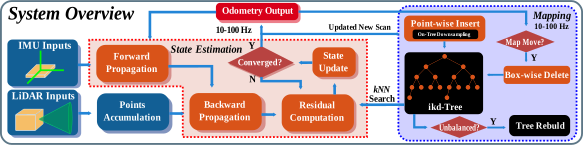
LiDAR + IMU Fusion
Combine LiDAR SLAM with IMU for better odometry:
class LiDAR_IMU_Fusion:
    def __init__(self):
        self.lidar_slam = LiDAR_SLAM()
        self.imu_filter = KalmanFilter()  # Fuse with IMU

    def step(self, lidar_points, imu_accel, imu_gyro):
        # SLAM update from LiDAR
        T_lidar = self.lidar_slam.update(lidar_points)

        # IMU provides high-frequency estimates
        v_imu = self.imu_filter.predict(imu_accel, imu_gyro)

        # Fuse: LiDAR for accuracy, IMU for update rate
        T_fused = fuse(T_lidar, v_imu)

        return T_fused
Common Issues and Solutions
| Problem | Cause | Solution |
|---|---|---|
| Map drift over long distance | Odometry accumulates error | Loop closure detection |
| Failure in featureless corridors | No distinctive landmarks | Semantic + topological maps |
| Slow on resource-limited hardware | Full point cloud processing | Downsampling + voxel grids |
Libraries
- Open3D: Easy 3D processing in Python
- PCL (Point Cloud Library): C++ for production code
- ROS:
ros-humble-perception-pclfor integration
Takeaway
LiDAR + SLAM is the foundation for autonomous mobile robots. Master point cloud processing and loop closure, and you can build production navigation systems.